Juno spacecraft captures turbulent view of Jupiter’s northern hemisphere
Citizen scientist Gary Eason enhances raw JunoCam data to highlight cyclonic storms where zonal jets break down
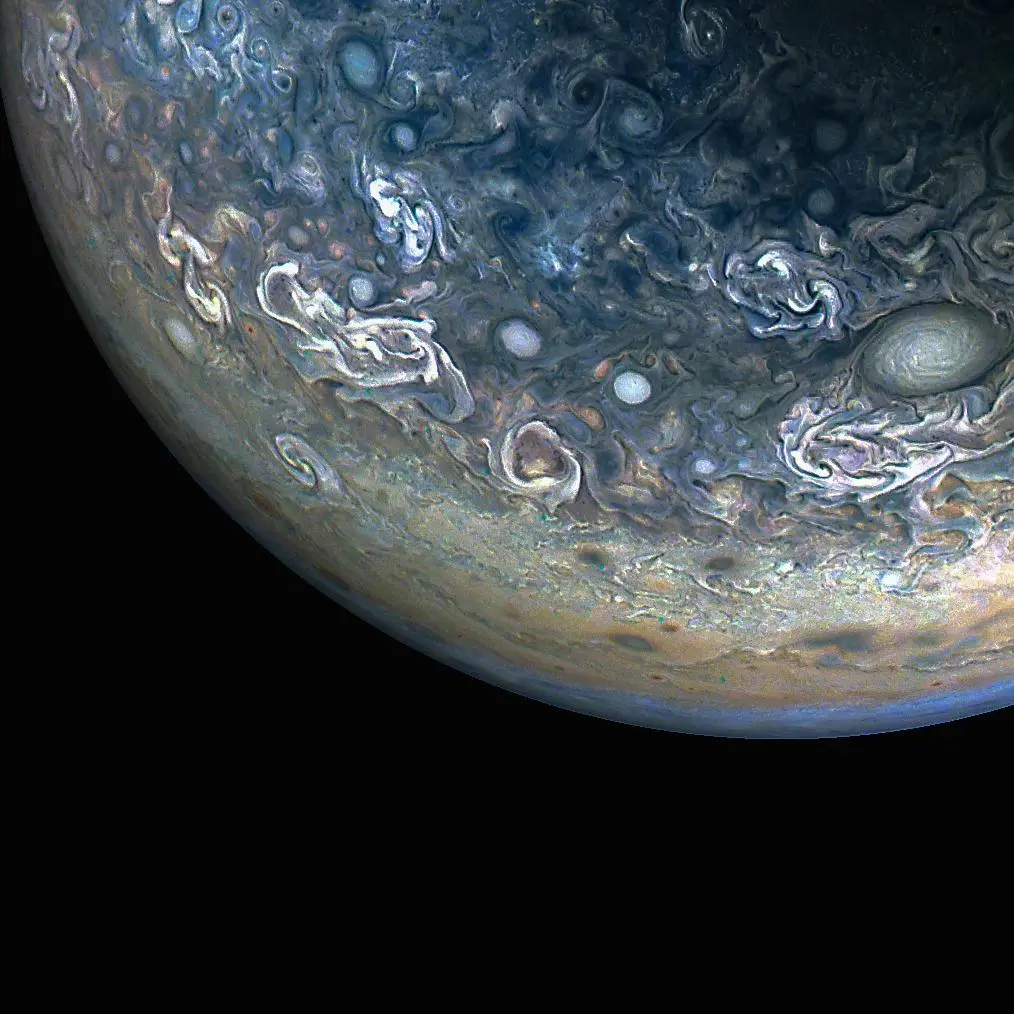
NASA’s Juno spacecraft has provided a detailed look at the turbulent atmosphere of Jupiter’s northern hemisphere, capturing raw data during its 61st close flyby of the gas giant on 12 May 2024. The mission continues to deliver high-resolution observations of the planet’s complex weather systems, with the latest imagery focusing on regions where standard atmospheric patterns become unstable.
The resulting image, which highlights chaotic clouds and cyclonic storms, was processed by citizen scientist Gary Eason. Using raw data from the JunoCam instrument, Eason applied digital techniques to enhance colour and clarity, transforming the scientific data into a visual representation that reveals intricate details of the planet’s upper atmosphere.
The imagery centres on a specific area known to scientists as a folded filamentary region. In these zones, the zonal jets that typically generate Jupiter’s familiar banded cloud patterns break down. This breakdown results in turbulent structures and chaotic cloud formations that are distinct from the planet’s more orderly equatorial and polar regions.
These turbulent structures are dynamic, evolving rapidly over the course of just a few days. The processed image allows for a closer examination of how these storms interact and how the atmosphere transitions from stable jet streams to chaotic, swirling patterns.
While JunoCam is designed to capture visible light images for scientific analysis, the final visual is an artistic interpretation rather than a direct, unprocessed observation. The use of citizen science projects enables the public to engage with NASA data, applying processing methods that can highlight features of interest within the raw scientific record.
The image credit attributes the capture to NASA, the Jet Propulsion Laboratory, the Southwest Research Institute, and the Mullard Space Science Laboratory, with image processing by Gary Eason under a Creative Commons Attribution licence. The flyby remains part of Juno’s ongoing mission to study Jupiter’s composition, gravity field, magnetic field, and polar magnetosphere.