Juno spacecraft captures rare image of Jupiter moon Thebe using navigation camera
NASA's Juno mission records close-up view of Thebe from 3,100 miles away, highlighting the instrument's versatility in low-light conditions.
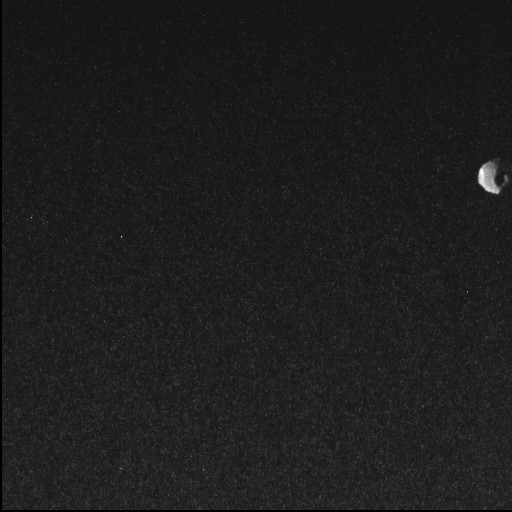
On 1 May 2026, NASA's Juno spacecraft recorded an image of Thebe, the second largest of Jupiter's inner moons, during a close flyby. The photograph was taken on 1 May 2026, marking a specific moment in the mission's ongoing observation of the gas giant's complex satellite system.
The image was captured by the spacecraft's Stellar Reference Unit (SRU), an instrument primarily designed for navigation by imaging star fields. Despite its intended function, the SRU proved effective for this scientific observation due to its high sensitivity in low-light conditions. The photo was taken from a distance of approximately 3,100 miles (5,000 kilometres), offering a resolution of about 1.9 miles (3 kilometres) per pixel.
Thebe is situated at the outer edge of Jupiter's faint ring system. Scientists believe the moon contributes to the formation of the planet's "gossamer" rings through the shedding of dust. This discovery underscores the dynamic nature of the ring system and the role smaller moons play in maintaining its structure.
While the SRU's main purpose is to guide the spacecraft, it has a history of secondary scientific use. Previous deployments of the instrument have included the discovery of "shallow lightning" in Jupiter's atmosphere and detailed imaging of the planet's ring system. This latest capture adds to the growing body of data gathered by the versatile sensor.
The Juno mission is managed by NASA's Jet Propulsion Laboratory (JPL) for the Southwest Research Institute. Scott J. Bolton serves as the principal investigator for the project. The mission operates as part of NASA's New Frontiers Program, which is managed at the Marshall Space Flight Center for the agency's Science Mission Directorate.
Although the resolution limits the visibility of fine surface details compared to dedicated science cameras, the image provides valuable context regarding Thebe's position relative to the ring system. The data remains a significant addition to the mission's archive of Jupiter observations.