James Webb Space Telescope reveals new detail in Lion’s Head Nebula
A composite image released by NASA offers a sharper look at the planetary nebula NGC 2392, providing new insights into the fate of Sun-like stars.
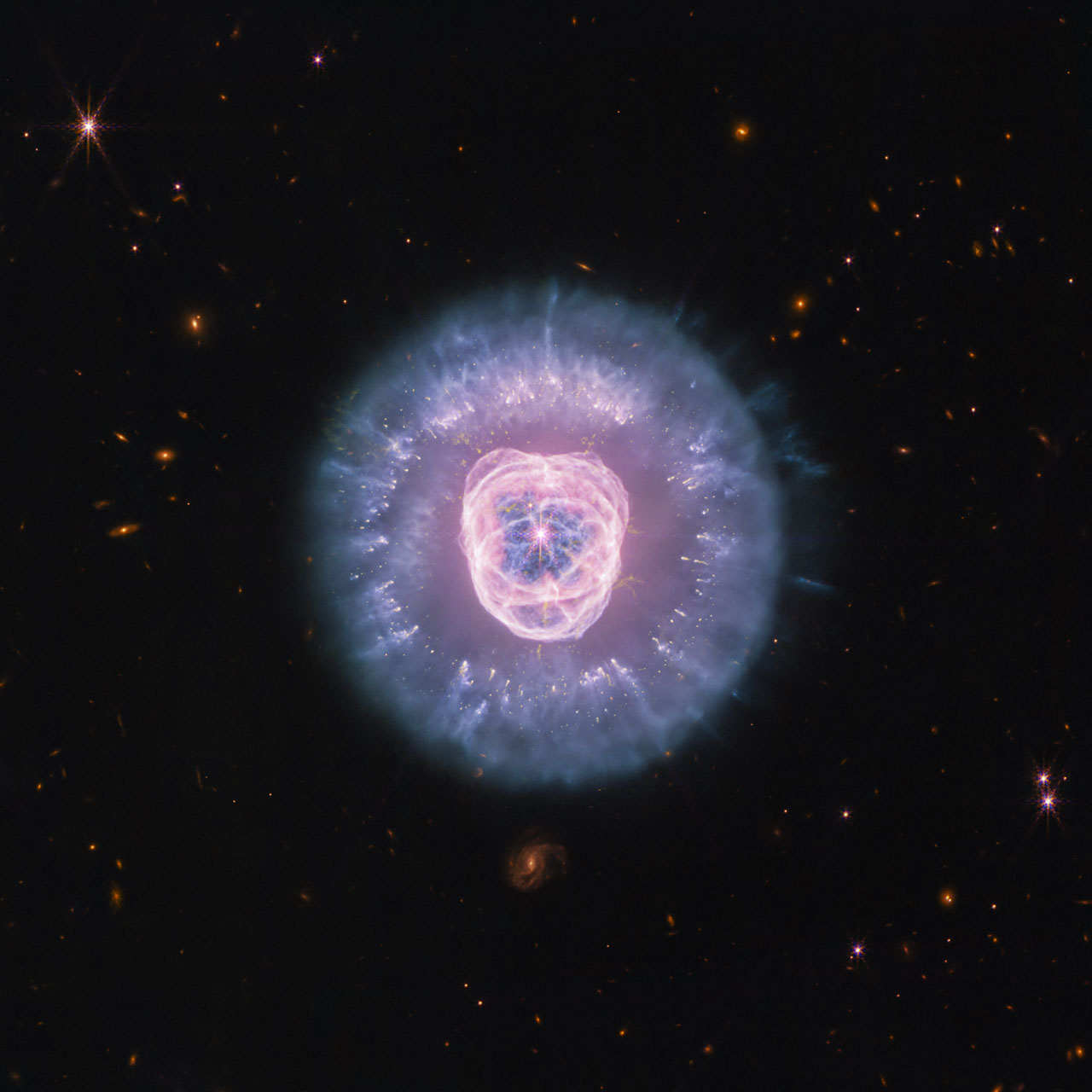
The James Webb Space Telescope (JWST) has released a new composite image of the Lion’s Head Nebula, also known as NGC 2392. The detailed view was captured using the telescope’s Near-Infrared Camera (NIRCam) and Mid-Infrared Instrument (MIRI). The image was released on 26 August 2026 by NASA, in collaboration with the European Space Agency (ESA), the Canadian Space Agency (CSA), and the Space Telescope Science Institute (STScI).
The Lion’s Head Nebula is the remnant of a Sun-like star that could no longer sustain the nuclear fusion in its core required to remain stable. As the star aged, it began to shed layers of gas and dust into space, forming the planetary nebula observed today. This process leaves behind a hot stellar core, known as a white dwarf, which remains at the centre of the structure.
In the new imagery, the white dwarf is located within the region resembling the lion’s nose. Intense radiation emitted from this central core is ionising the surrounding gas as it expands. This interaction creates the irregular bubble that forms the lion’s face, while dust clumps that have survived the radiation and a cloud of ionised gas make up the lion’s mane.
The release highlights the potential of the nebula as an analogue for the future of our own Sun. By studying the Lion’s Head Nebula, scientists hope to better understand the lifecycle of stars similar to our own. The new, more detailed view allows researchers to examine how the gas and dust interact with each other and with the radiation from the white dwarf.
The image processing was carried out by Alyssa Pagan at the Space Telescope Science Institute. The release serves as part of the Astronomy Picture of the Day (APOD) series, which features a different image of the universe each day along with a brief explanation written by a professional astronomer.
This latest observation contributes to the broader scientific effort to map the complex structures of planetary nebulae. The clarity provided by the JWST instruments offers a significant step forward in visualising the dynamic environment surrounding dying stars.