Italy’s first test of new police immunity law follows Bologna death
The death of a Moroccan-born man in Bologna has sparked violent protests and renewed debate over police accountability, marking the first application of a controversial legal reform designed to shield officers from immediate prosecution.
The death of Abderrahim Fakir, a 42-year-old Moroccan-born man who had resided in Bologna for more than three decades, has ignited a fierce national debate regarding police conduct and legal accountability in Italy. Video footage obtained by Al Jazeera captures the final moments of Fakir’s life, showing two Italian police officers and a civilian restraining him on the ground for approximately five minutes. The recording, filmed from a nearby apartment balcony shortly after 12:30pm local time on Sunday, 19 July 2026, shows Fakir screaming for help for more than four minutes before falling silent. His ankles were secured with a black plastic zip tie, and paramedics present at the scene reportedly did not realise he had lost consciousness until after the restraint ended.
Fabio Anselmo, the lawyer representing Fakir’s family, criticised the officers for failing to provide aid while Fakir was restrained. Speaking at a news conference in the Italian Senate on 21 July, Anselmo stated that Fakir may have still been alive when the officers stood up, yet no one attempted to help him or remove the restraints. Anselmo referenced a January 2026 ruling by the European Court of Human Rights in the case of Riccardo Magherini, which found that Italy had violated Article 2 of the European Convention on Human Rights due to a failure to justify the necessity of maintaining a suspect in a prone position.
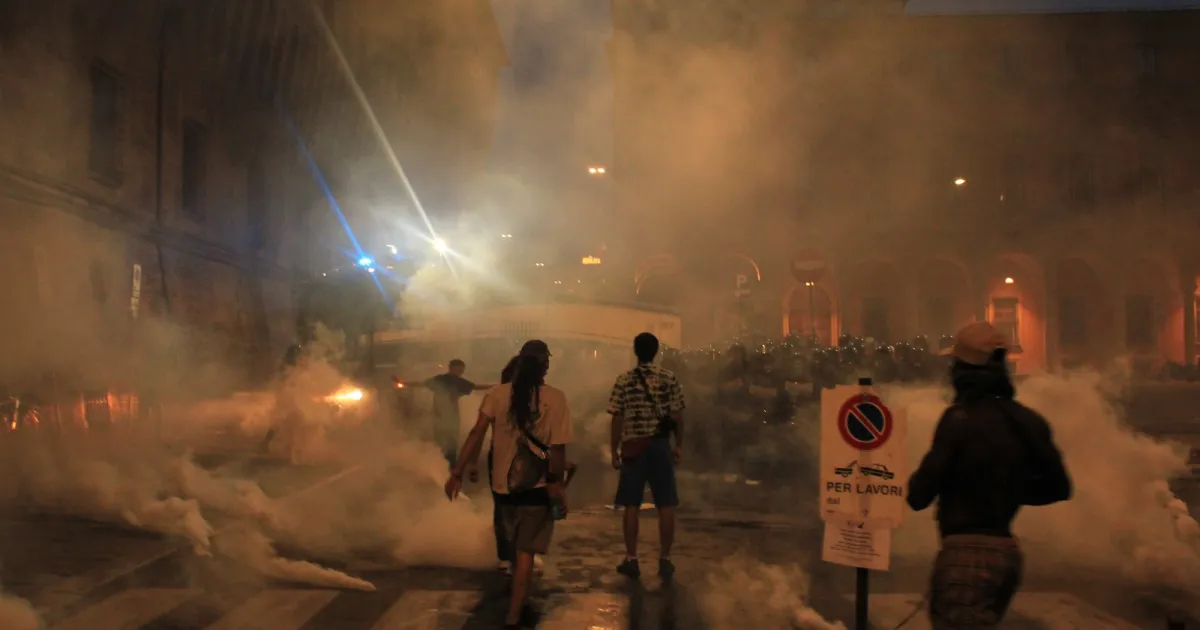
Bologna police maintained that officers responded to reports of a person behaving violently and that emergency services were called immediately. They stated that restraint procedures were carried out in the presence of medical personnel. However, the incident triggered spontaneous vigils that quickly escalated into clashes with riot police. Demonstrators threw bottles and fireworks, smashed shop windows, and set cars alight, leading to baton charges, water cannon use, and tear gas deployment. Police reported that 64 officers were injured and that Bologna’s historic centre suffered extensive damage.
Prime Minister Giorgia Meloni condemned the violence as “unacceptable” but insisted the circumstances of Fakir’s death must be fully established. Opposition parties have called on Interior Minister Matteo Piantedosi to report to parliament on the incident and release any body-camera footage. The investigation into Fakir’s death is the first to be conducted under Italy’s new Article 45-bis procedure, introduced by the Meloni government’s Security Decree in February 2026. This reform prevents police officers from being immediately entered into the register of criminal suspects when alleged offences are committed in the course of their duties.
Critics, including Anselmo, argue that Article 45-bis undermines accountability, describing it as a “legal monstrosity” designed to satisfy public opinion rather than strengthen the rule of law. Legal scholars and human rights organisations have echoed these concerns, warning that the delay in entering officers into the suspect register could hinder judicial processes. Fakir’s final months were marked by financial pressure and anxiety over Italy’s tougher migration debate, including the implementation of the EU’s Pact on Migration and Asylum, though it remains unclear if these factors contributed to the encounter.