Iran’s Centralised Propaganda Machine Uses AI and Pop Culture to Project Wartime Narrative
As the conflict with the United States and Israel intensifies, Iranian authorities have shifted from hand-painted art to AI-accelerated printed banners, transforming the capital into a curated visual text of state power.
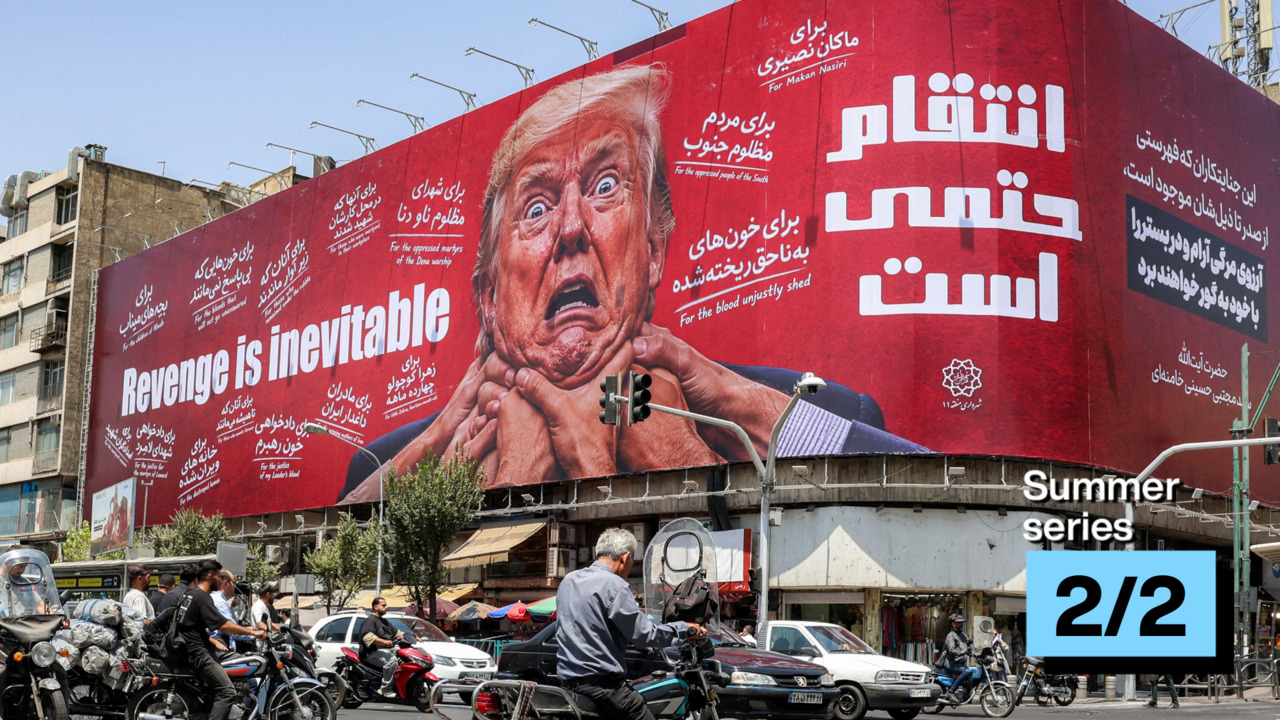
Amidst an ongoing war with the United States and Israel, Iran has deployed massive, state-commissioned murals across Tehran to disseminate its official narrative. These visual campaigns, which utilise artificial intelligence to accelerate production and adopt Western pop culture aesthetics, depict anti-American sentiment, military victories, and the martyrdom of figures such as former Supreme Leader Ali Khamenei and Revolutionary Guard commanders. While designed for international consumption and domestic reinforcement, the imagery coexists with subtle, unsanctioned public expressions like graffiti.
The production process is now centralised, with designs commissioned by government bodies such as the "House of Islamic Revolution Designers" and installed by the Islamic Development Organisation and Tehran Municipality’s Beautification Bureau. The medium has shifted from hand-painted murals to giant printed banners that can be installed or replaced quickly. This allows the regime to adapt its visual messaging in real time, moving away from the community-driven initiatives of the 1980s to a highly controlled, institutionalised output.
A specific mural on Valiasr Avenue depicts Donald Trump with his mouth covered by a blue veil in the shape of the Strait of Hormuz, accompanied by the slogan "At the breaking point" in Persian and English. This was installed on May 2 during stalled negotiations over the Strait. The maritime passage, through which nearly 25% of the world's oil is transported, is displayed here as a weapon capable of silencing Washington, with the imagery explicitly designed to be shared by international media.
A banner depicts the lineage of religious leaders, showing Ruhollah Khomeini standing beside Ali Khamenei (described as killed in initial strikes on February 28) who hands the flag to his successor, Mojtaba Khamenei. Another mural in Fatemi Square references "The Lord of the Rings," depicting two colossal statues flanking the Strait of Hormuz: Alireza Tangsiri (killed March 26, 2026) and Rais Ali Delvari (a 1915 national hero). These compositions borrow the visual language of blockbuster cinema to immortalise political figures as heroes within a national story.
Sepideh Parsapajouh of the French National Centre for Scientific Research (CNRS) notes that while the city is a "vast narrative space," public passersby often ignore the images, though some engage in subtle resistance through graffiti or erasure. Despite the omnipresence of these state-sponsored visuals, the researcher stresses that public imagery does not necessarily reflect public opinion, with many residents viewing the murals as a fixed part of the urban landscape rather than a source of active support.