India defends engagement with Myanmar’s military leader amid diplomatic friction
Prime Minister Narendra Modi’s meeting with Min Aung Hlaing draws sharp criticism from the National Unity Government and Western nations, who argue the visit legitimises the post-coup regime.
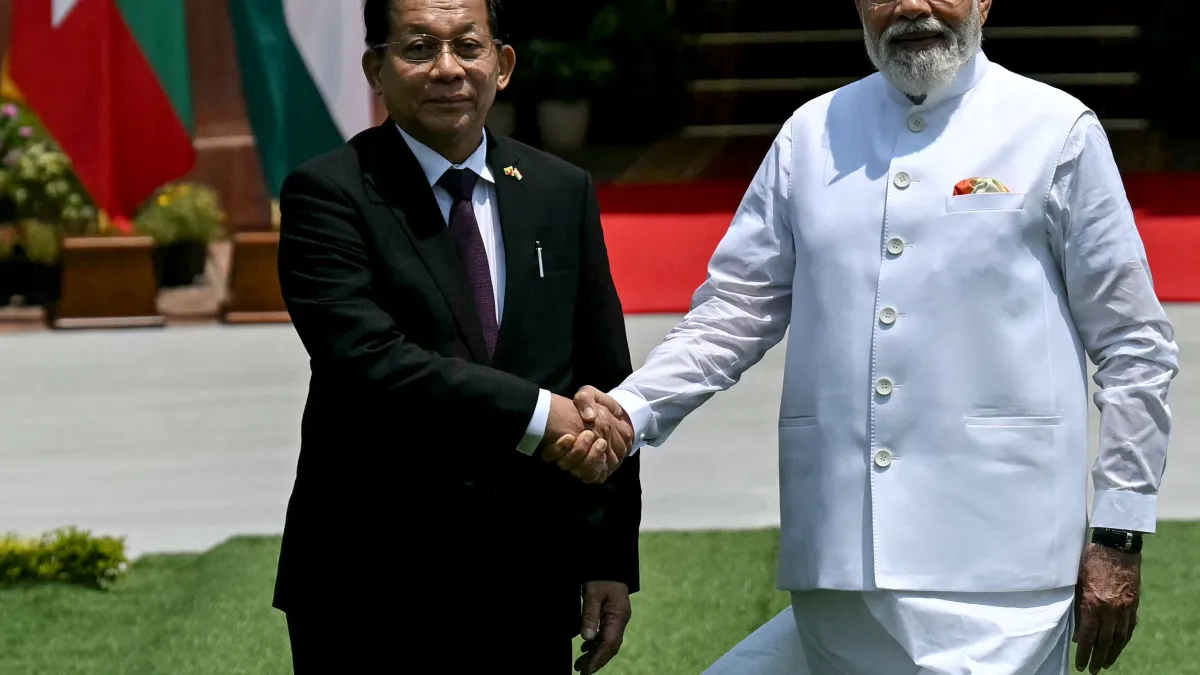
Indian Prime Minister Narendra Modi has held talks with Min Aung Hlaing, the leader of Myanmar’s military government, in New Delhi, reaffirming New Delhi’s commitment to engagement despite growing international criticism. The meeting, which did not include a joint media address, focused on deepening cooperation in trade, defence, security, and border management.
Indian Foreign Secretary Vikram Misri stated that India’s policy is not intended to serve as a commentary on Myanmar’s internal political arrangements. He emphasised that New Delhi believes sustained dialogue is the most effective strategy, arguing that historical precedents show disengagement yields fewer results than continued interaction. Misri noted that isolating Myanmar would be counterproductive to India’s strategic interests.
The visit marks the first time Min Aung Hlaing has travelled to India since being sworn in as president in April, following an election that critics describe as an effort to cement his hold on power. His previous visit occurred in 2019 when he served as Myanmar’s military chief. During his five-day trip, which began with a visit to the Buddhist pilgrimage site of Bodh Gaya in Bihar, he is expected to hold talks with business representatives in Mumbai.
Bilateral relations are driven by significant economic and security imperatives. Bilateral trade was valued at $1.95bn in the 2025-2026 period, with both sides agreeing to accelerate connectivity projects and expand ties in energy and critical minerals. The two nations share a 1,643-kilometre land border and a maritime boundary in the Bay of Bengal, necessitating close cooperation on intelligence sharing and combating armed rebel groups.
Security cooperation also extends to combating cybercrime and human trafficking. Misri highlighted that India and Myanmar have rescued more than 2,400 Indian nationals over the past 18 months, addressing issues affecting thousands of Indians lured to scam centres in the region.
The engagement has drawn sharp rebuke from Myanmar’s opposition. Zin Mar Aung, foreign minister of the National Unity Government (NUG), wrote to Indian External Affairs Minister Subrahmanyam Jaishankar on May 28, urging New Delhi to weigh the implications of normalising military rule. She cited the prolonged conflict and humanitarian suffering following the 2021 coup, which ousted the elected government and detained leaders including Aung San Suu Kyi.
Western nations have similarly sought to isolate Myanmar’s military rulers since the 2021 coup, which triggered a brutal civil war. Resistance groups, including the People’s Defence Force operating under the NUG, have captured significant territory in recent months, further complicating the diplomatic landscape as India maintains its policy of pragmatic engagement.