Hubble Telescope Reveals Detailed Structure of Distant Spiral Galaxy NGC 3137
NASA's Hubble Space Telescope has released high-resolution imagery of NGC 3137, part of the PHANGS-HST program studying stellar life cycles across multiple observatories.
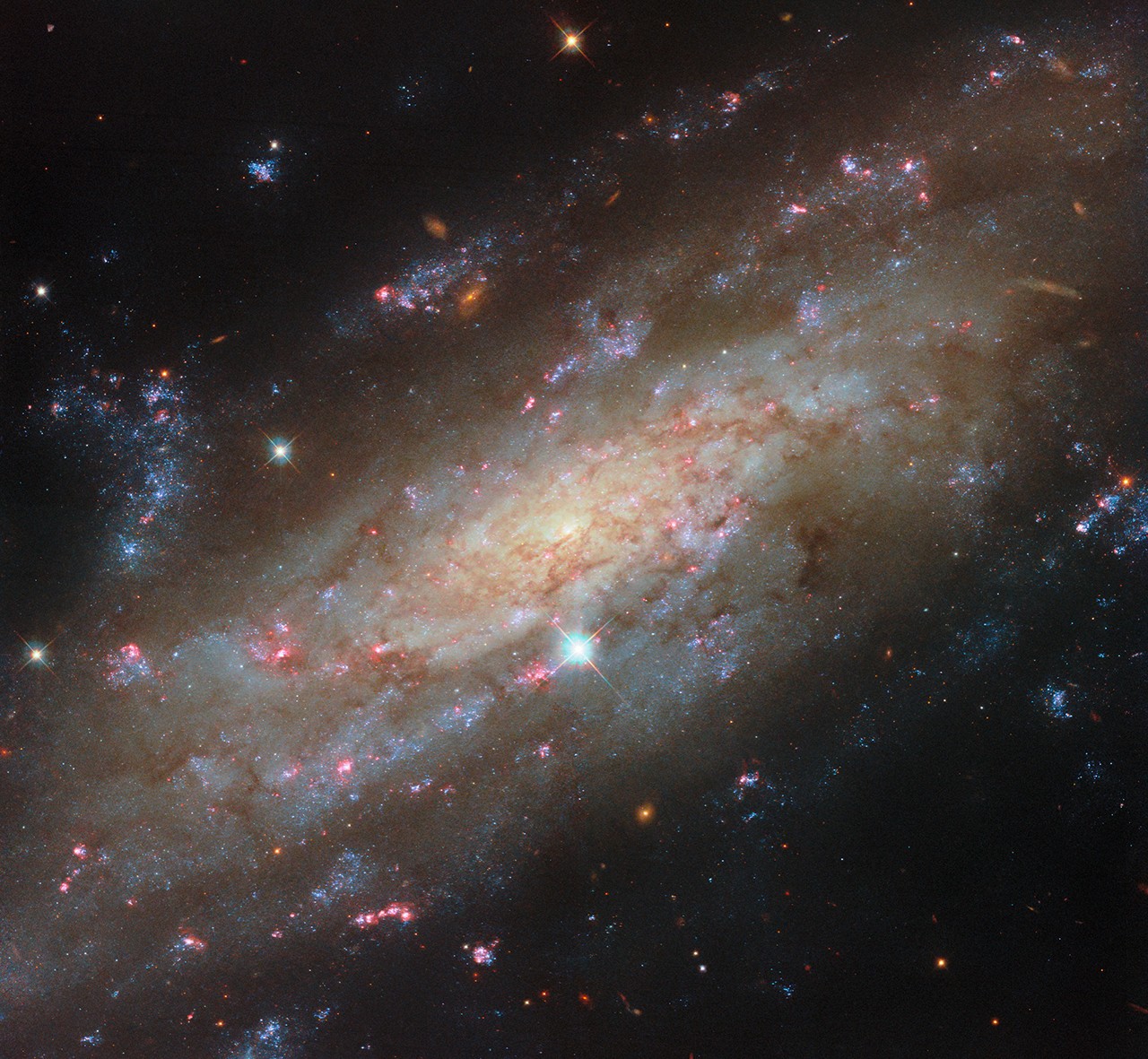
NASA's Hubble Space Telescope has released a new high-resolution image of the spiral galaxy NGC 3137, located 53 million light-years away in the constellation Antlia. The visualisation, constructed from observations in six different colour bands, offers a detailed view of the galaxy's glittering star clusters, glowing gas clouds, and the central region encircled by fine, dusty clouds.
The galaxy is of particular interest to astronomers because it travels through space with the NGC 3175 group, a collection of galaxies thought to be similar to the Local Group containing the Milky Way. This group includes two large spiral galaxies and over 500 candidate dwarf galaxies, providing researchers with a unique opportunity to study the dynamics of a galactic system comparable to our own.
The new image reveals that NGC 3137 is highly inclined from our point of view, offering a distinct perspective on its loose, feathery spiral structure. The galaxy is peppered with dense clusters of bright blue stars and glowing red gas clouds, which signal the presence of hot, young stars still encased in their birth nebulae. These brilliant star clusters are the primary focus of the latest observations.
At the heart of the galaxy lies a supermassive black hole estimated to be 60 million times more massive than the Sun. Researchers are utilising this data to measure the ages of stars in galaxies like NGC 3137, tracking the cycle from young star formation to ancient stellar populations. Since its 1990 launch, Hubble has fundamentally changed our understanding of the universe, and this release continues that legacy.
The observations are part of the PHANGS-HST program, a collaborative initiative combining data from Hubble, the James Webb Space Telescope, and the Atacama Large Millimeter/submillimeter Array (ALMA). This massive undertaking integrates Hubble's optical and ultraviolet capabilities with Webb's infrared sensitivity and ALMA's radio dishes to study star formation and stellar life cycles in nearby galaxies.
By studying this nearby galaxy group, astronomers can gain deeper insights into the evolution of spiral galaxies, from the early years of their hosts to the current processes of stellar birth and death. The project, led by Principal Investigator D. Thilker, aims to provide an in-depth view of stellar life across 55 nearby galaxies.