Hubble Telescope Reveals Ancient Dwarf Galaxy Merger Shaped Early Milky Way
Definitive evidence from NASA’s Hubble Space Telescope confirms the absorption of the LKH dwarf galaxy 11.8 billion years ago, challenging previous models of the Milky Way’s formation.
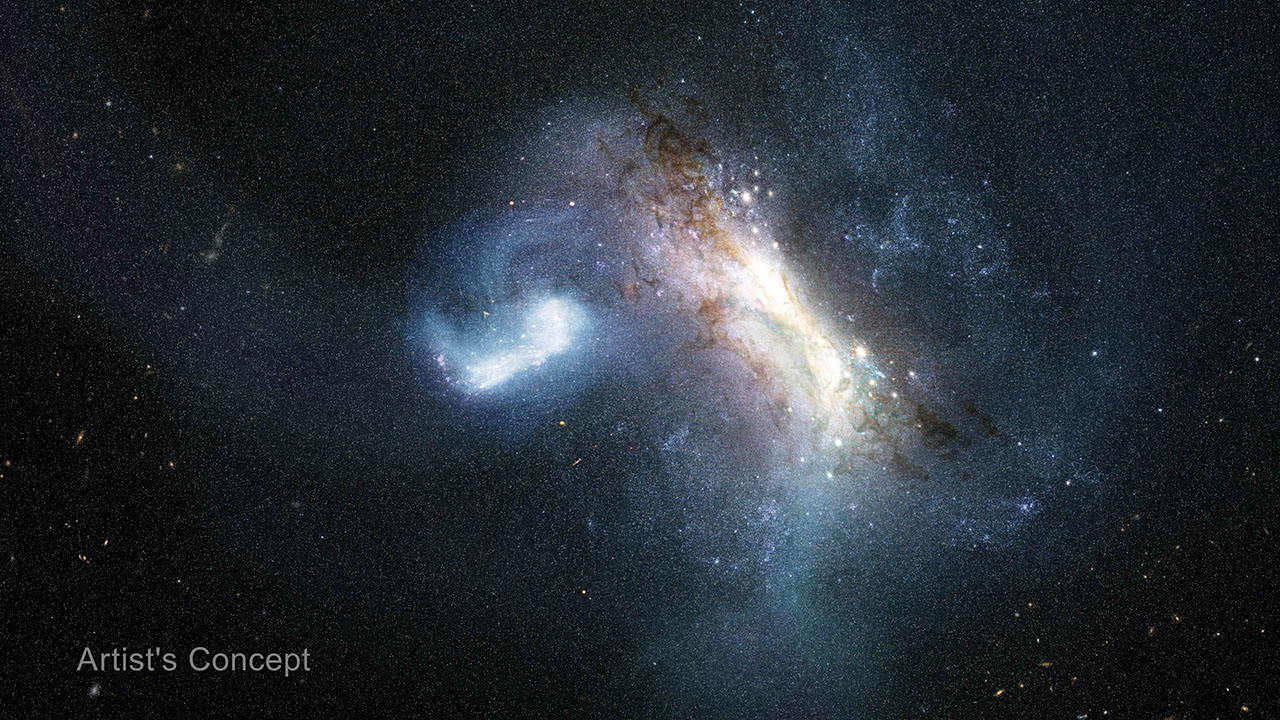
New data from NASA’s Hubble Space Telescope provides definitive evidence that a dwarf galaxy, named LKH, merged with the young Milky Way approximately 11.8 billion years ago. This discovery, published in the journal Nature Astronomy, extends the known history of the Milky Way’s evolution by 1.8 billion years.
The Milky Way is a massive spiral galaxy that grew by forming new stars and collecting stars, gas, and dark matter from other galaxies through mergers. While the most recent massive merger involved the Sagittarius dwarf galaxy beginning over 6 billion years ago, and the Gaia-Sausage-Enceladus merger occurred 10 billion years ago, researchers had long suspected an even earlier event. Hubble has now uncovered evidence of this prior collision, which took place just 2 billion years after the Big Bang.
Researchers identified a distinct population of globular clusters with specific ages and metal content, indicating they originated from the absorbed LKH galaxy. The team analysed Hubble observations of 39 globular clusters in the inner 20,000 light-years of the Milky Way. They found these clusters were older than those from the Gaia-Sausage-Enceladus merger but younger than those born within the Milky Way itself, regardless of metal content.
The LKH galaxy contained roughly 500 million times the mass of the Sun in stars, representing a significant fraction of the Milky Way’s mass at that time. The dwarf galaxy was named LKH, an acronym for Low-energy-Kraken-Heracles, in honour of three earlier research papers that championed the idea of an early merger.
These findings challenge previous studies suggesting the earliest phases of the Milky Way’s evolution were defined solely by stars born within the galaxy itself. The study demonstrates that stars born in external galaxies must also be considered when reconstructing the Milky Way’s history.
Hubble’s high-resolution imaging, coupled with precision data from ESA’s Gaia mission, allowed scientists to measure the age and metal content of these clusters with unprecedented accuracy. The Hubble Space Telescope has been operating for more than three decades as a project of international cooperation between NASA and ESA.
The researchers plan to continue studying globular clusters to unravel the full history of the Milky Way’s massive mergers across cosmic time. This work aims to characterise all the merger events that have shaped our galaxy, providing a clearer picture of how the Milky Way was built.