Hubble Survey Paves Way for Roman Telescope to Map Milky Way's Galactic Bulge
Astronomers have utilised the Hubble Space Telescope to build a foundational catalog of millions of point sources, setting the stage for the Nancy Grace Roman Space Telescope to detect exoplanets and rogue worlds via microlensing.
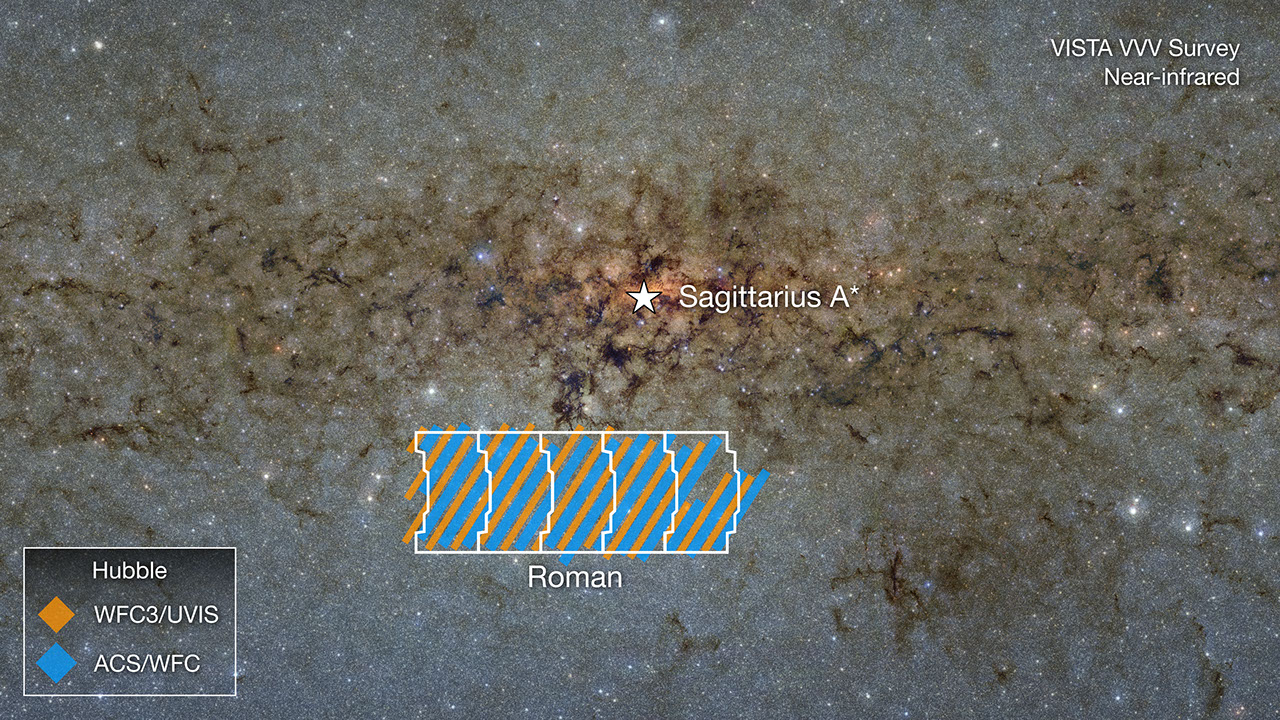
NASA has initiated a large-scale survey using the Hubble Space Telescope to observe the Milky Way's galactic bulge, providing essential precursor data for the upcoming Nancy Grace Roman Space Telescope. This campaign, which began in the spring of 2025, serves as a critical foundation for the Roman mission, scheduled for launch in early September 2026. The primary objective is to gather pre-existing data that will enable astronomers to determine the individual masses of stars and planets during the Roman mission's Galactic Bulge Time-Domain Survey, rather than relying solely on indirect mass ratios.
The current Hubble survey covers a significantly larger area than previous studies, surpassing the size of earlier mosaics such as that of the Andromeda galaxy. While prior Hubble surveys of the bulge covered approximately 0.5 square degrees each, this program targets much of the same area Roman will observe, creating a high-resolution catalog of 20 to 30 million point sources. By comparing these pre-existing images with future Roman observations, astronomers aim to create a comprehensive catalog that Roman is predicted to expand to between 200 and 300 million point sources.
A key focus of the upcoming Roman mission is the detection of exoplanets, rogue planets, and isolated neutron stars via microlensing. This technique involves a gravitational lensing event where the light from a distant object is warped by the mass of a closer object, allowing for the detection of objects as small as Mars moving between Earth and the densely packed stars within the galactic bulge. Timing is a key consideration in this process, as identifying light sources separately before a microlensing event occurs aids in disentangling foreground and background stars.
To facilitate this, the Hubble survey is designed to identify light sources separately before microlensing events occur. When a telescope observes a lensing object, such as a bright star, aligning with a star in the galactic bulge, it can be difficult to decipher which of the two the starlight comes from. If astronomers can identify these sources beforehand, they can go back later to say, for example, that a red star went in front of a blue star during a specific event. This method turns a more opaque measurement of the relationship between a star and its planet into one far more certain.
A paper detailing the team's work was published on 11 May 2026 in the Astrophysical Journal, outlining the methodology and objectives of the project. The research team predicts that while the Hubble survey will build a catalog of 20 to 30 million point sources, Roman will add to this by an order of magnitude by the end of the survey. This data from the most recent Hubble survey is available in the Mikulski Archive for Space Telescopes, ensuring the findings remain accessible for further analysis.
The Nancy Grace Roman Space Telescope is managed at NASA Goddard with participation from various institutions, including JPL, Caltech/IPAC, and the Space Telescope Science Institute. The mission will utilise a field of view covering approximately 1.7 square degrees, taking a snapshot every 12 minutes over six 72-day observing seasons. This extensive data collection will allow the telescope to produce some of the deepest images ever taken of any part of the sky, fundamentally shaping our understanding of the universe.