Hubble reveals galaxy’s gas loss on path to Virgo Cluster
New imagery from NASA’s Hubble Space Telescope shows how the active spiral galaxy Messier 88 is losing its star-forming fuel as it moves through the dense environment of the Virgo Cluster.
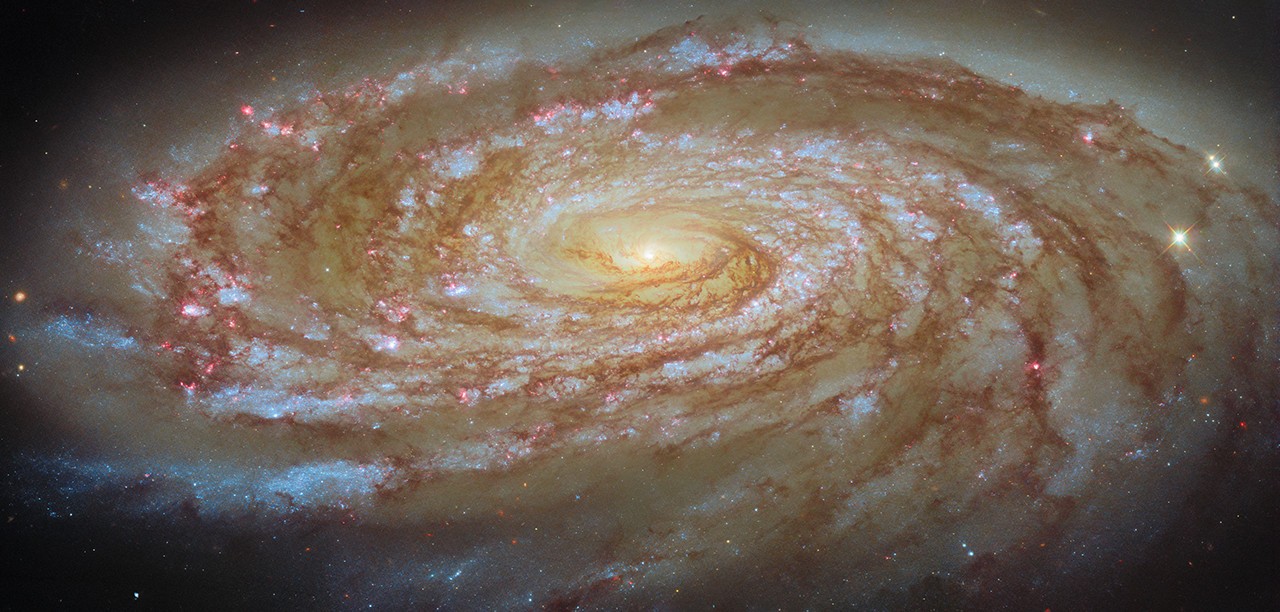
NASA’s Hubble Space Telescope has captured detailed observations of Messier 88, an active spiral galaxy located approximately 63 million light-years away in the constellation Coma Berenices. The imagery, obtained through programme #18103 led by Principal Investigator D. Thilker, utilises Hubble’s Wide Field Camera 3 to examine how galaxies evolve within crowded cosmic environments. The data reveals that the galaxy is currently undergoing significant structural changes as it journeys toward the centre of the Virgo Cluster.
Messier 88, also designated as NGC 4501, is a member of the Virgo Cluster, a massive gravitational assembly containing more than 1,000 galaxies. As the cluster moves through space, its constituent galaxies orbit a central point of gravity. M88 is on a trajectory that will bring it to the innermost reaches of the cluster, with its closest approach to the anchor galaxy Messier 87 expected in 200 to 300 million years. This long-term journey is already fundamentally altering the galaxy’s physical state.
The primary mechanism driving this change is ram pressure stripping, a process where a galaxy’s gas is swept away as it moves through the intracluster medium. Hubble’s observations show that M88’s swirling gas disk is truncated and compressed on its leading edge, resembling snow piling up before a plough. The galaxy possesses considerably less cold gas than expected for its size, particularly in its outer regions, indicating a reduced capacity for future star formation.
At the heart of M88 lies a supermassive black hole estimated to be 100 million times the mass of the Sun. This black hole is actively accreting gas and dust, powering outflows of gas from the galaxy’s centre. A population of old, reddish stars surrounds the core, giving M88 a warmly glowing centre, while tightly wound spiral arms outlined by pink and blue star clusters fan out from it.
The observations were conducted as part of a dedicated programme to understand the lives of spiral galaxies in dense environments. By resolving individual star clusters and nebulae in galaxies tens of millions of light-years away, astronomers can study how interactions with cluster environments impact galactic evolution. The findings provide clear evidence of how cosmic journeys strip galaxies of the raw fuel necessary for star formation.