Hubble Detects Ionizing Light from Early Galaxy MXDFz4.4
The discovery of galaxy MXDFz4.4 suggests that tightly clustered young stars in small, early-universe galaxies were responsible for clearing the opaque neutral hydrogen gas that once filled the cosmos.
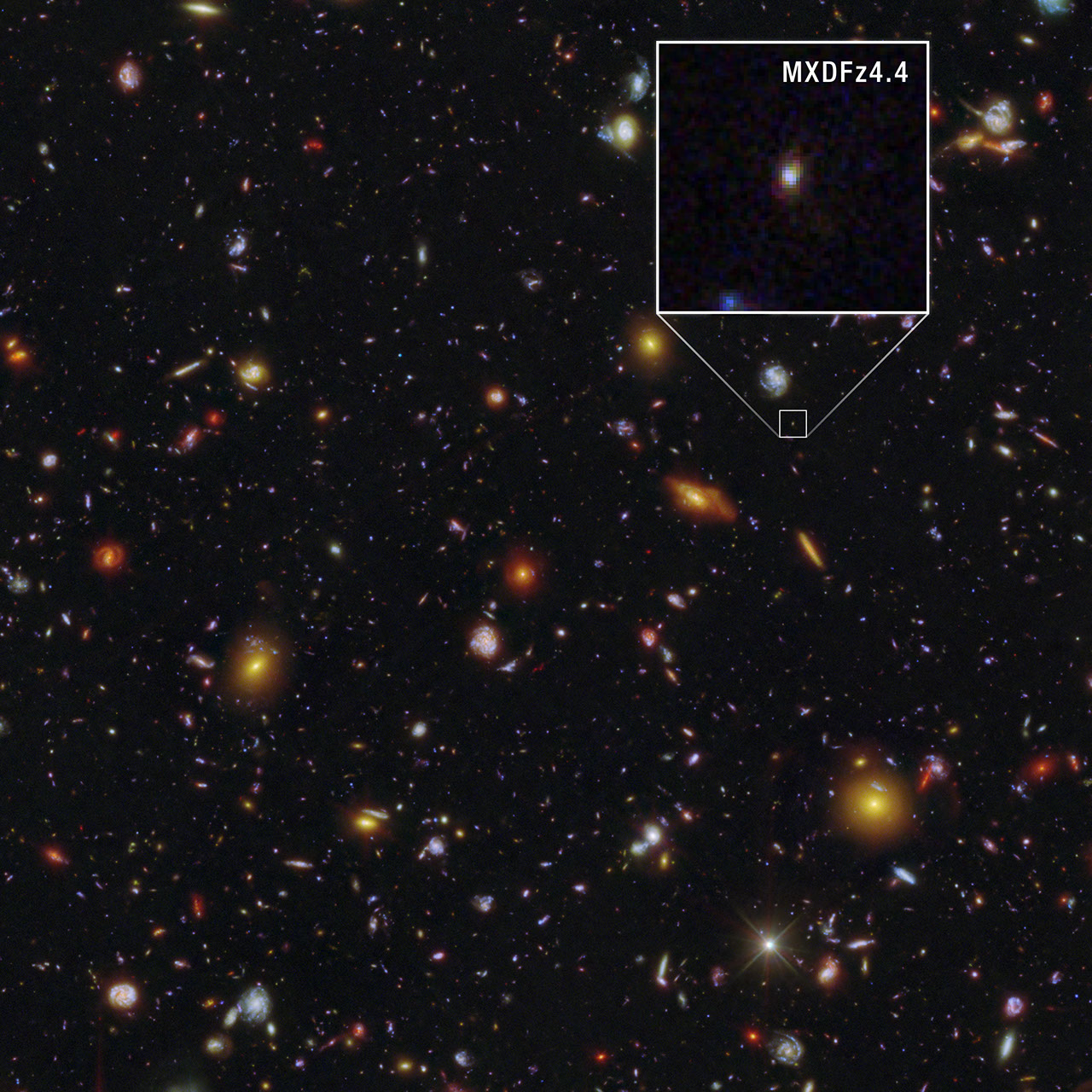
Astronomers using NASA’s Hubble Space Telescope have detected ultraviolet light from galaxy MXDFz4.4, which existed 1.4 billion years after the big bang. The galaxy contains tightly clustered young, massive stars that produce ionizing light capable of clearing the opaque neutral hydrogen gas surrounding it. This discovery provides critical evidence regarding the Era of Reionization, suggesting that similar galaxies were responsible for making the early universe transparent. The findings, published in the Astrophysical Journal, were supported by data from the James Webb Space Telescope and the European Southern Observatory’s Very Large Telescope.
MXDFz4.4 is cataloged as existing at the end of the Era of Reionization, a period when the universe transitioned from opaque to transparent gas. Before this discovery, the earliest galaxy identified emitting ionized light was from when the universe was 1.6 billion years old; MXDFz4.4 pushes this timeline back by 200 million years. The galaxy is approximately 100 times smaller in area than the Milky Way but is forming stars 10 times faster. Researchers estimate that 50 to 100% of the young stars’ energetic ionizing light is escaping the surrounding gas.
Lead author Ilias Goovaerts, a postdoctoral fellow at the Space Telescope Science Institute (STScI), stated that observing such a galaxy was previously thought to be impossible due to the expected thickness of the neutral hydrogen fog. Co-author Marc Rafelski, Hubble deputy mission head at STScI, noted that while many galaxies from this era have been found, none had previously been detected emitting ionizing photons. The combination of Hubble’s ultraviolet observations with near-infrared data from the James Webb Space Telescope (JWST) and visible light data from the European Southern Observatory’s Very Large Telescope (VLT) made the discovery possible.
The findings, published in the Astrophysical Journal on June 23, highlight the unique role of Hubble in capturing this specific wavelength of light. While JWST provided data on the galaxy’s mass and star formation history, and the VLT helped pinpoint the galaxy’s existence at 1.4 billion years after the big bang, Hubble’s sensitivity and resolution were essential for detecting the ionizing photons. This multi-telescope approach allowed researchers to distinguish between older, cooler stars and the recent bursts of young, massive stars responsible for transforming the surrounding gas.
This discovery sets a critical precedent for understanding how the universe became transparent. The Era of Reionization took hundreds of millions of years to unfold, and MXDFz4.4 offers a rare glimpse into the mechanisms that drove this change. By confirming that small, dense galaxies could produce enough ionizing light to clear their immediate surroundings, the study supports the hypothesis that such galaxies played a major role in the cosmic transition. Future observations of similar galaxies may help refine measurements of how the early universe evolved.