Hubble captures transitional galaxy NGC 1266 in new image
New observations of the enigmatic galaxy NGC 1266 highlight its lens-shaped structure, dust-obscured face, and minimal star formation, offering insight into galactic evolution.
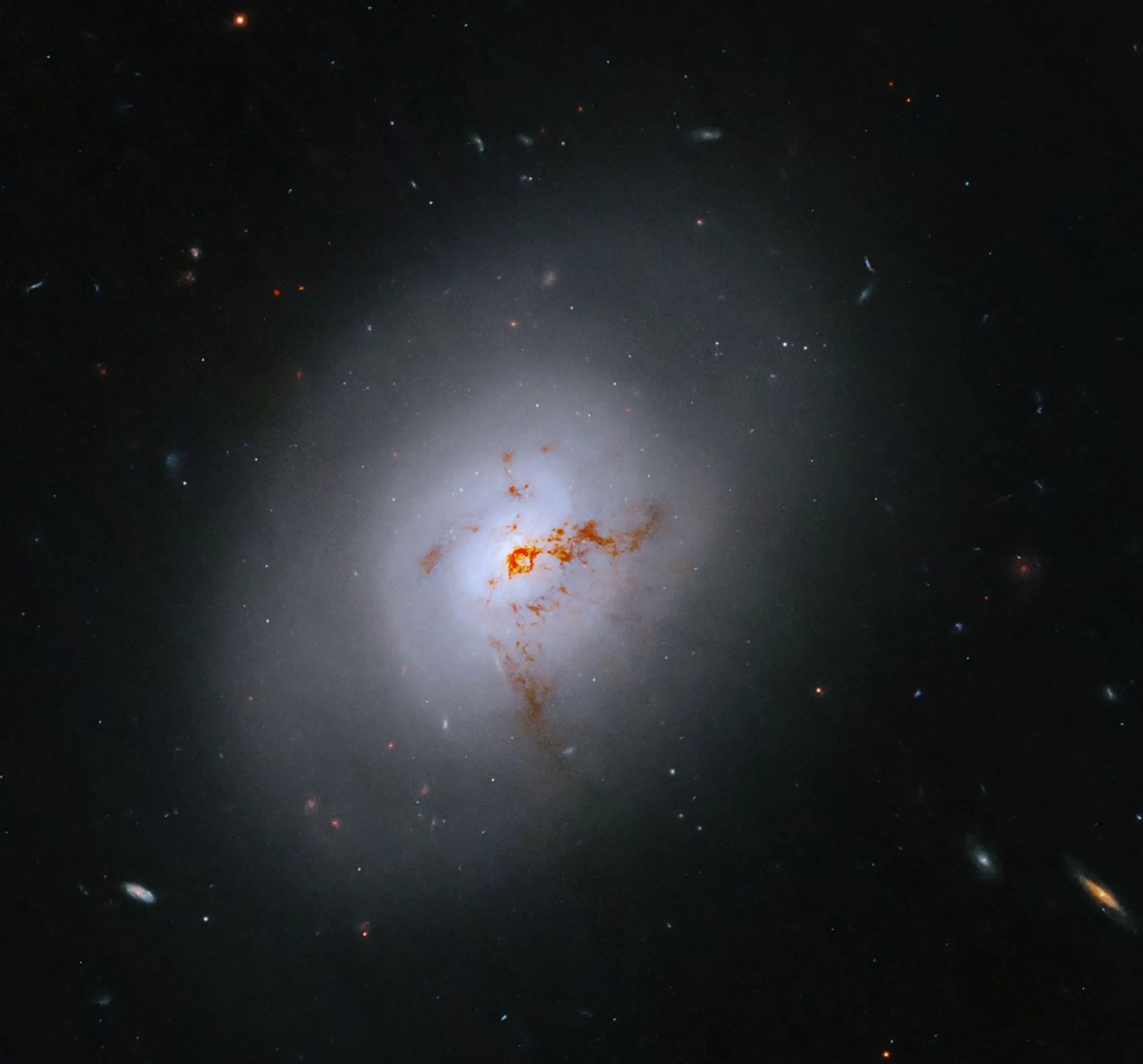
The NASA Hubble Space Telescope has released a new image of NGC 1266, a lenticular galaxy situated approximately 100 million light-years away in the constellation Eridanus. The observation provides a detailed view of an enigmatic celestial object that astronomers classify as a transitional galaxy, representing an evolutionary bridge between spiral and elliptical types.
NGC 1266 exhibits the characteristic lens-shaped structure of lenticular galaxies, featuring a bright central bulge and a flattened disk similar to spiral galaxies. However, it lacks the prominent spiral arms and exhibits little to no star formation, traits more commonly associated with elliptical galaxies. This combination of features underscores its role in the broader context of galactic evolution.
The Hubble image reveals a face that hints at spiral structure, yet holds no obvious spiral arms. Reddish-brown clumps and filaments of dust partially obscure the galaxy’s full face, adding complexity to its visual appearance. These dust features are significant in understanding the internal dynamics and evolutionary stage of the galaxy.
Beyond the galaxy itself, the image captures light from distant background galaxies shining through its diffuse outer regions. These background sources appear in red, blue, and orange hues, dotting the inky-black background and providing a sense of depth and scale to the observation. The presence of these distant objects highlights the vast distances involved in such astronomical imagery.
The image credits are attributed to NASA, ESA, and K. Alatalo from the Space Telescope Science Institute (STScI), with image processing conducted by G. Kober from NASA and the Catholic University of America. This collaborative effort ensures the high fidelity and scientific accuracy of the released data, allowing researchers and the public to study the galaxy’s unique characteristics.
Astronomers continue to study galaxies like NGC 1266 to better understand the processes that drive galactic transformation. The specific evolutionary path of individual galaxies can be complex, and observations such as this contribute to the broader knowledge of how galaxies transition between different morphological types over cosmic time.