Hubble captures stellar nursery LH 95 in the Large Magellanic Cloud
Newly released imagery from July 2026 shows the LH 95 region, a stellar association within the dwarf galaxy that orbits the Milky Way.
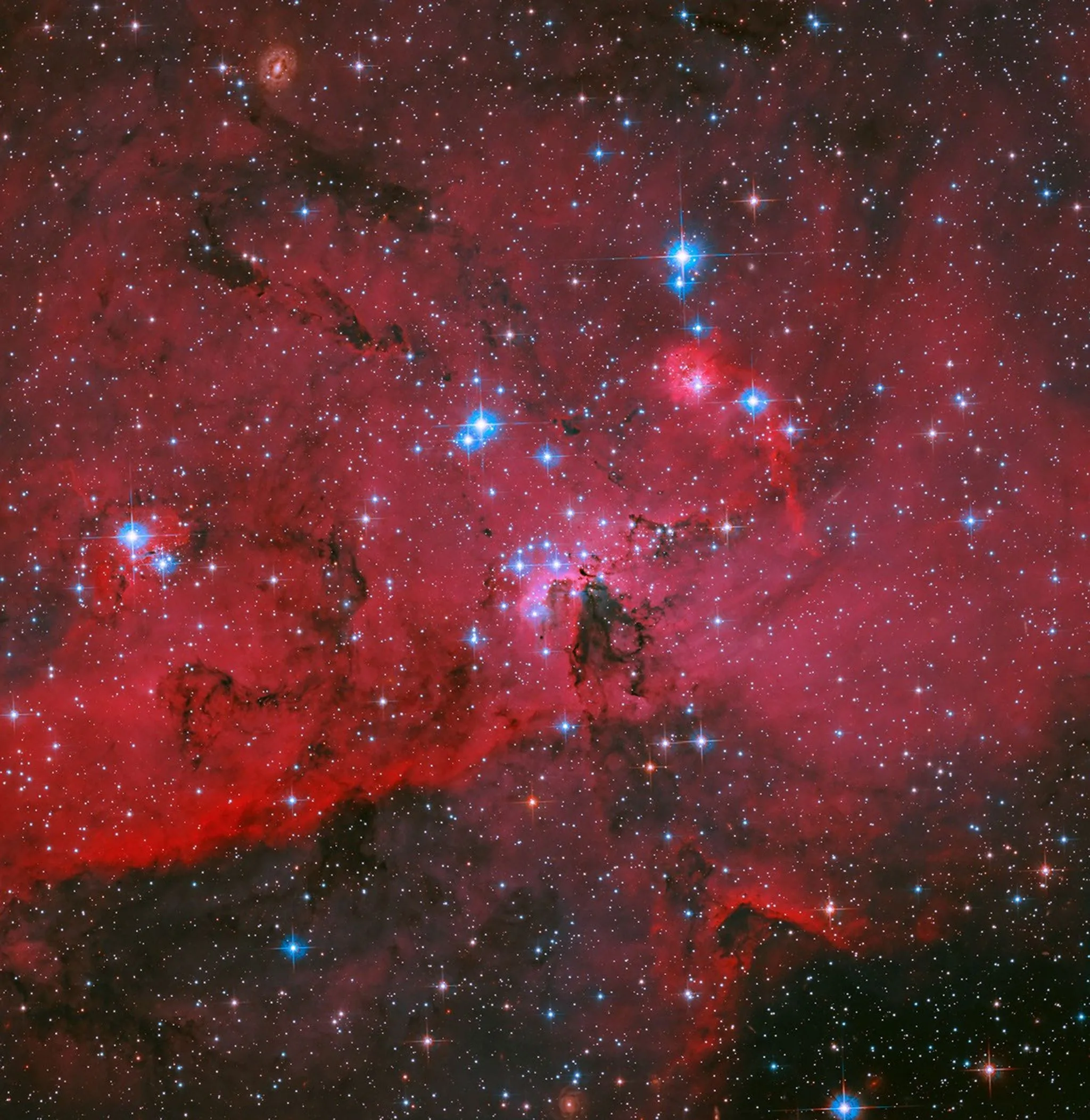
NASA’s Hubble Space Telescope has released a new image of the LH 95 stellar nursery, located within the Large Magellanic Cloud. The photograph, captured on July 3, 2026, depicts a vivid scene where blue and white stars shine against a crimson background of glowing gas and dust. The image was officially published by NASA on July 14, 2026.
The LH 95 region is identified as a stellar association, a grouping of stars found within the Large Magellanic Cloud. This dwarf galaxy orbits the Milky Way. The association contains a mix of low-mass infant stars and massive blue giant stars, which heat and illuminate the surrounding landscape of gas and dust.
The visual data highlights the contrast between the bright stellar population and the glowing interstellar medium. The crimson hue of the background gas is illuminated by the energy from the young stars within the nursery. This type of stellar association is one of many present in the Large Magellanic Cloud.
The image credits include contributions from several institutions and researchers. N. Da Rio from The University of Virginia, G. De Marchi from the European Space Agency’s ESTEC facility, and D. Gouliermis from Universitat Heidelberg are credited for the observation. The image processing was carried out by Gladys Kober of NASA and the Catholic University of America.
This release provides a detailed view of star formation processes in a nearby galaxy. The Large Magellanic Cloud remains a key target for astronomical study due to its proximity to the Milky Way. The new image adds to the visual record of stellar nurseries within this dwarf satellite galaxy.