Hubble captures galaxy in transition as black hole suppresses star formation
New observations reveal how a supermassive black hole’s powerful winds are stripping a distant galaxy of the material needed to create new stars.
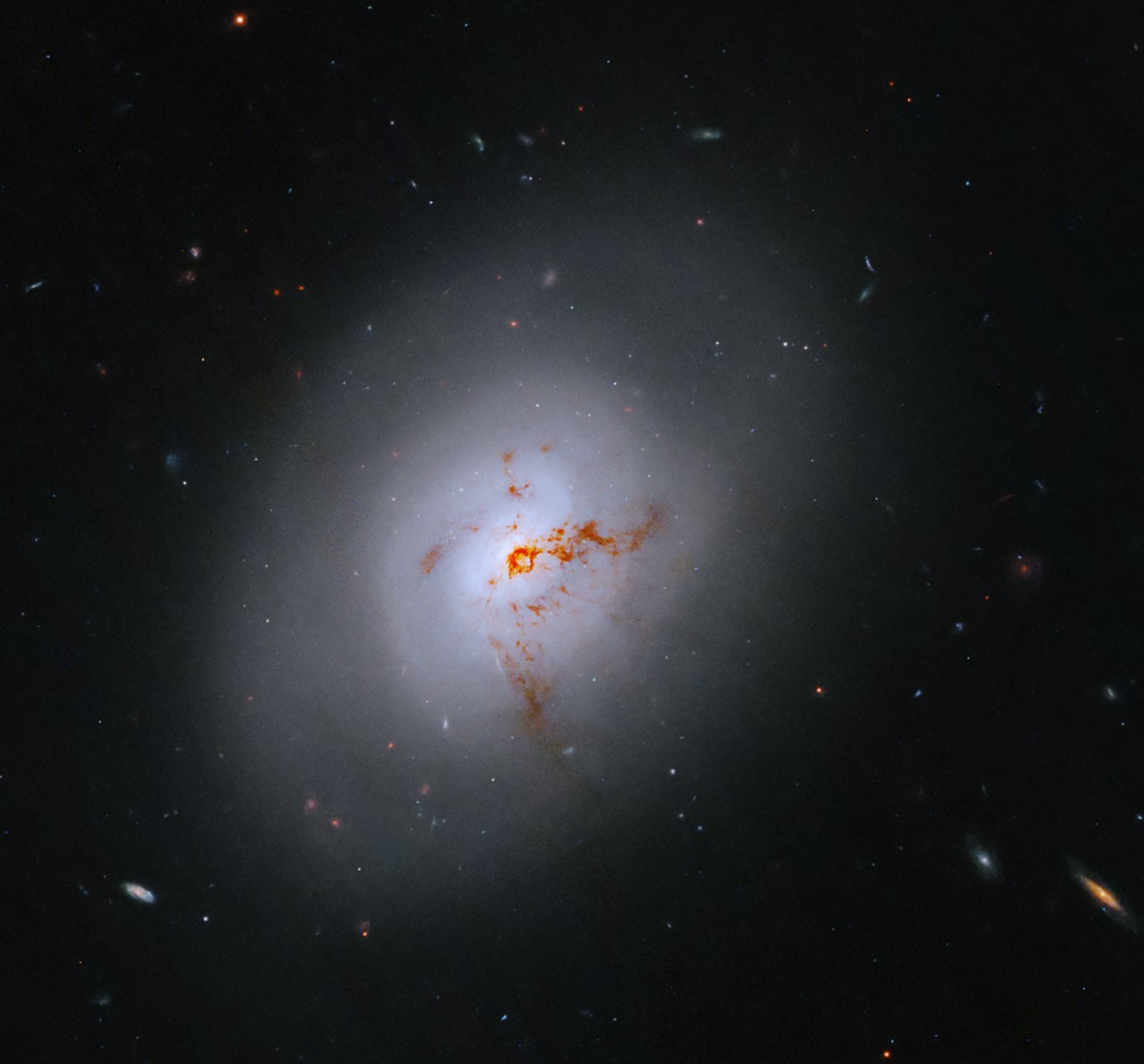
NASA’s Hubble Space Telescope has captured new imagery of NGC 1266, a lenticular galaxy situated approximately 100 million light-years away in the constellation Eridanus. The observations highlight a system in the midst of a significant evolutionary shift, transitioning from a period of intense star formation to a quieter, more quiescent state.
Astronomers classify NGC 1266 as a post-starburst galaxy, a rare category that accounts for roughly one percent of the local galaxy population. These systems possess a young population of stars but contain few active star-forming regions. The galaxy’s structure features a bright central bulge and a flattened disk that hints at spiral characteristics, yet it lacks the distinct spiral arms typically associated with such formations.
The transition is attributed to a minor galaxy merger that occurred approximately 500 million years ago. This collision triggered a burst of star formation, increased the mass of the central bulge, and funneled gas into the galaxy’s supermassive black hole. The influx of matter activated the black hole, creating an active galactic nucleus that generated powerful winds and jets along its axis of rotation.
Over time, these energetic outflows have depleted the galaxy’s reservoir of star-forming gas. Hubble’s observations reveal strong gas outflows and turbulence within the space between stars, indicating that the black hole is actively stripping or ejecting material. This process disturbs the remaining gas and dust sufficiently to prevent it from gravitationally condensing into new stars.
Researchers have identified that any remaining stellar nurseries are confined to the galaxy’s core, with virtually no star formation occurring beyond this region. The shockwaves from the black hole’s activity create turbulence that suppresses the birth of infant stars, offering astronomers a clear view of the physical processes that halt galaxy evolution.
Since its launch in 1990, the Hubble Space Telescope has provided critical insights into these complex interactions. Studies of post-starburst galaxies like NGC 1266 help scientists better understand how supermassive black holes influence their host galaxies and drive the broader evolution of the universe.