Hubble captures faint dwarf galaxy in study of cosmic flow
The Hubble Space Telescope has released a new image of the dwarf irregular galaxy ESO 490-017, located 23 million light-years away, as part of a programme investigating the gravitational drivers of the universe's large-scale structure.
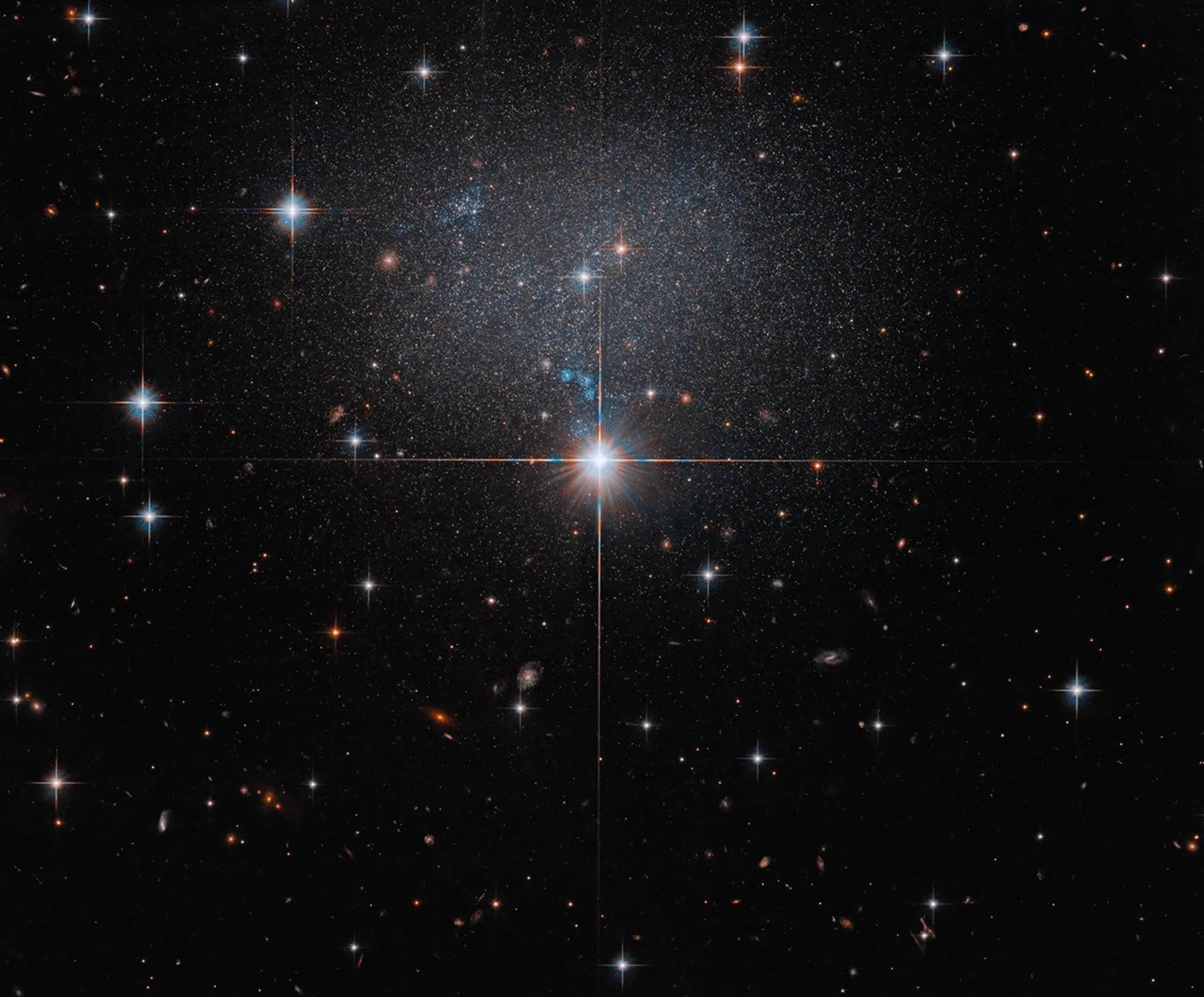
NASA released an image on 27 May 2026 from the Hubble Space Telescope featuring the dwarf irregular galaxy ESO 490-017. The galaxy is situated approximately 23 million light-years from Earth in the constellation Canis Major and spans roughly 12,000 light-years in diameter. The observation was conducted as part of a Hubble programme designed to study the movement of galaxies and galaxy clusters through space.
The data collected for this image contributes to a broader investigation into the "cosmic flow," a phenomenon driven by the uneven distribution of matter in the universe. According to NASA, the gravitational influence of this matter drives the movement of large-scale structures. By observing how galaxies and clusters move, researchers aim to better understand the underlying distribution of mass across the cosmos.
ESO 490-017 presents a challenge for imaging due to its low surface brightness. In the released image, the galaxy appears as a faint, starry swarm positioned behind brighter foreground stars. These foreground stars are easily identifiable by their characteristic diffraction spikes, which contrast with the diffuse glow of the distant galaxy.
The background of the image reveals numerous distant galaxies, described by NASA as red, orange, and beige dots peppering the black expanse. Many of these background objects exhibit distinct spiral structures, providing a visual context for the scale and density of the universe surrounding the target galaxy.
The image credits are attributed to NASA, ESA, and R. Tully from the University of Hawaii. Image processing was carried out by G. Kober from NASA and the Catholic University of America. The release serves as a visual record of the ongoing efforts to map the gravitational architecture of the universe.