Hubble captures distant galaxy cluster in visible and infrared light
NASA’s observatory records massive, X-ray-bright cluster four billion light-years away as part of ongoing studies into gravitational lensing and core interactions.
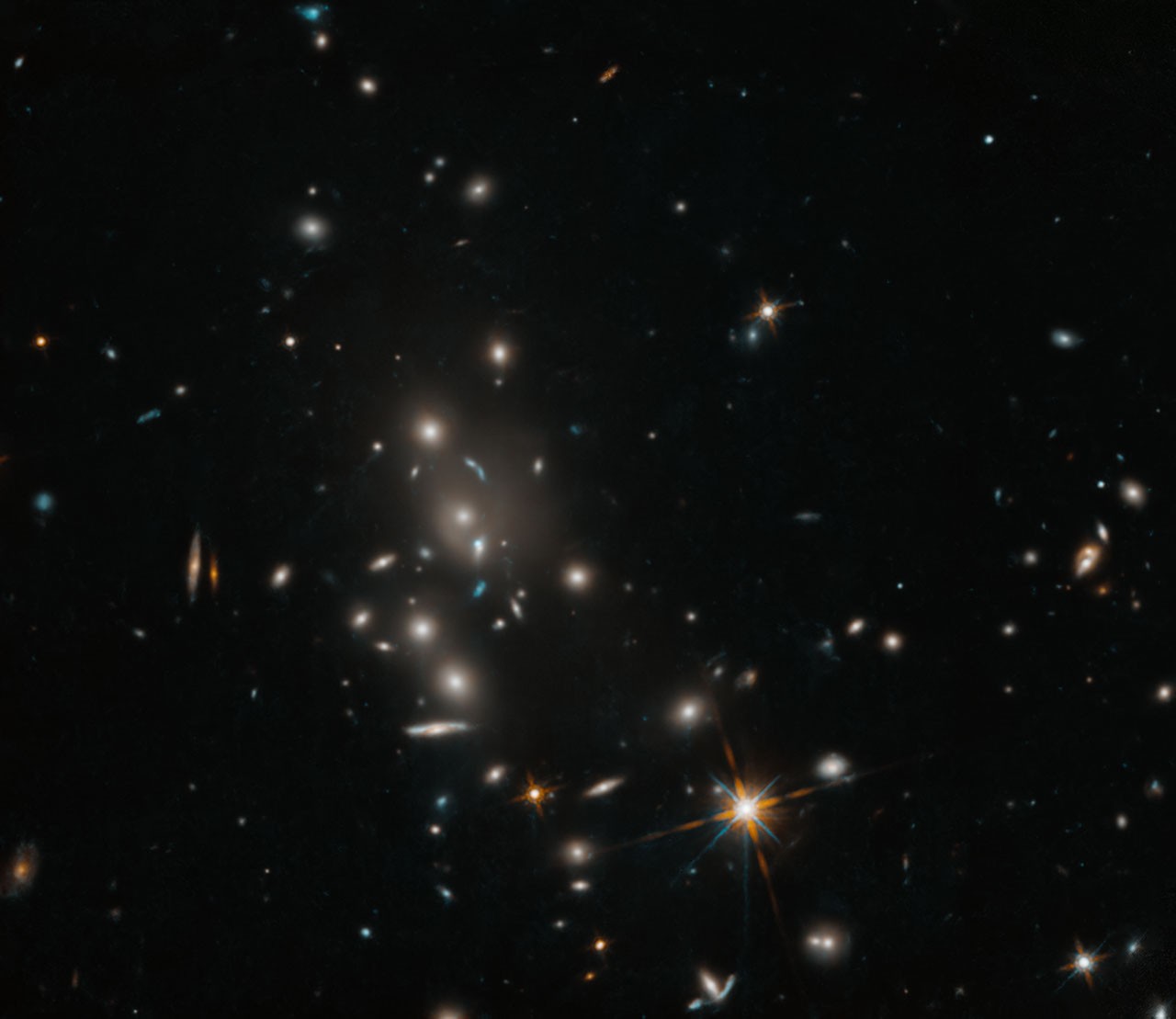
NASA’s Hubble Space Telescope has recorded an image of the galaxy cluster MACS J1141.6-1905, situated approximately four billion light-years from Earth in the constellation Crater. The observation, conducted in visible and infrared light, forms part of two scientific programmes focused on massive, X-ray-bright galaxy clusters.
The data was collected to achieve specific astronomical objectives, including the identification of distant galaxies that are gravitationally lensed by the cluster’s mass. Researchers also aimed to better understand the physical nature of interactions occurring at the core of each cluster.
The resulting image reveals galaxies of various shapes and sizes clustered toward the centre-left of the frame. Foreground stars within the field of view exhibit distinct diffraction spikes, an optical effect caused by light diffracting around the supports for Hubble’s secondary mirror.
This dataset has been integrated into Hubble’s archive, which now comprises 1.7 million observations. The agency describes the archive as a valuable resource for current and future astronomers, who can mine 36 years of observational data using new analytical tools to facilitate further discoveries.
Since its launch in 1990, the Hubble Space Telescope has significantly altered the fundamental understanding of the universe. The new data from MACS J1141.6-1905 adds to the extensive record of astronomical observations maintained by NASA.