Hubble captures asymmetric spiral galaxy NGC 4654 in Virgo Cluster
NASA’s Hubble Space Telescope has released detailed observations of NGC 4654, an intermediate spiral galaxy located 72 million light-years away. The data highlights how high-velocity movement through the Virgo Cluster and a past gravitational encounter have created its distinctive lopsided form.
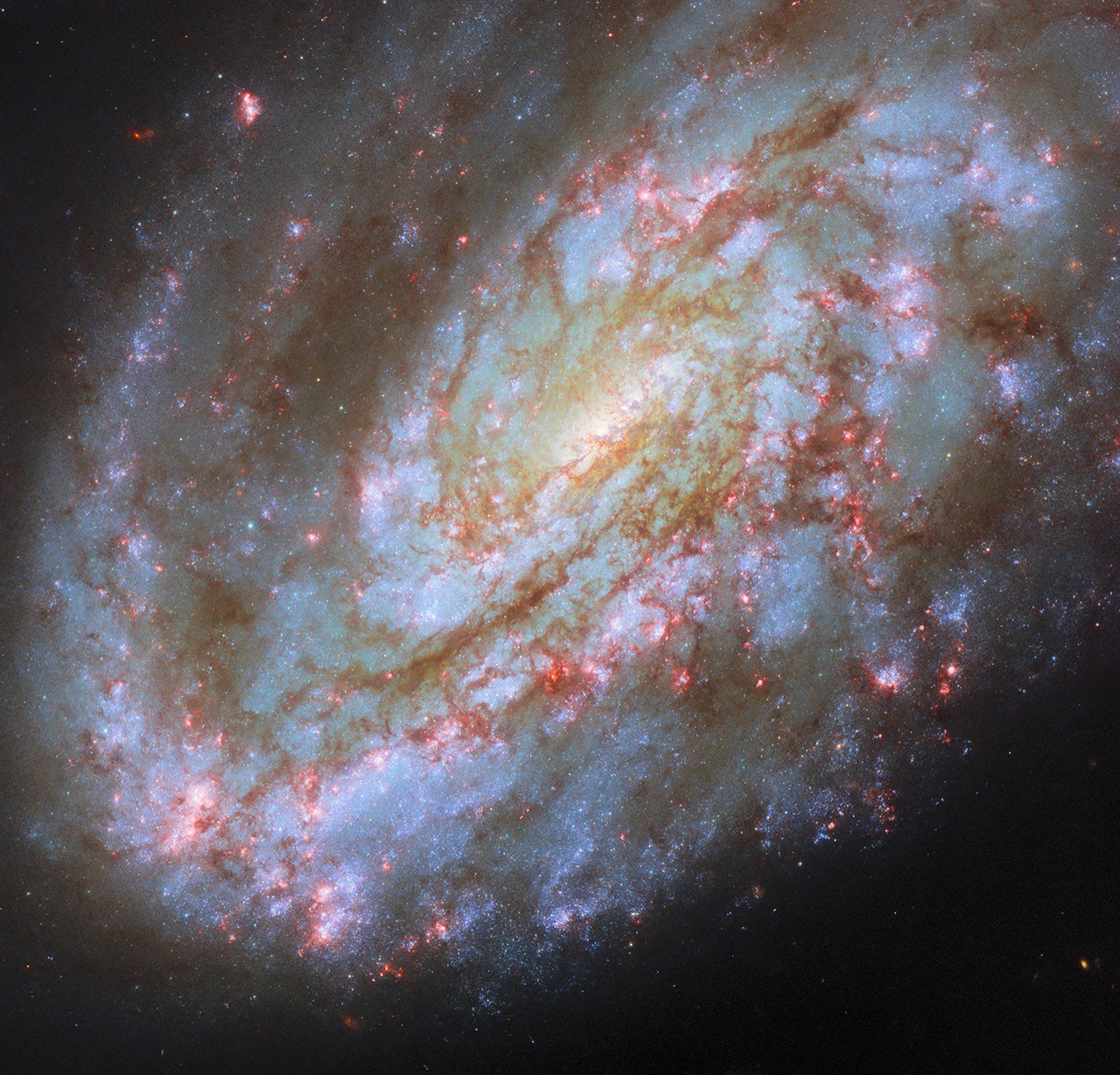
The Hubble Space Telescope has imaged the spiral galaxy NGC 4654, situated 72 million light-years from Earth within the Virgo Cluster. Classified as an intermediate spiral galaxy, NGC 4654 possesses a weak bar structure at its centre, placing it between barred and unbarred spiral classifications. The image reveals significant asymmetry, characterised by a rounded leading edge and a long gaseous tail extending beyond the captured field of view.
Astronomers attribute this structure to ram pressure stripping as the galaxy moves at high velocity through the Virgo Cluster’s intracluster medium. As NGC 4654 ploughs through the hot, rarefied gas filling the space between cluster galaxies, the intracluster medium exerts pressure that compresses the galaxy’s leading edge and drags its gas behind it. This process creates the elongated tail observed in the data.
The distribution of stars within NGC 4654 is also uneven, a feature considered unusual for a spiral galaxy. The spiral arm on the leading edge is rich with stars and gas, while the opposite arm noticeably lacks stars. While ram pressure contributes to this effect, astronomers suggest that a gravitational fly-by interaction with galaxy NGC 4639 approximately 500 million years ago also played a role. This past encounter is thought to have ripped away gas along one side, limiting star formation and creating the galaxy’s lopsided shape.
Despite the loss of gas, NGC 4654 continues to form stars at a rate of nearly two solar masses per year. This active star formation is visible in the Hubble data as bright pink regions of newborn stars. The image captures red light emitted by clouds of energised gas where these stars are located, appearing as bright pink bubbles across the forward spiral arm, around the weak bar, and out to the edge of the disk.
The data used in this image comes from two observing programs, #15654 and #17502, aimed at linking galactic gas with star formation. By observing prominent galaxies in the vicinity of our own, researchers hope to better understand how gas moves in galaxies, where and when it collapses to form stars, and what effect those new stars have on the surrounding gas.