Hegseth Defends US Pacific Commitment Amidst Iran Operations and Spending Demands
At the Shangri-La Dialogue in Singapore, Pete Hegseth sought to reassure regional partners that concurrent global obligations, including military actions in Iran, do not equate to abandoning Asia-Pacific security commitments.
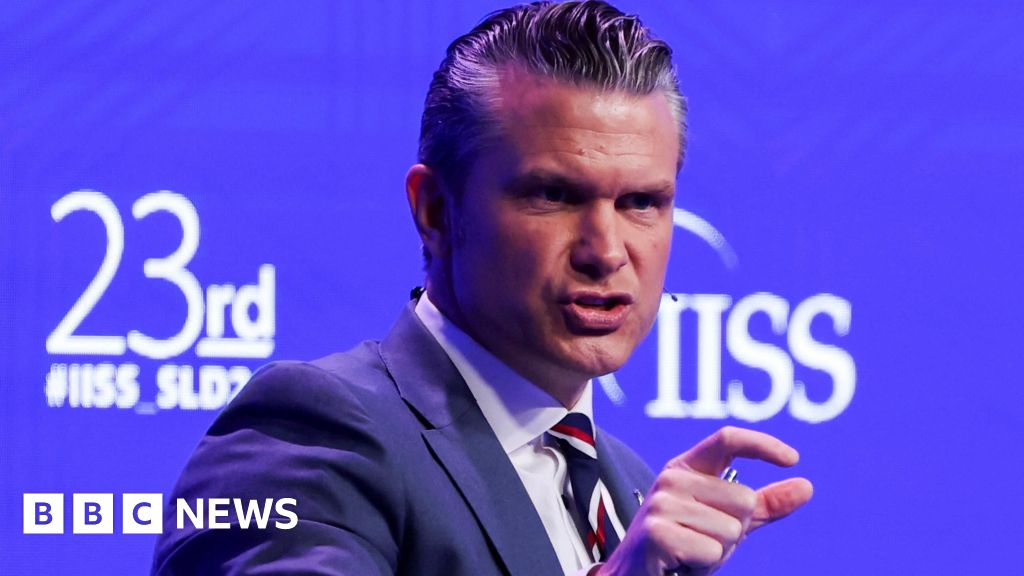
US Defence Secretary Pete Hegseth addressed the Shangri-La Dialogue in Singapore on Saturday, seeking to dispel concerns among Asia-Pacific allies that the United States is withdrawing from the region due to concurrent global military obligations, including operations in Iran. Speaking at the forum organised by the International Institute of Strategic Studies, Hegseth insisted that Washington is not "turning our backs" on the Pacific, despite the logistical and strategic demands of maintaining a presence in the Middle East.
Hegseth’s remarks came in response to anxieties raised by Japan’s Defence Minister Shinjiro Koizumi, who warned that some nations might underestimate US commitment or attempt to "drive a wedge" between Washington and its partners. Hegseth countered that the US national defence strategy prioritises "power projection" in the Pacific, asserting that the United States can manage "global obligations to ensure that, say, Iran doesn't get a nuclear weapon" while simultaneously working with allies on a "substantive, serious approach" to the region.
A significant portion of the dialogue focused on the suspension of a $14bn arms package to Taiwan, a move taken to conserve munitions for the conflict in Iran. When questioned about the US capacity to fulfil arms deals with partners, Hegseth stated he would "very much decouple the two" issues. He maintained that the United States remains in a "very strong position" regarding its overall munitions stockpile and production capabilities, aiming to reassure partners that the suspension was a tactical adjustment rather than a strategic retreat.
Central to Hegseth’s address was a call for Asian partners to increase defence spending to a target of 3.5% of GDP, a figure he reiterated from the previous year’s forum. He praised nations such as Japan, South Korea, Australia, and the Philippines for their increased military expenditure and cooperation with the US. Conversely, Hegseth explicitly categorised New Zealand as a "freeloader" in response to a question, while also issuing a warning that "Europe and Nato have some big decisions to make."
Hegseth advocated for a strategy of "measured and deliberate strength," arguing that diplomatic rhetoric alone is insufficient. "Rules are great, but if you can't back them up with hard power, the rules are not worth the paper they are written on," he said, calling for "more ships and more subs" rather than additional conferences. This hard-power emphasis stood in contrast to the keynote address by Vietnam’s President To Lam, who called for more dialogue to resolve regional tensions.
While acknowledging "rightful alarm" regarding China’s historic military buildup, Hegseth adopted a tone that differed from his previous year’s speech, where he had accused Beijing of posing an "imminent threat" to Taiwan. Speaking weeks after President Donald Trump held talks with Chinese President Xi Jinping, Hegseth stated the US seeks a "genuinely stable equilibrium" without "needless confrontation." He noted that while allies do not seek constant escalation, they desire a balance of power where no state, including China, can impose its hegemony.
The diplomatic landscape at the forum was further marked by China’s decision to decline sending its defence minister for the second consecutive year, opting instead for a lower-level delegation. This absence has been interpreted by some observers as a snub to the forum, while others view it as a method to avoid publicly pitting itself against the US in a region where the two powers continue to jostle for influence.