From black hole stars to plastic cookies: The scientific breakthroughs of August
Astronomers have identified a new celestial object dubbed a “black hole star,” while researchers in the United States and Europe have developed edible cookies from plastic waste and sound-powered microfliers.
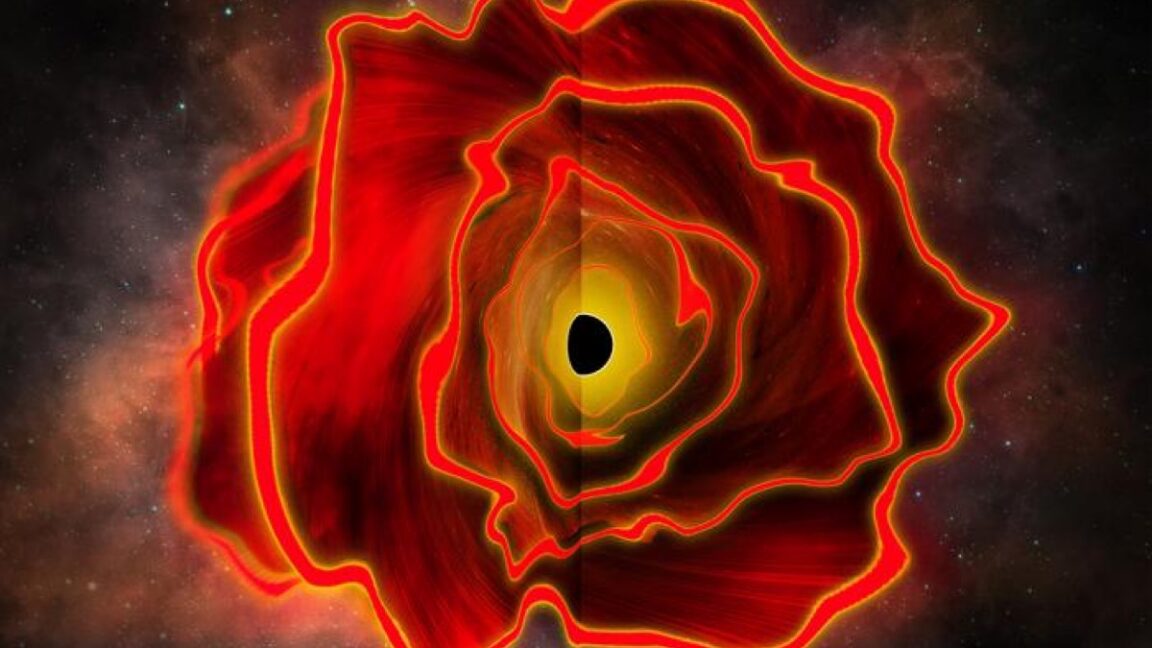
Astronomers have identified a new class of celestial object, dubbed a “black hole star,” which resolves a long-standing mystery regarding mysterious red dots observed in data from the James Webb Space Telescope. The discovery, detailed in a paper published in Nature, centres on an object named MoM-BH*-1, which exhibits the size of a large star but produces energy comparable to an active accreting black hole.
The object is characterised by a massive central black hole of approximately 100 solar masses, surrounded by a dense hydrogen cocoon the size of our solar system. This configuration explains the object’s extreme brightness, which is 100 billion times that of a star, and its deep “Balmer break” without the presence of metals. Two additional black hole stars have since been identified, offering potential insights into how supermassive black holes formed shortly after the Big Bang.
In a separate development addressing environmental concerns, researchers at Southern Illinois University have developed edible cookies made from polyethylene terephthalate (PET) plastic waste. Dubbed µBites, the cookies are created by using programmed yeast to convert plastic molecules into proteins, vitamins, and flavourings. The team presented their work at a meeting of the American Chemical Society, suggesting the product could serve as a food source for future deep-space missions or colonies on the Moon and Mars.
Further bridging the gap between biology and physics, oceanographer John Spiesberger at the University of Pennsylvania has linked whale call acoustics to Einstein’s special theory of relativity. Spiesberger identified a phenomenon known as “temporal interference,” where reflected echoes cause signal peaks to appear to travel faster than light. While the apparent speed exceeds the speed of light, the encoded information remains consistent with physical laws, a finding published in Physical Review E.
In the field of genetics, scientists at the University of California, Davis, have identified the gene SDMYB as the mechanism controlling sex-switching in avocado flowers. Avocado trees are hermaphrodites that switch between releasing and receiving pollen throughout the day to avoid self-pollination. By identifying the specific alleles associated with A-type and B-type flowering schedules, growers can now determine a tree’s type at the seeding stage, eliminating the need to wait 10 to 15 years for the tree to flower.
Engineering innovations also featured in the August research roundup. Scientists at the École polytechnique fédérale de Lausanne (EPFL) created miniature boats and microfliers powered by sound using Helmholtz resonance. By embedding hollow cavities in 3D-printed devices, the team converted sound waves into propulsive force, allowing for directional steering and aerodynamic lift. Additionally, a new heat-driven elastocaloric cooling system published in Nature Energy uses coupled ultra-thin nickel-titanium films to convert thermal energy into mechanical work, enabling solid-state cooling without electricity.