Five infant orangutans found in Odisha forest, prompting inquiry into India’s wildlife trade
The discovery of critically endangered apes in Balasore district has drawn scrutiny to the growing volume of exotic animal trafficking entering India through air and land routes.
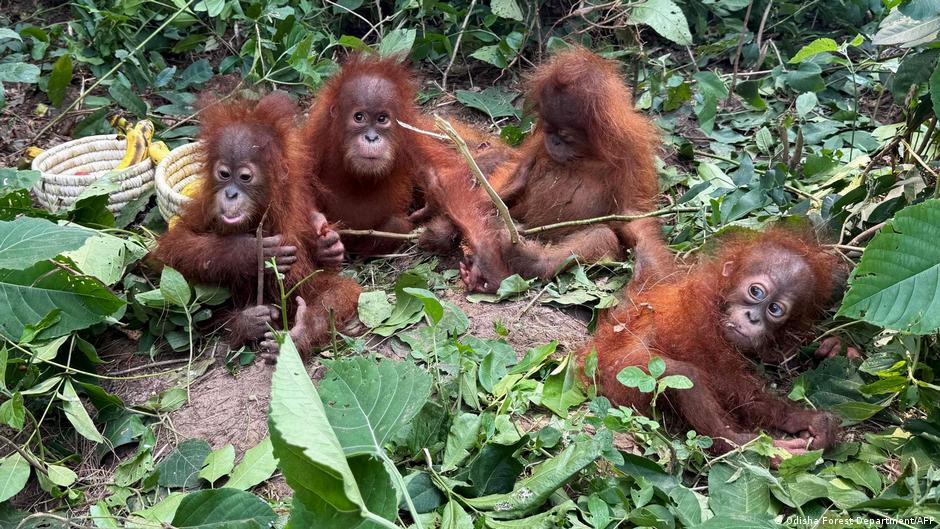
Rangers in the Balasore district of Odisha have discovered five infant orangutans in a local forest, a finding that has prompted the state government to request an investigation by the Wildlife Crime Control Bureau. The species is native to the Indonesian island of Sumatra and the island of Borneo, making their presence in eastern India a significant anomaly. The Odisha government suspects the critically endangered animals may have been released by an international wildlife smuggling racket, though the exact origin remains under review.
Indonesia’s Forestry Ministry has formally asked India to establish the origin of the abandoned orangutans. If the animals are confirmed to have come from their usual habitat abroad, Indonesia has requested their return. The discovery has raised broader questions about how exotic animals are entering the country and the extent to which India is being used as a destination for illegal wildlife trade.
The incident highlights a trend of increasing seizures across the country. In November 2024, authorities in Bengaluru seized 40 rare animals arriving from Kuala Lumpur, Malaysia. This was followed by a seizure of 284 exotic animals by Mumbai Customs in June 2025 and the interception of 20 animals, including green tree pythons, in Pune in July 2025. According to figures from the wildlife trade monitoring network TRAFFIC, 7,272 individual animals were seized from passenger baggage in smuggling attempts between Thailand and India between January 2022 and May 2025.
Conservationists indicate that enforcement systems are struggling to keep pace with the volume of trade. A June 2026 analysis by Humane World for Animals India suggests that demand is being fuelled by growing ownership of exotic pets and unregulated digital marketplaces. Wildlife biologist Ravi Chellam noted that social media platforms have aided the growth of illegal trade by serving as online marketplaces where individuals can display and boast about their collections.
Uttara Mendiratta, a conservation researcher, observed that the volume of trafficking and the number of endangered species involved have increased significantly since 2020. She noted that traders previously involved in smuggling live star tortoises out of India are now also sourcing other exotic wildlife. Tito Joseph of the Wildlife Protection Society of India added that while smuggling has always existed, it has increased significantly since 2018, with routes extending from Myanmar and Bangladesh into India.
The case underscores the difficulty of mapping the networks behind individual seizures. Conservation filmmaker Trishala Ashok argued that enforcement has not evolved at the same speed as the trade, with authorities often reacting to individual incidents rather than dismantling the broader supply chains. She emphasised that a seizure should be the beginning of an investigation into who supplied, moved, and paid for the animals, rather than the end.