Finance Ministers and Central Bank Governors Reaffirm Regional Unity Amid Economic Risks
A joint statement issued on 4 May 2026 underscores the commitment to cooperation between Japan, China, South Korea, and ASEAN members.
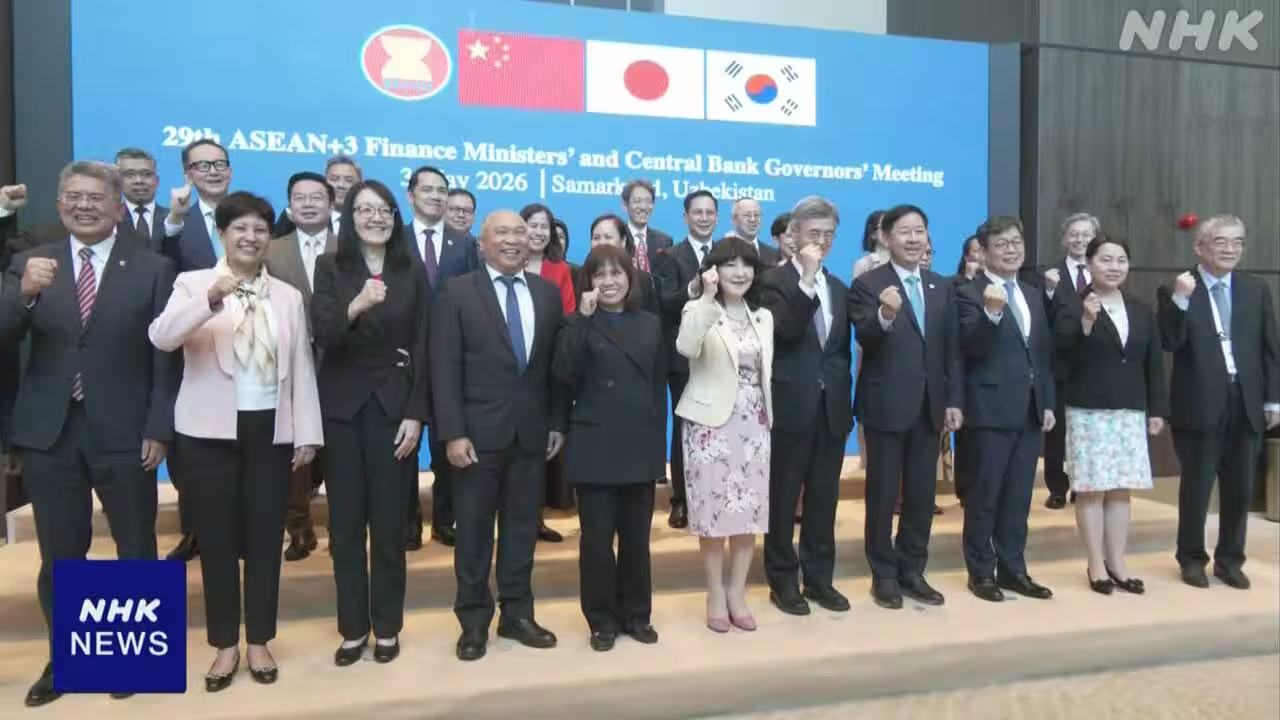
Finance ministers and central bank governors from Japan, China, South Korea, and the ten ASEAN member states convened on 4 May 2026 to address mounting economic risks in the Indo-Pacific region. The high-level gathering, which brought together key policy decision-makers from the ASEAN+3 grouping, focused specifically on the potential for economic slowdown and inflationary pressures driven by the ongoing situation in Iran.
The primary objective of the meeting was to assess the impact of external shocks on regional stability. Officials noted that the situation in Iran has created significant uncertainty regarding economic indicators, prompting a coordinated response from the finance and central banking sectors. While the source material does not detail specific quantitative data regarding the slowdown or inflation, the consensus among attendees was that the region requires a unified approach to mitigate these emerging threats.
In response to these challenges, the participants issued a joint statement reaffirming the critical importance of regional unity and cooperation. This declaration serves as a formal affirmation of the collective resolve to maintain economic stability despite the volatile external environment. The statement highlights that the ASEAN+3 framework remains a vital mechanism for policy coordination among the involved nations.
The involvement of both finance ministers and central bank governors signals a high-level commitment to addressing these macroeconomic concerns. By engaging at this senior level, the ASEAN+3 grouping aims to ensure that policy responses are robust and aligned across member states. This structural engagement underscores the recognition that individual national strategies may be insufficient to counteract the broader regional risks posed by the Iran situation.
The meeting builds upon ongoing discussions noted on 3 May 2026, which also addressed the Iran situation alongside other regional economic issues. The progression from earlier talks to this formal declaration of unity suggests a deepening of the policy dialogue within the forum. The focus remains firmly on governance and institutional cooperation rather than specific performance metrics, reflecting a cautious but determined stance toward future economic management.
Ultimately, the joint statement serves as a reminder of the interconnected nature of the regional economy. As the ASEAN+3 grouping continues to navigate these complex risks, the emphasis on unity provides a foundational framework for future policy actions. The commitment to cooperation established during this meeting will likely guide the collective response to inflation and slowdown risks in the coming months.