Experts warn AI-generated historical videos distort reality with modern biases
Scholars from the University of Zurich and University of Hamburg caution that generative tools like Veo reproduce stereotypes rather than historical truth, urging critical source analysis to combat misinformation.
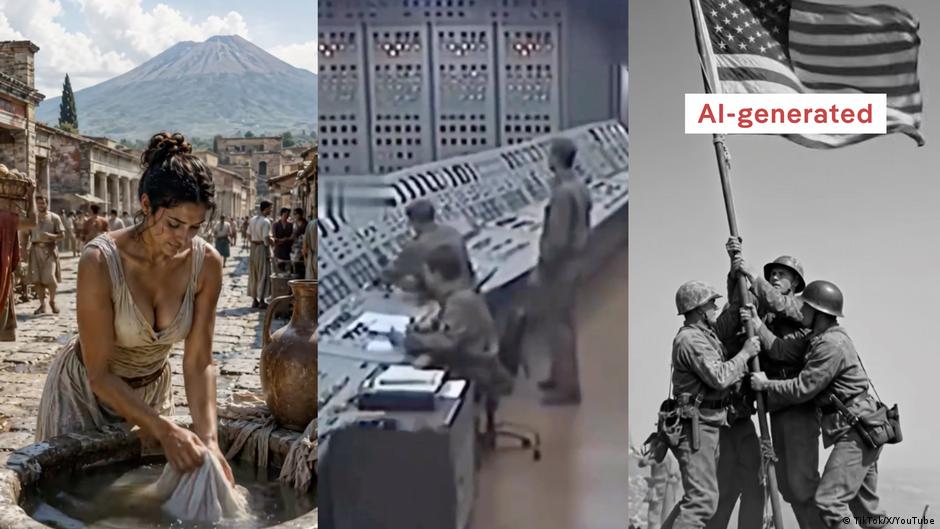
Deutsche Welle has published a fact-check analysis addressing the proliferation of viral artificial intelligence-generated videos that falsely claim to depict historical events. The report highlights specific synthetic clips, including reconstructions of the 1945 Iwo Jima flag-raising, the 1986 Chernobyl disaster, and the eruption of Pompeii in 79 C.E. Experts from the University of Zurich and the University of Hamburg warn that these tools, such as Veo, do not retrieve authentic footage but instead generate synthetic imagery that often reflects modern biases and technical artefacts.
The analysis underscores the growing challenge of distinguishing genuine historical records from AI fabrications, noting that while image manipulation has historical precedents, AI enables fabrication at an unprecedented scale. Roland Meyer, a media scholar at the University of Zurich, described the trend as a "deceptive promise." He noted that while AI can recombine images to fill perceived gaps in the archive, the resulting synthetic images primarily reproduce typical patterns, clichés, and stereotypes of the past rather than offering an accurate window into history.
DW Fact check identified several specific examples to illustrate these risks. A video purportedly showing Pompeii in 79 C.E. was discredited on the basis that video technology did not exist at the time. The clip also displayed clear signs of AI generation, including "zombie-like" movement and modern appearances for the subjects. Similarly, a video claiming to show CCTV footage of the Chernobyl disaster was confirmed as AI-generated, with no authentic footage available from that specific moment.
Another viral clip, based on the iconic 1945 photograph of US soldiers on Iwo Jima, was identified as being produced by the generative AI tool Veo. The video lacks authentic documentary footage and instead resembles a Hollywood film, featuring unnatural glitches and a watermark identifying its synthetic origin. Historian and AI specialist Sebastian Kubon advised viewers to simply ask whether video technology existed during the depicted era, a question that immediately exposes the fabrication.
Jürgen Zimmerer, an Africa history professor at the University of Hamburg, warned that visual sources have always been controversial and subject to manipulation by regimes. However, he emphasised that the current difference lies in the scale at which AI can generate altered and completely fabricated scenes. The experts urged the public to consult reputable archives, museums, and academic experts, and to critically analyse the source, presenter, and intent behind such images to avoid mistaking algorithmic approximations for historical truth.