Curiosity Rover Releases High-Resolution Image of Rock Freed After Drill Incident
NASA's Curiosity rover has published new imagery of a rock nicknamed 'Atacama' following a mechanical snag that required several days of robotic arm repositioning and vibration to resolve.
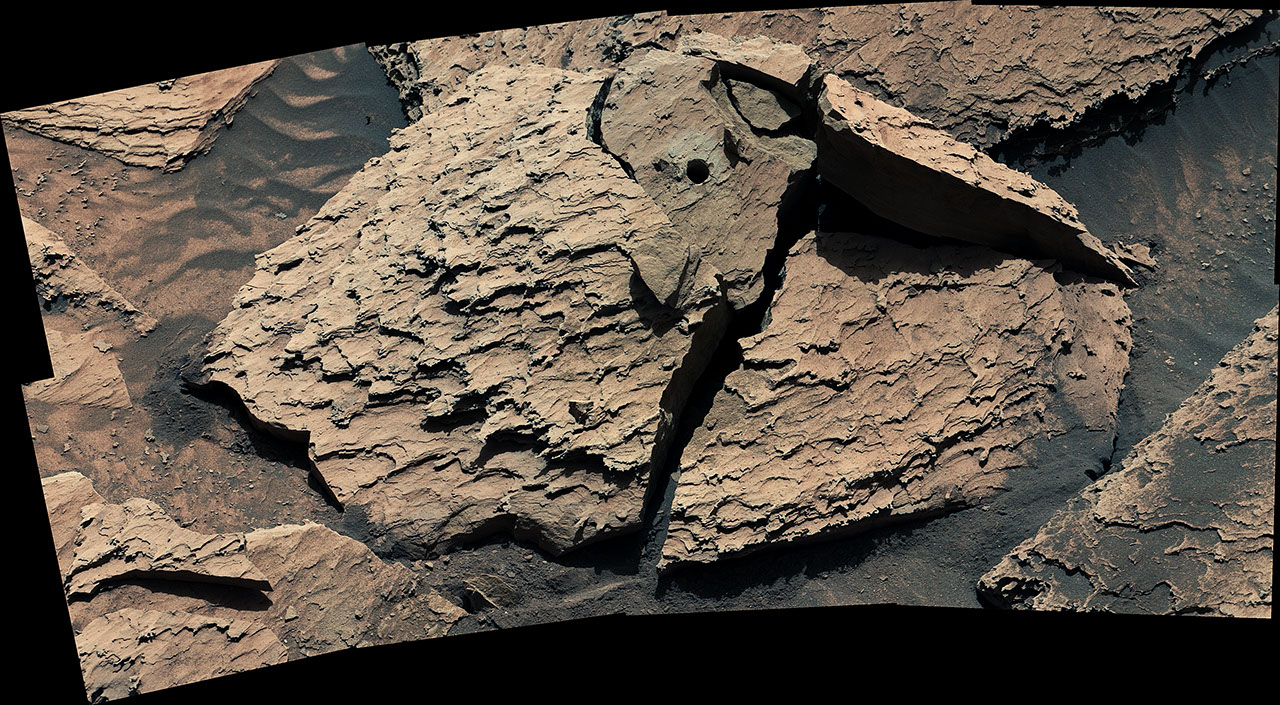
NASA's Curiosity Mars rover has released a high-resolution image of a rock it nicknamed 'Atacama', marking the successful conclusion of a mechanical incident involving the vehicle's drilling apparatus. The rock, which had become lodged in the drill on April 25, was finally detached on May 1 after engineers spent several days repositioning the robotic arm and vibrating the tool to dislodge it.
The newly published image, dated May 6, 2026, is a mosaic composed of eight individual photos stitched together. To aid public understanding, the colour balance of the composite has been adjusted to resemble Earth daylight conditions, providing a clearer view of the specimen than the raw data would allow. The rock is estimated to be approximately 1.5 feet in diameter at its base and six inches thick, with a circular hole clearly visible where the drill bit made contact.
According to mission data provided by the Jet Propulsion Laboratory, the rock would weigh roughly 28.6 pounds, or 13 kilograms, on Earth. Given the lower gravity on the Red Planet, the mass of the stone translates to roughly one-third of that weight in the Martian environment. These dimensions and mass estimates are critical for scientists analysing the geological context of the site where the rover is currently operating.
The Curiosity rover was built by NASA's Jet Propulsion Laboratory, which is managed by Caltech in Pasadena, California. JPL leads the mission on behalf of NASA's Science Mission Directorate as part of the Mars Exploration Program portfolio. The imaging of the freed rock was conducted using the Mastcam instrument, which was built and is operated by Malin Space Science Systems in San Diego.
This event highlights the ongoing challenges and resilience of long-duration planetary exploration. The incident occurred on sol 4,875 of the mission, forcing the engineering team to dedicate significant time to troubleshooting the arm's interaction with the terrain. The successful release of the rock allows the mission to continue its scientific objectives without the obstruction of the debris in the drill mechanism.