Curiosity Resumes Drilling on Mars as Psyche Spacecraft Conducts Flyby
The Curiosity rover has begun drilling operations at a new site named Campo Marte, while simultaneously gathering atmospheric data to assist the Psyche spacecraft during its close approach to the Red Planet.
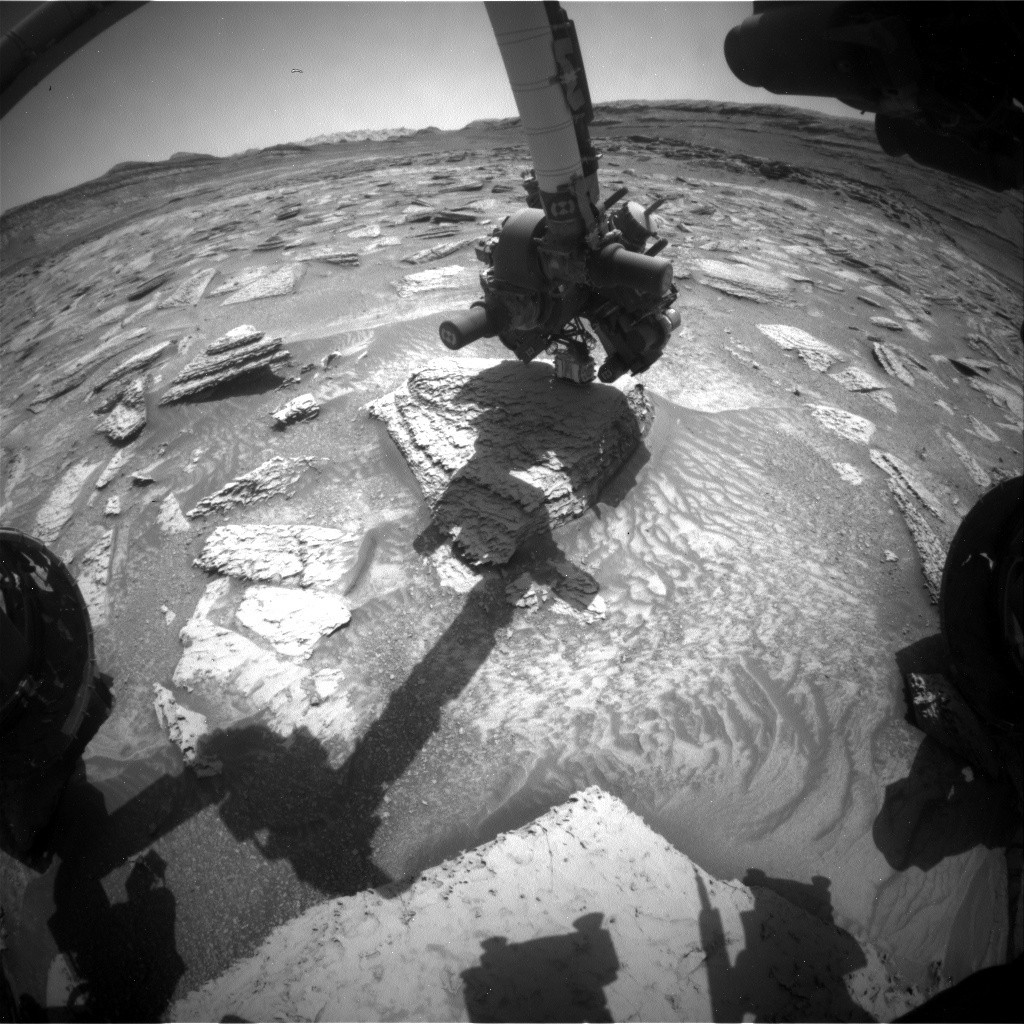
NASA’s Curiosity rover has resumed drilling operations on Mars at a new target designated Campo Marte, located within the same geologic stratum as the previous Atacama site. The target sits in the layered sulfate unit situated above the boxwork structures, continuing the mission’s exploration of this specific Martian terrain. The name Campo Marte, which translates from Spanish as "Field of Mars," honours a natural red sandstone feature in Bolivia, adhering to the team’s convention of naming targets in this quadrangle after locations near the Uyuni region in South America.
Prior to commencing the drill, the mission team characterised the target using the ChemCam Laser-Induced Breakdown Spectroscope (LIBS) and the Alpha Particle X-ray Spectrometer (APXS). Close-up imaging was obtained with the Mars Hand Lens Imager (MAHLI), while additional LIBS rasters provided geochemical data on nearby blocks, including vein and nodule-like features. The team also noted that the Campo Marte block is substantially thicker than the Atacama block, a physical characteristic the team hopes will prevent the rock from lifting off the ground during drilling, thereby allowing for the normal withdrawal of the drill bit.
The decision to proceed with drilling at Campo Marte follows a previous operation involving the Atacama block, which required the rover’s arm to be freed from the rock. While the team collected interesting data regarding the volume and density of the Atacama block during that incident, they have stated there is no intention to repeat that particular experiment. The focus now remains on standard drilling procedures at the new site, with the expectation that the greater mass of the Campo Marte block will facilitate a smoother operation.
Concurrently with the drilling activities, Curiosity supported the Psyche spacecraft during its close flyby of Mars. Psyche is utilising the planet’s gravity to gain a boost on its journey to the main asteroid belt, with its ultimate destination being 16 Psyche, one of the largest members of an unusual spectral category of asteroids that has not yet been visited by a spacecraft. Although the asteroid is expected to be scientifically distinct from Mars, the flyby provided a valuable opportunity to exercise Psyche’s instruments and data analysis pipelines.
To assist in validating Psyche’s instruments, the Curiosity team coordinated a set of atmospheric observations timed with the flyby. These included a zenith movie captured by the Navigation Camera (Navcam) to document clouds, and a solar observation using the Mastcam to measure atmospheric opacity. The Mastcam observations were supported by a fresh set of calibration data. These efforts, combined with coordinated observations from Mars orbiters and the Perseverance rover, are intended to contribute to the broader instrument validation effort for the Psyche mission.
The activities detailed in this update were reported by Lucy Lim, a Planetary Scientist at NASA Goddard Space Flight Center, in a blog post published on Earth planning date Friday, May 15, 2026. The report covered operations conducted during Sols 4893 to 4899 of the Mars Science Laboratory mission.