Cockroach Janata Party stages first street protest in New Delhi
Leader Abhijeet Dipke returns to India as hundreds of supporters gather at Jantar Mantar to demand the resignation of Education Minister Dharmendra Pradhan following exam irregularity controversies.
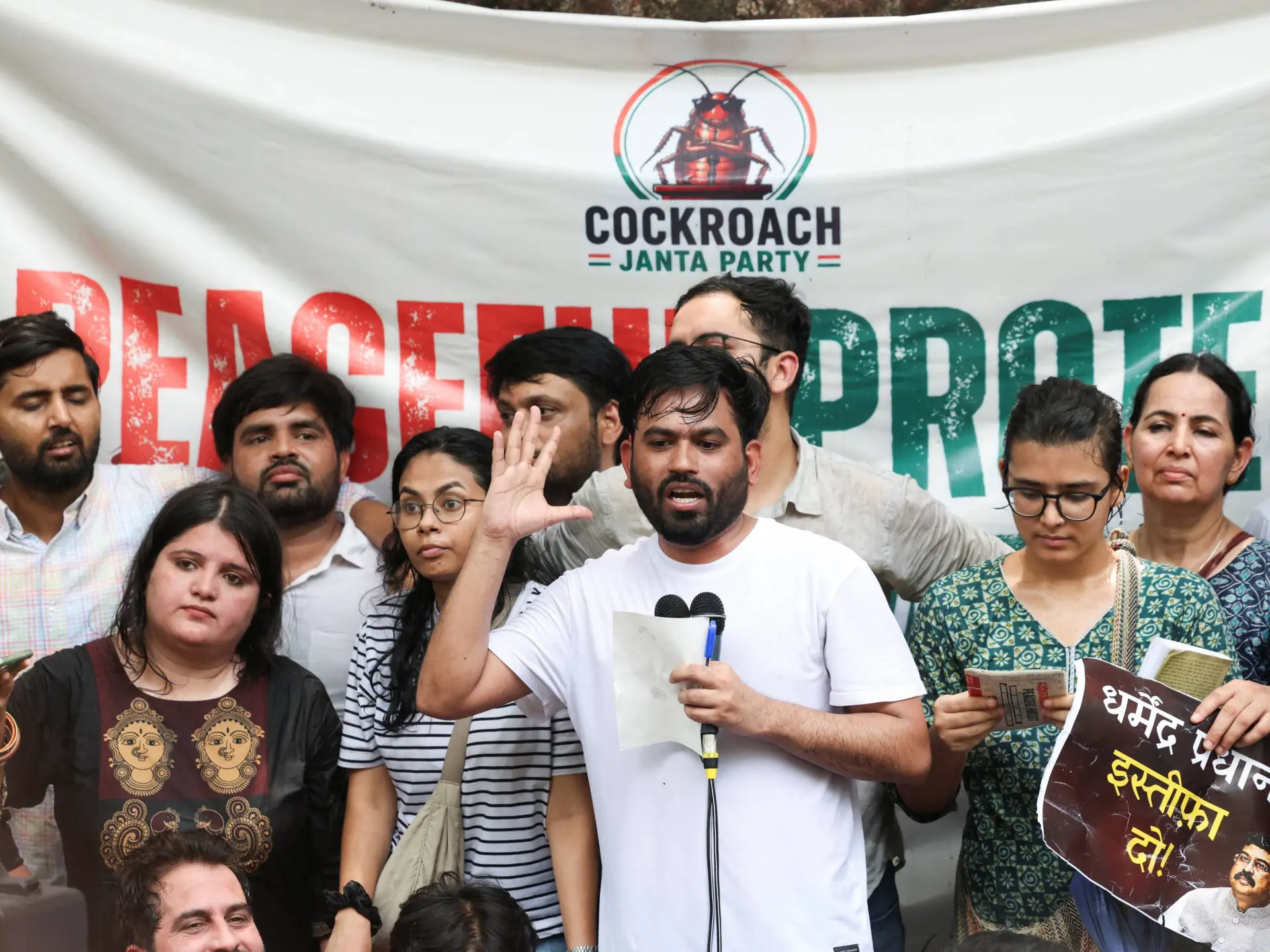
The leader of the Cockroach Janata Party (CJP), Abhijeet Dipke, has returned to India to lead the movement’s first physical street protest in New Delhi. The demonstration took place on Saturday at Jantar Mantar, a historic astronomical observatory located near the Indian Parliament, marking a significant shift for the group from online activism to grassroots mobilisation.
Hundreds of mostly young supporters attended the rally, with many participants wearing cockroach masks. The gathering represents the first time the party has moved beyond its digital presence to engage in physical street politics. The CJP emerged approximately three weeks prior to the event as a parody political party, rapidly amassing over 15 million Instagram followers within a week of launching its website.
The immediate catalyst for the protest was a controversy surrounding exam irregularities that emerged in May, involving Education Minister Dharmendra Pradhan. The rally was organised specifically to demand the minister’s resignation, reflecting the group’s focus on specific governance failures rather than broad ideological campaigning.
The party’s name and symbol were inspired by a hearing in May where India’s Chief Justice Surya Kant likened critics and some unemployed youth to cockroaches. The CJP has adopted the insect as a symbol of endurance, blending self-deprecation with political satire to critique the political establishment. This strategic use of irony has allowed the movement to garner significant attention among Gen Z voters.
The demonstration served as a real-world test of the group’s ability to channel its substantial digital momentum into tangible political pressure. While the party has seen explosive growth on social media, the physical turnout in New Delhi provides the first empirical data on its capacity to organise and sustain a traditional political protest.
The source material does not specify the exact date of the protest beyond it occurring on Saturday, nor does it provide a precise figure for the number of attendees, describing the crowd only as "hundreds." Similarly, while the demand for the Education Minister’s resignation is clear, the specific broader demands of the party are not detailed in the available records.
The Cockroach Janata Party’s emergence highlights a growing trend of satirical political engagement among younger demographics in India. By leveraging social media platforms to bypass traditional media gatekeepers, the movement has created a parallel political narrative that challenges conventional forms of political discourse and institutional authority.