China retains economic stranglehold on North Korea despite Russia arms boom
New data reveals that while arms sales to Russia have generated billions for the regime, China’s control over essential imports and the majority of legal trade continues to dictate Pyongyang’s economic and diplomatic posture.
North Korea’s economy remains overwhelmingly tethered to China, which accounts for up to 95% of the country’s legitimate trade and 85% of its exports, according to the Washington-based think tank The National Committee on North Korea. Despite a recent surge in revenue from arms supplies to Russia, Beijing retains enormous economic clout over Pyongyang by controlling the flow of essential imports, including petroleum, food, machinery, and electronics.
In 2024, North Korea’s legitimate imports totalled $2.33 billion, a figure that underscores the regime’s reliance on Chinese deliveries to keep its centrally planned economy functioning. With no domestic oil production, these supplies are critical for maintaining basic industrial and civilian operations. This dependency provides China with significant leverage over North Korean leader Kim Jong Un, a dynamic that US President Donald Trump is reportedly attempting to exploit to bring Pyongyang back to nuclear negotiations.
The regime’s legal export base is similarly constrained and modest. According to the Korea Trade-Investment Promotion Agency (KOTRA), North Korea’s legitimate exports reached only $360 million in 2024. Fake hair and wigs constitute approximately 40% of this volume, largely destined for China for re-export globally. This niche sector emerged after United Nations sanctions imposed in 2017 blocked traditional revenue streams such as coal and minerals, leaving the state to rely on low-tech, labour-intensive industries.
Beyond legal trade, the North Korean state has developed a sophisticated shadow economy to generate hard currency. Overseas workers, many deployed in Russia and China, contribute around $500 million annually, while cyber operations and remote IT work brought in $800 million in 2024. North Korean hackers also stole a record $2.02 billion in cryptocurrency last year, accounting for over half of global digital currency theft, according to blockchain intelligence firm Chainalysis.
However, the most significant financial lifeline has come from military cooperation with Moscow. South Korea’s Institute for National Security Strategy estimates that supplies of artillery shells, rockets, and ballistic missiles to Russia have generated between $7 billion and $13.8 billion for Pyongyang since 2023. These revenues are reportedly being used to accelerate the North’s nuclear and ballistic missile programmes and to purchase additional oil and food from China.
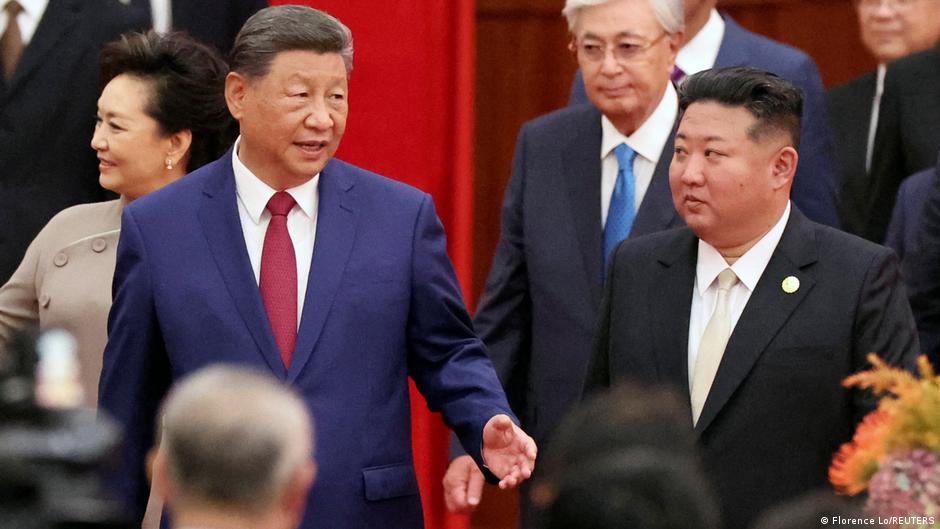
Amidst this complex economic web, Chinese President Xi Jinping is expected to visit Pyongyang in the coming weeks. Beijing has not yet confirmed the trip, but reports suggest Xi will act as a mediator between Kim Jong Un and Donald Trump regarding the stalled nuclear talks. The visit highlights China’s continued role as the primary gatekeeper for North Korea’s international engagement, even as the regime seeks to diversify its revenue sources through illicit activities and Russian military contracts.
North Korea’s 2024 GDP was recorded at $26.6 billion, roughly 70 times smaller than South Korea’s $1.86 trillion economy. Since the imposition of UN sanctions in 2017, Pyongyang has lost approximately $2.2 billion annually in export revenue, further entrenching its dependence on China and its own shadow economy to sustain the regime.