China challenges US AI dominance with open-source push at Shanghai summit
Experts say Chinese firms are leveraging lower costs and grey market hardware to keep pace with American innovation, while the new World AI Cooperation Organization seeks to win Global South support.
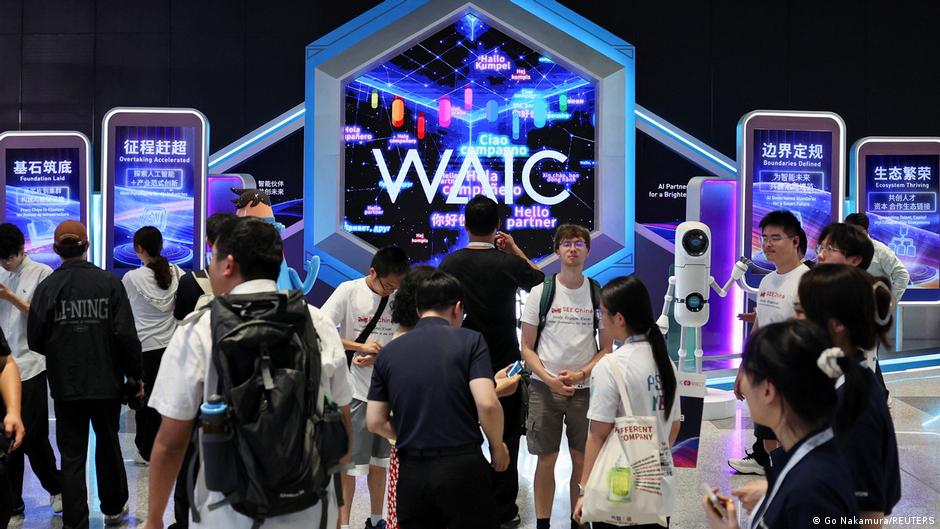
Chinese President Xi Jinping used his keynote address at the World Artificial Intelligence Conference in Shanghai to champion a vision of open-source and inclusive artificial intelligence, signalling Beijing’s intent to lead global standards and counter United States dominance. While Xi did not explicitly name Washington, his criticism of the “overextension of the concept of national security” was interpreted as a direct challenge to American export controls and closed-source ecosystems. The speech underscored China’s ambition to position itself as the primary advocate for a new AI order, particularly among nations in the Global South.
Analysts indicate that China is steadily narrowing the technological gap with the United States in large language model development. Experts from Leiden University and the DGA-Albright Stonebridge Group note that Chinese developers are maintaining global competitiveness by training open-weight models on limited but advanced hardware. Recent benchmark tests of models such as GLM-5.2 and Kimi K3 suggest the performance disparity has largely disappeared for many applications, with Chinese offerings often proving cheaper to run and capable of handling most commercial tasks.
Despite the US Commerce Department’s expansion of export controls in January 2025, which has impacted domestic chip manufacturing at scale, progress in Beijing has not halted. Research from Gavekal Research highlights that while the controls have restricted cheap, large-scale production, significant volumes of advanced chips continue to enter China via the grey market. Furthermore, Chinese firms retain access to overseas cloud computing resources, leading experts to conclude that the US strategy of slowing Chinese AI development has failed at many levels while causing collateral damage to American supply chains.
The diplomatic dimension of this competition was highlighted by the announcement of the World AI Cooperation Organization (WAICO), which has attracted 29 member countries. Xi described the initiative as a response to calls from developing nations for greater involvement in AI governance, positioning it as a counterweight to the US-led “Pax Silica” framework aimed at securing critical mineral and AI supply chains. By promoting open-weight models released under permissive licenses, Beijing hopes to create overseas markets for its technology and ensure its models become the standard for international deployment.
Experts suggest the real contest lies in which technological stacks are adopted by the Global South. China holds a structural advantage in AI diffusion due to lower costs and extensive digital infrastructure already established by companies such as Huawei across developing countries. However, challenges remain, including a lack of trust from the Global North and ongoing hardware shortages that limit inference capacity. As one academic noted, the rise of China’s AI sector represents the emergence of a non-Western technological superpower, pointing toward a future defined by overlapping technological networks rather than a single global sphere.