Chandra Observatory identifies candidate supernova remnant near Galactic Centre
Astronomers using NASA’s Chandra X-ray Observatory have found a possible supernova remnant in the central region of the Milky Way, a discovery that could offer new insights into the chemical enrichment of the galaxy’s core.
Astronomers have identified a candidate supernova remnant in the dense central region of the Milky Way galaxy, relying on data gathered by NASA’s Chandra X-ray Observatory. The finding, announced on 22 June 2026, is based on observations conducted on 11 June 2026. If the identification holds up to further scrutiny, the object would rank as one of the closest known supernova remnants to the supermassive black hole at the Galactic Centre.
Supernova remnants represent the expanding debris fields left behind after massive stars explode. These events play a critical role in galactic evolution by dispersing essential elements such as iron, oxygen, and silicon into the surrounding space. These materials are fundamental components for the formation of planets and the development of life as we know it.
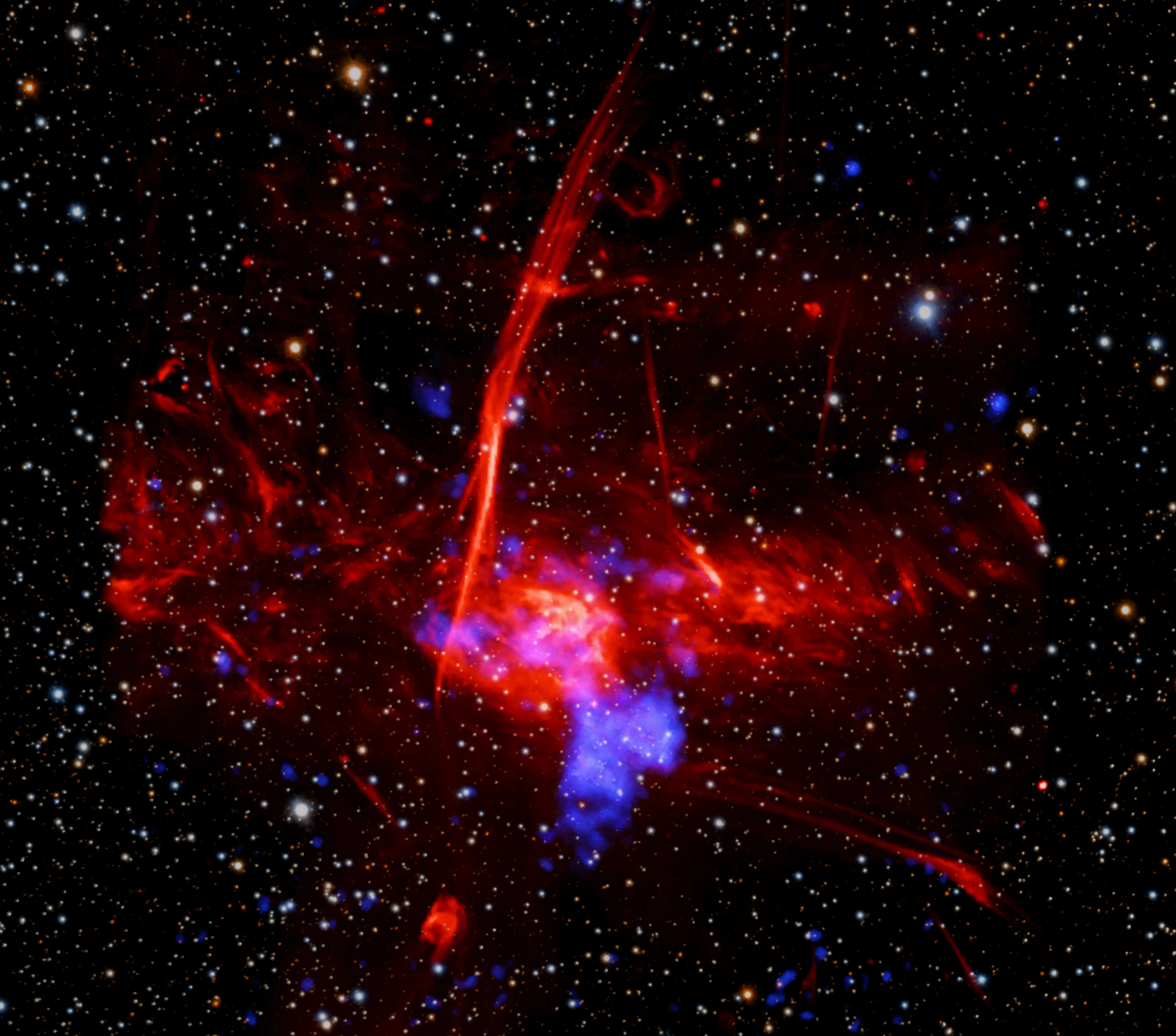
The candidate remnant is located in an exotic environment characterised by massive stars, dense clouds of gas orbiting rapidly, and long threads of strong magnetic fields. This complex setting makes the identification of such objects challenging, yet it provides a unique laboratory for studying how stellar explosions influence their immediate surroundings.
The identification of this object relies on a combination of multi-wavelength data. In addition to X-ray observations from Chandra, researchers utilised data from ESA’s XMM-Newton. The analysis also incorporated optical imagery from PanSTARRS, radio data from MeerKAT, and infrared observations from the James Webb Space Telescope (JWST).
While the discovery is significant, NASA and the research team describe the object as a "possible" or "candidate" supernova remnant. Confirmation is pending further analysis to verify its exact distance and physical properties relative to the Galactic Centre. The image released alongside the announcement, dated 11 June 2026, illustrates the data sources used in the study, including contributions from NASA/CXC/UCLA/Z. Zhu et al., ESA/XMM-Newton, and image processing by NASA/CXC/SAO/L. Frattare and P. Edmonds.