BepiColombo enters final approach to Mercury after eight-year journey
The ESA-led mission has jettisoned its propulsion module ahead of scheduled orbital insertion around Mercury on 21 November.
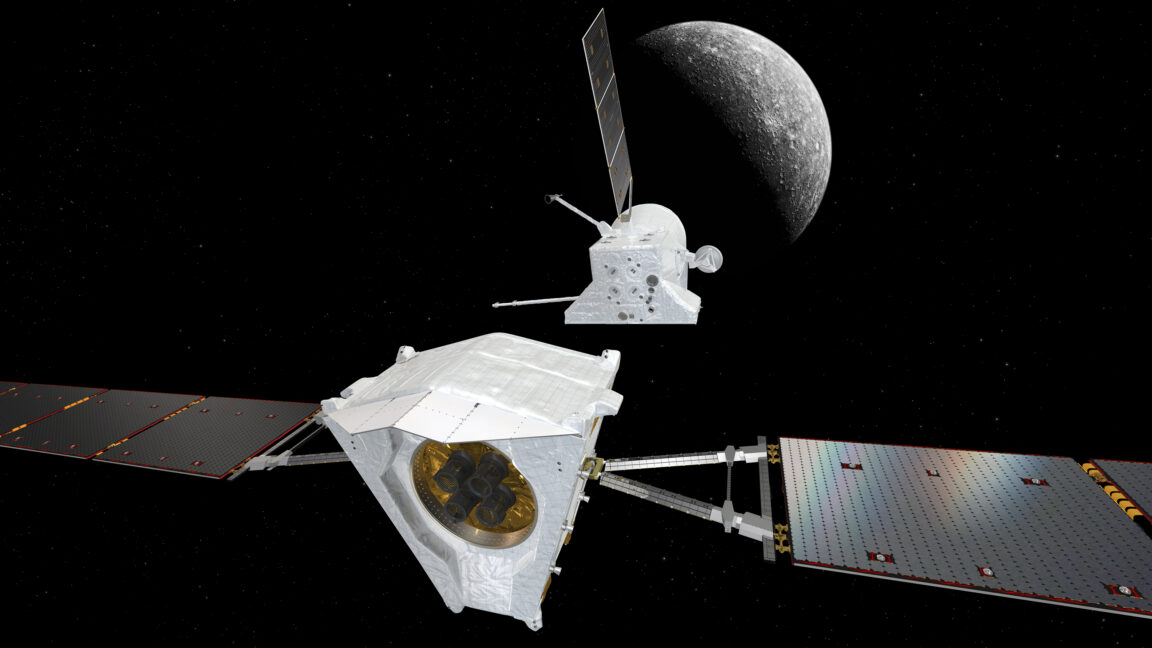
The European Space Agency’s BepiColombo mission has reached a major milestone after separating its Mercury Transfer Module during the final stage of an eight-year journey to the Solar System’s innermost planet.
The European and Japanese orbiters remain connected and are scheduled to enter orbit around Mercury on 21 November. They are expected to separate from each other in December, with routine science observations planned to begin in April 2027, provided the arrival sequence proceeds as intended.
BepiColombo launched in 2018 and has travelled more than 10 billion kilometres using electric propulsion and nine planetary flybys. Its ion thrusters lost partial power in 2024, extending the mission’s cruise by about a year.
The transfer module provided propulsion and power during the voyage but was no longer required before orbital insertion. Early telemetry indicated positive power margins and confirmed that the European orbiter’s solar arrays were recharging its batteries after separation.
The separation took place about 63 million kilometres from the Sun, where the spacecraft faces extreme temperatures and intense radiation. The orbiter must now manage its own power generation, propulsion, pointing and thermal control.
The mission, led by ESA with contributions from Japan and the United States, will study Mercury’s surface and composition, as well as its magnetic fields, plasma and dust. Ars Technica reported that scientists also hope to investigate whether permanently shadowed polar craters contain water ice.