Baltops exercise scaled back as US priorities shift and Kremlin explores Bering Sea tunnel
Washington’s drawdown and shifting geopolitical focus coincide with Russia’s economic forum and unusual diplomatic overtures, raising questions about alliance cohesion.
NATO’s annual “Baltops” exercise is currently underway in the Gulf of Riga and the Baltic Sea, stretching south to Skagen, Denmark, yet the operation is notably smaller than in previous years. The drill, which involves 20 ships, approximately 6,000 troops, and participation from 16 nations, is conducting anti-submarine warfare drills, amphibious landings, and maritime drone operations. However, the exercise features half the usual number of ships, a reduction attributed primarily to a significant drawdown of United States naval assets.
Military analysts indicate that the scaled-back nature of the exercise reflects Washington’s changing priorities and a worldview that has moved away from the European arena. Nearly half of the US deployed warships are currently stationed in the Persian Gulf. This strategic shift is compounded by President Trump’s consistent criticism of NATO allies on social media, specifically targeting their failure to immediately assist in his war against Iran and their objections to his proposal to annex Greenland.
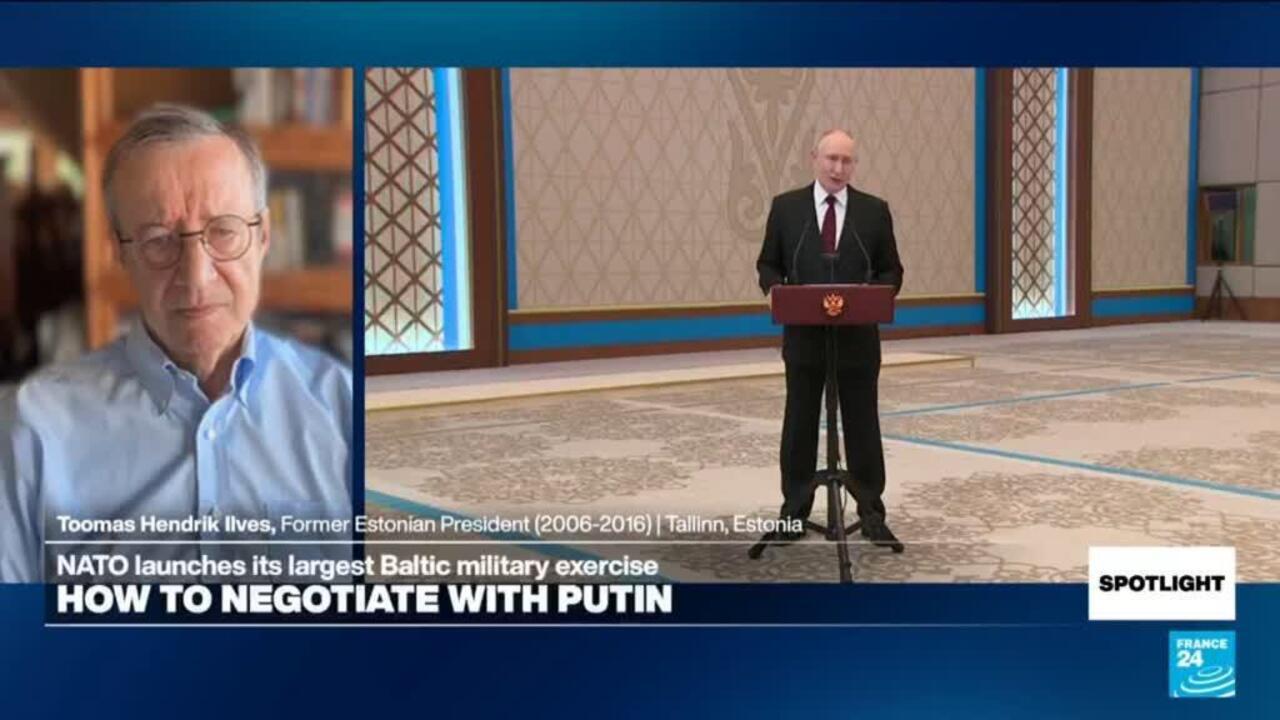
Amidst these tensions, Estonia’s former President Toomas Hendrik Ilves, who served a decade in office between 2006 and 2016, is providing commentary on strategies for dealing with Russian President Vladimir Putin. Ilves’ insights are being delivered against the backdrop of the ongoing alliance exercise, which is one of NATO’s most significant annual drills and the oldest, having started in 1972. The alliance is currently working on deterrence strategies against a possible threat from Moscow.
Concurrently, Russia is concluding its St Petersburg economic forum, where Kremlin officials have reportedly discussed a vague potential deal or memorandum of understanding to construct an underwater tunnel linking Russia to the US under the Bering Sea. This unusual diplomatic overture occurs against a backdrop of heightened geopolitical tensions, including recent Russian drone incursions into Romanian airspace in late May 2026, which prompted Romanian authorities to scramble F-16 jets and evacuate residents.
The current geopolitical landscape also sees the United Kingdom Prime Minister Keir Starmer hosting Ukrainian President Volodymyr Zelenskyy, French President Emmanuel Macron, and German Chancellor Friedrich Merz for a strategy summit on Ukraine. The gathering aims to coordinate continued international support as the conflict with Russia enters a new phase of heightened intensity, underscoring the complex diplomatic and military challenges facing Western nations.