Authors urge international pressure to break cycle of violence in Middle East
The Israeli-Palestinian duo argues that political leaders on both sides lack the imagination to envision peace, calling on Europe and the United States to leverage economic influence to force dialogue.
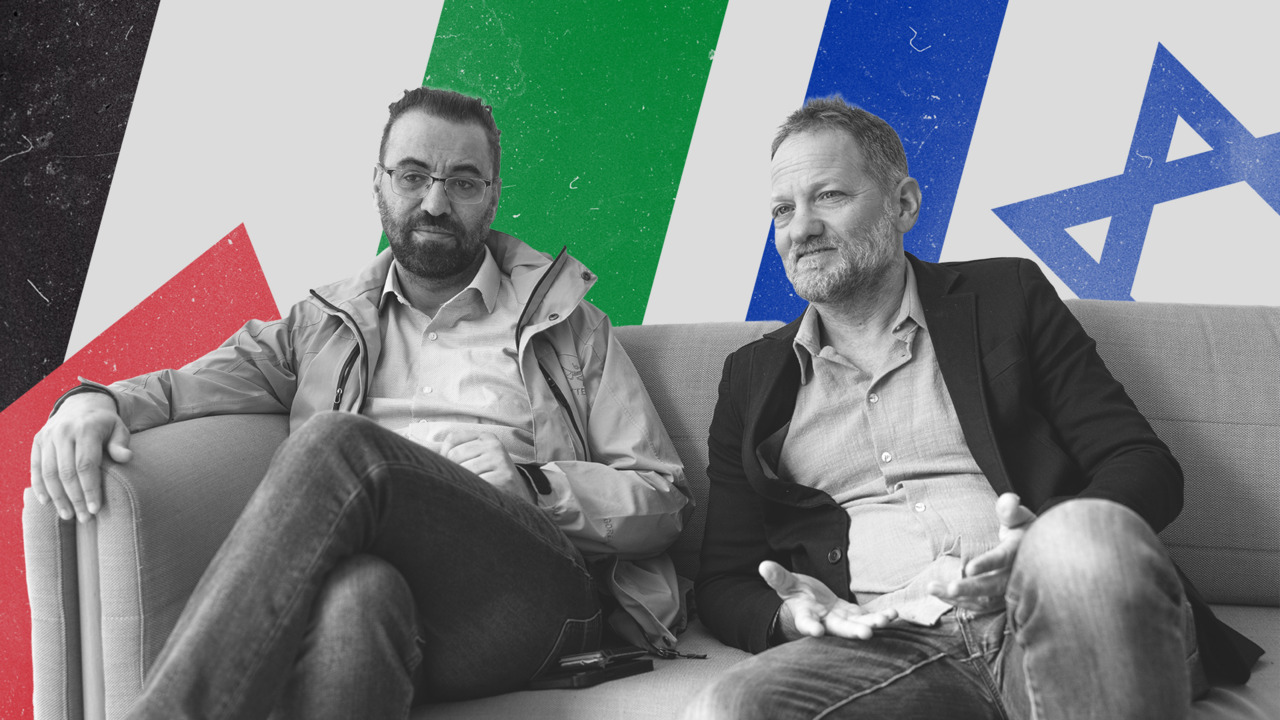
Israeli and Palestinian authors Aziz Abu Sarah and Maoz Inon have released a new book titled "The Future is Peace: A Shared Journey Across the Holy Land," urging international communities to apply pressure on political leaders to end the cycle of violence. Published in April 2026, the work draws on the authors’ shared experience of bereavement following the October 7 attacks, arguing that segregation fuels hate and that current governance models are failing to secure a future for their populations.
Abu Sarah, a Palestinian from East Jerusalem, and Inon, an Israeli from a kibbutz near Gaza, met professionally prior to the 2023 attacks but deepened their partnership after Inon sent a condolence message to Abu Sarah following the death of Inon’s parents, Yakovi and Bilha Inon, who were killed in Netiv HaAsara. The authors contend that the prevailing political narratives on both sides are driven by tribalism and fear, with leaders lacking the imagination to envision a reality beyond war.
Citing poll data, the authors note that over 70 per cent of Israelis and more than 80 per cent of Palestinians desire regional peace, suggesting that the current trajectory is not reflective of public sentiment. They argue that settlers and militant groups have marginalised moderate voices, and that passive resistance is insufficient to counter acts such as settlers attacking Palestinian farmers during harvests. Instead, they advocate for active, visible participation by citizens to challenge the status quo.
The book specifically targets the United States and European nations, highlighting a disparity in foreign policy engagement. Inon states that the United States provided more than $20 billion in weapons to Israel in 2026 while cutting funding for peacemaking initiatives to zero. He argues that Europe, despite being Israel’s primary economic partner, exerts minimal leverage, describing its contributions as negligible. The authors call on these powers to use their diplomatic and economic weight to force Israelis and Palestinians into dialogue.
Abu Sarah and Inon also warn of the global repercussions of the conflict, pointing to recent anti-Semitic attacks in the UK and US, as well as anti-Muslim protests in the UK, as evidence that the violence is endangering diaspora communities worldwide. They caution against the misconception that political changes in Israel, such as potential coalition shifts, will automatically resolve the issue, emphasising that the problem is entrenched in state policy rather than individual leadership.
With Israel having taken control of over 60 per cent of Gaza’s land and seeking to expand influence in the West Bank, the authors describe the situation as an emergency. They argue that ethnic cleansing and military expansion are the current realities, and that waiting for electoral cycles is no longer a viable strategy. The publication arrives amidst heightened regional instability, including a fragile ceasefire between Iran and Israel in early 2026 and subsequent strikes in May.
The authors stress that peace cannot be achieved through bombs or war, but requires a unified stand from Jewish and Muslim communities in Europe and the US to support peacemakers. They acknowledge the dangers faced by activists, with Abu Sarah noting he was attacked by both Israeli and Palestinian governments when he ran for Jerusalem mayor. Despite these risks, they maintain that giving up is not an option, urging citizens to create a new reality through sustained, collective action.