Artemis II crew captures rare moonlit Earth image en route to the Moon
NASA scientists say the image, taken from the Orion spacecraft after translunar injection, offers a unique perspective on Earth’s interaction with the solar system and human activity.
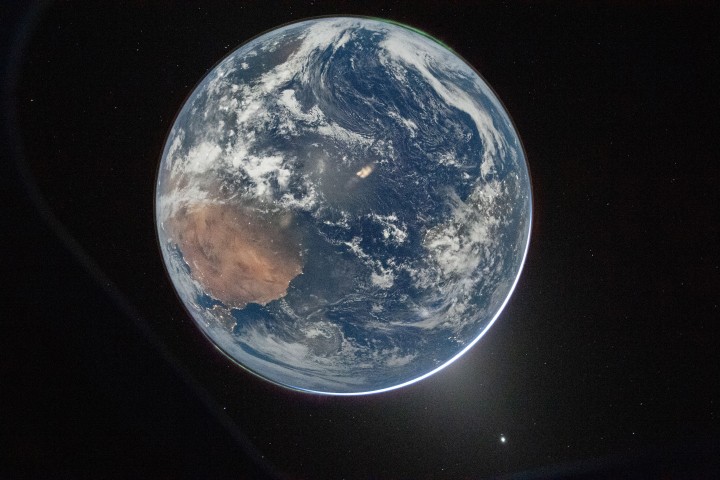
An astronaut aboard the NASA Artemis II mission has transmitted a full-disk image of Earth illuminated by moonlight, capturing the planet’s night side against a backdrop of celestial phenomena. Taken from the Orion spacecraft shortly after it completed its translunar injection burn, the photograph provides a rare view of Earth eclipsing the Sun, with only a sliver of solar light visible around the bottom right edge.
The image reveals city lights across Spain, Portugal, northern Africa, sub-Saharan Africa and Brazil, alongside green auroras near the north and south poles. Zodiacal light, a fuzzy glow caused by sunlight reflecting off interplanetary dust, appears to the lower right of the planet, while Venus is visible as a bright object in the same quadrant. The crew utilised a camera ISO setting of 51,200 to capture these low-light details, a significant increase from the standard daytime setting of 100 or 200.
NASA scientists have described the image as scientifically valuable for illustrating Earth’s interaction with the solar system and human activity. Cindy Evans, senior exploration scientist at NASA’s Johnson Space Center, was one of the first people on Earth to view the image and noted its depiction of Earth as a dynamic planet interacting with the solar wind.
Miguel Román, Deputy Director for Atmospheres and Data Systems at NASA’s Goddard Space Flight Center, highlighted the image’s relevance to his research into artificial light at night. He stated that the photograph underscores the complexity of Earth science and serves as a glimpse into future observational capabilities, noting that Earth at night remains visually compelling and scientifically underexplored.
The Artemis II photo stands apart from previous nighttime views, such as those from the Apollo 12 mission or the International Space Station, by presenting a single human-captured full-disk view that includes multiple low-light features simultaneously. The image was prepared for the Earth Observatory by Lauren Dauphin, with the accompanying story by Lindsey Doermann.