American League baseball standings exhibit unprecedented parity as top teams struggle to separate from the pack
As of May 2026, the American League displays an atypical lack of separation between teams, with projections suggesting a tightly clustered finish rather than the traditional hierarchy.
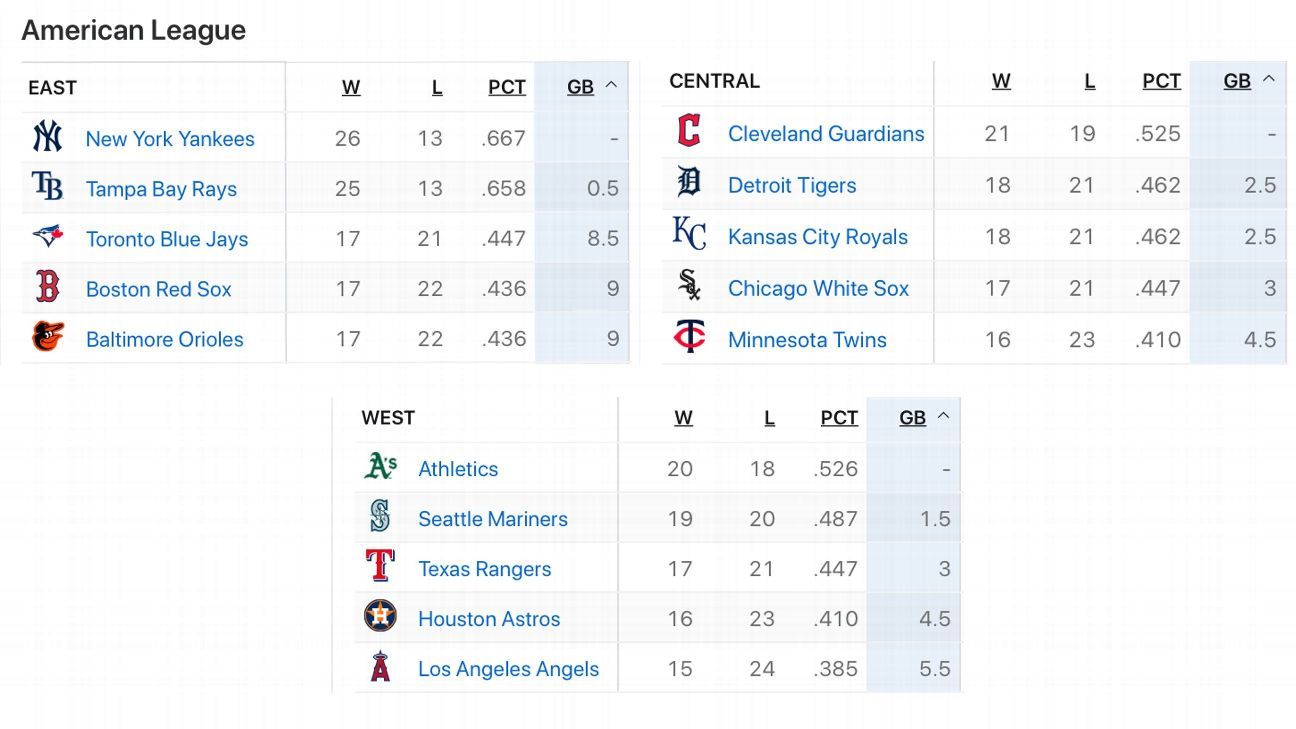
As of May 2026, the American League standings display an atypical lack of separation between teams, with two division leaders only two games over .500 and the league's worst team just three games out of a playoff spot. The Oakland Athletics and Cleveland Guardians currently lead their respective divisions, yet both sit with records of 20-18 and 21-19 respectively. This tight clustering extends to the bottom of the table, where the Detroit Tigers and Seattle Mariners are tied for the final wild-card berth at 18-21.
While the New York Yankees and Tampa Bay Rays are currently on pace for over 100 wins, analysts warn these paces are unlikely to hold. If current winning percentages were to extrapolate to a full 162-game season, 10 of the 15 teams would land in the 68-to-77 win zone. This statistical anomaly results in a current standard deviation of 14.4 wins, a figure that is lower than the previous year's 19.0 but higher than the historical low of 7.2 recorded in 2015.
The current landscape represents a sharp reversal of the 2019 American League dynamic, which featured extreme disparity with three teams winning over 100 games and three losing over 100. In contrast, the 2026 season appears to be moving toward a model of mediocrity rather than parity, where the distinction between elite contenders and average clubs is blurring. Projections indicate that the final win distribution will remain tightly clustered rather than diverging into a wide gap between top and bottom teams.
Consequently, the competitive threshold for postseason qualification has shifted dramatically. Thirteen of the 15 AL clubs currently have at least a 14 per cent chance of making the playoffs, with 11 holding a greater than 20 per cent shot. This scenario suggests that the league is experiencing a period where the mighty National League holds a 23-game edge in interleague play, though analysts note this is likely due to early schedule imbalances rather than a fundamental shift in league talent.
Despite the unusual bunching of records, simulations suggest there is little chance the league will end up with a record level of clustering. Statistical models predict that by the end of the season, the most likely outcome is a return to a more normal dynamic as the effects of the schedule even out. For now, the data indicates that whatever is happening in the American League is going to make for a really fun summer for fans of American League teams.