Al Jazeera analysis traces Hindutva ideology from 1920s origins to current legislative impact
A May 2026 review by Al Jazeera details how a nationalist movement rooted in Vinayak Savarkar’s writings has shaped modern Indian governance, citing recent court rulings and citizenship reforms as evidence of its entrenched influence.
Al Jazeera published an analysis on 22 May 2026 examining Hindutva, a right-wing nationalist ideology distinct from the Hindu religion. The report traces the movement’s origins to Vinayak Savarkar’s 1923 writings and the 1925 founding of the Rashtriya Swayamsevak Sangh (RSS). It outlines the Bharatiya Janata Party’s (BJP) political evolution from the 1980s to Prime Minister Narendra Modi’s 2014 victory. The article highlights legislative measures including the 2019 abrogation of Article 370, the Citizenship Amendment Act (CAA), and the National Register of Citizens (NRC). It also details allegations of violence against religious minorities, citing historical incidents such as the 1999 burning of Australian missionary Graham Staines, the 2002 Gujarat riots, and post-2014 lynching incidents where perpetrators have reportedly faced no punishment.
The analysis notes that on 14 May 2026, the high court in Madhya Pradesh ruled that the Kamal Maula mosque in Dhar was a temple dedicated to a Hindu goddess. Following the ruling, saffron flags associated with Hindu far-right groups appeared at the site, with supporters celebrating and filming rituals. The report frames this event within a broader pattern where far-right activists have made similar claims across the country, emboldened by the BJP’s rise to power.
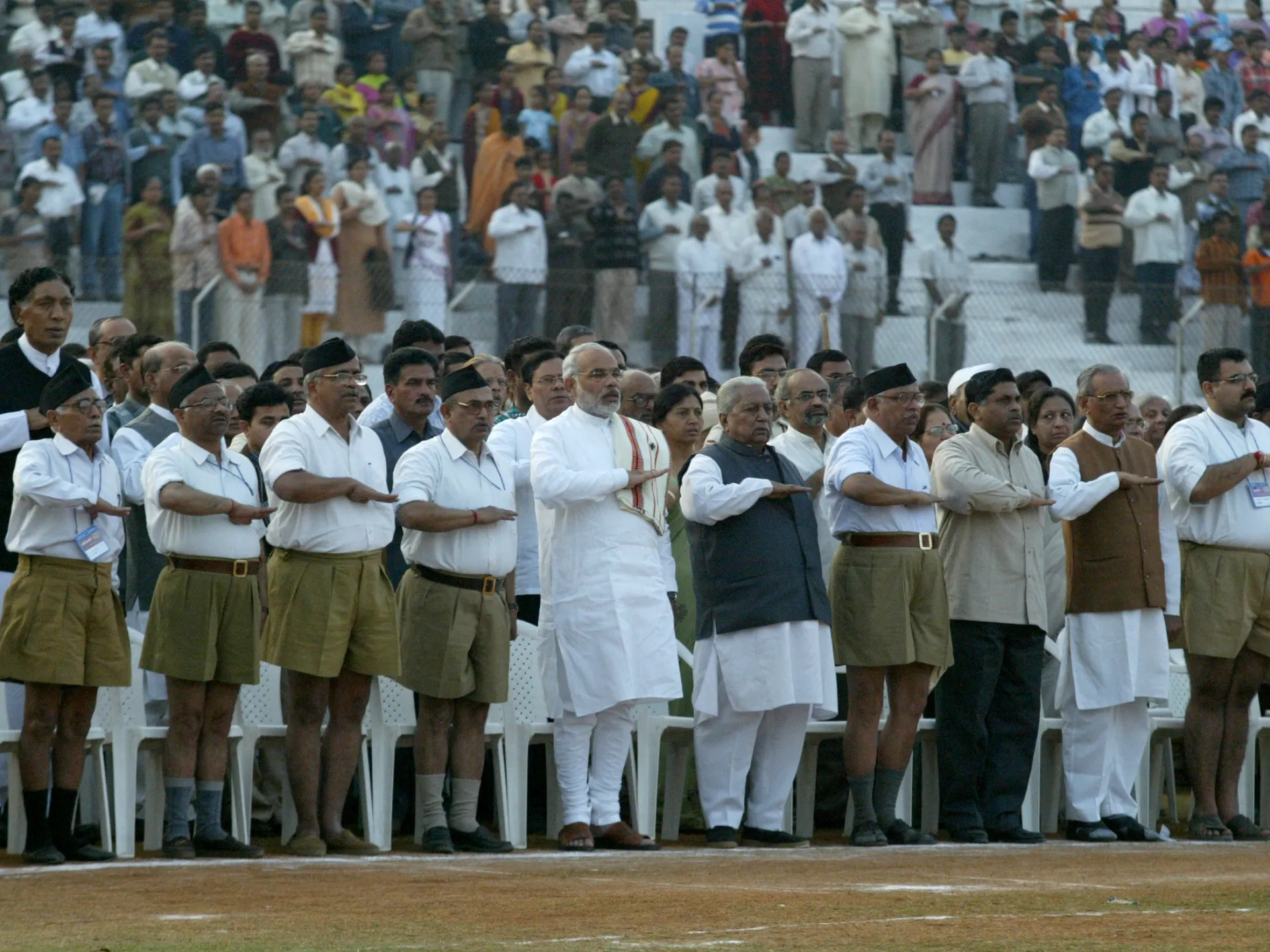
Hindutva is defined in the report as a political ideology that seeks to define Indian national identity through a specific interpretation of Hindu values, despite India being a constitutionally secular state. The movement’s ideological roots are traced to Savarkar’s 1923 pamphlet, *Essentials of Hindutva*, which proposed a vision of Hindu identity based on territory and culture. The RSS, founded in 1925 by Keshav Baliram Hedgewar, evolved into a network of affiliated institutions spanning education, health, and politics, serving as the organisational backbone for the BJP, which emerged as a political force in the 1980s.
Legislative shifts under the BJP government have institutionalised these ideological priorities. The report highlights the 2019 abrogation of Article 370, which removed special autonomous status from Jammu and Kashmir, and the passage of the Citizenship Amendment Act (CAA). The CAA, which officially went into effect in March 2024, grants expedited citizenship to certain non-Muslim immigrants from neighbouring countries. This legislation is accompanied by the National Register of Citizens (NRC), which the report describes as threatening to strip millions of Muslims of their citizenship and label them as infiltrators.
The analysis also documents allegations of violence against religious minorities linked to groups affiliated with the RSS, such as the Bajrang Dal. Historical incidents cited include the 1999 burning of Australian missionary Graham Staines and his sons, and the 2002 Gujarat riots, during which Modi was chief minister. The report states that since 2014, Indian far-right groups have been accused of lynching dozens of Muslims, often on accusations related to cow slaughter, with almost no perpetrators punished and some victim families facing charges.