WIRED updates 2026 laptop power bank guide with 300-watt models from EcoFlow and Anker
The latest review highlights a shift toward faster charging rates, with top-tier devices now delivering up to 300 watts, though air travel restrictions remain a key consideration for consumers.
WIRED has published an updated guide to the best laptop power banks for 2026, identifying a clear trend toward higher power outputs and faster recharge times in the portable charging market. The review, titled "The 5 Best Laptop Power Banks I've Personally Tested (2026)," prioritises high-capacity units with at least 20,000 mAh, a threshold the publication notes is sufficient to charge most laptops twice.
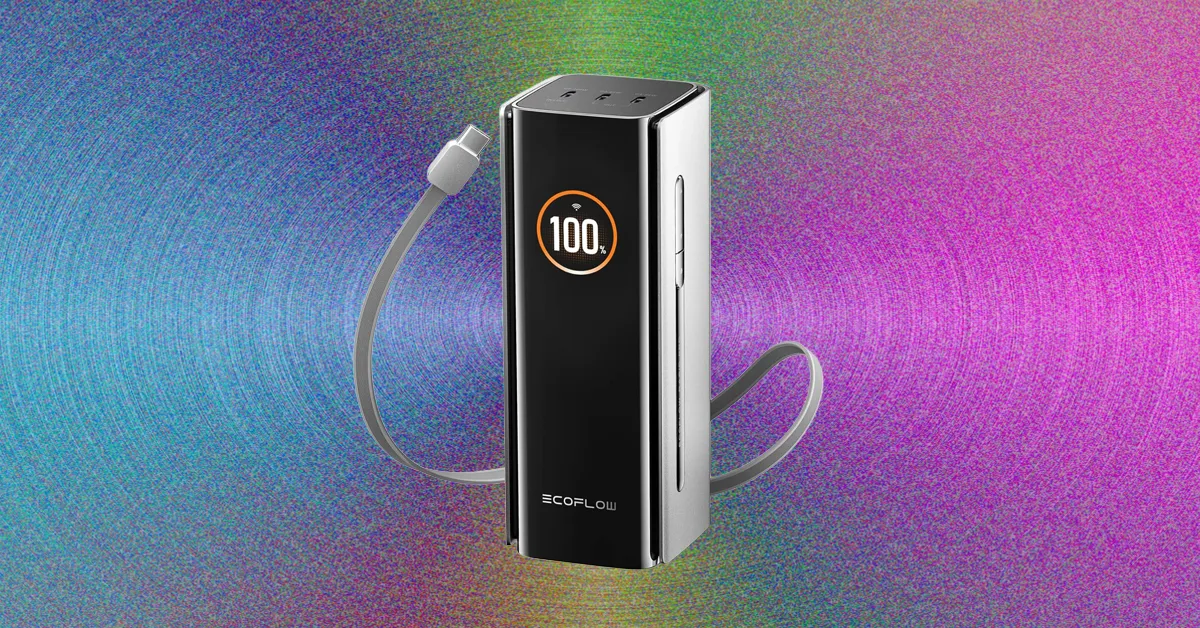
Leading the pack in terms of raw power is the EcoFlow Rapid Pro X, which delivers 300 watts. This model features a retractable USB-C cable rated at 140 watts, three additional USB-C ports, and a digital display that monitors battery health and temperature. Recharging is notably rapid, taking under 30 minutes to reach 80 percent capacity via dual USB-C input at 250 watts, or just 20 minutes when using EcoFlow’s proprietary dock at 320 watts.
Anker’s Prime series also achieves the 300-watt maximum, offering a more compact form factor with 26,250 mAh capacity. It includes two USB-C ports and one USB-A port, allowing simultaneous charging of multiple devices such as MacBooks and smartphones. Like the EcoFlow, it utilises a smart display and app control, and can recharge to 80 percent in 20 minutes via dual USB-C input. Anker also offers a separate 90,000-mAh model designed for off-grid use with solar input, though its size and weight make it unsuitable for air travel.
New entrant ReelCharge offers the ReelPro (Model PWB3001), a 27,000 mAh unit with a built-in braided USB-C cable. While its combined output is capped at 200 watts and it lacks some fast-charging protocols for phones, it provides a three-year warranty and an informative display. Meanwhile, Aohi’s Starship model delivers 240 watts via two USB-C ports, featuring a distinctive sci-fi aesthetic, though reviewers noted its display is too dim for use in direct sunlight.
The guide also outlines critical travel constraints, noting that most recommended models are suitable for carry-on luggage as they fall within the 100 watt-hour limit for flights. However, larger units like the Anker 90,000-mAh model are explicitly flagged as too large for air travel. WIRED advises consumers to verify specific airline policies, as some carriers impose stricter rules on the number of power banks allowed onboard or their placement during flight.
