WIRED dissects fluid dynamics behind World Cup 2026 shot-bending
A new analysis published ahead of the tournament details the Magnus force and drag coefficients governing mid-air curves, moving beyond Newtonian vacuum models to real-world aerodynamics.
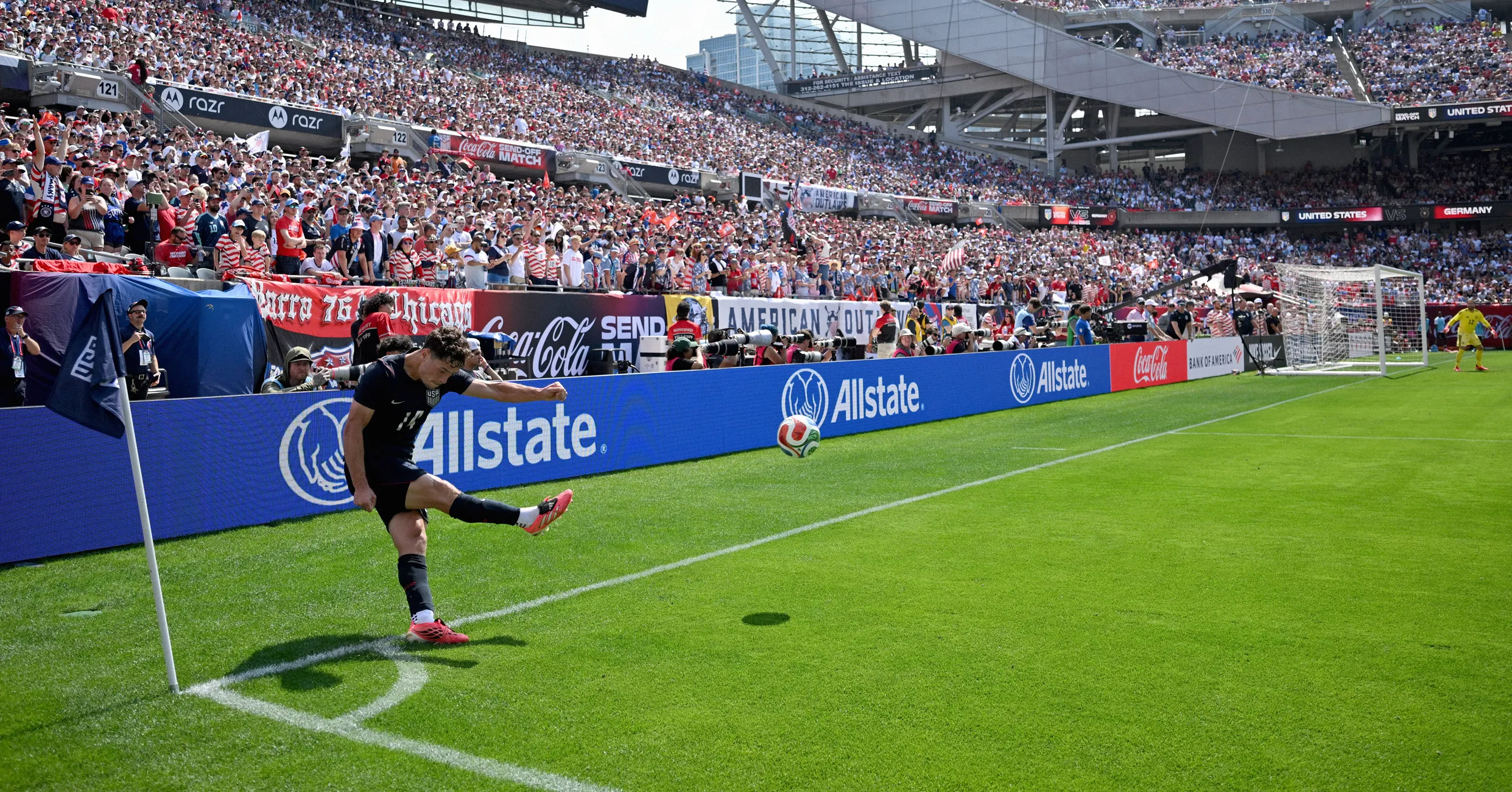
WIRED published an article on 13 June 2026 detailing the fluid dynamics that allow soccer players to bend shots in midair, timed ahead of the World Cup 2026. The piece explains how air resistance and the Magnus force—generated by ball spin—deviate a ball’s path from a simple ballistic trajectory governed solely by gravity. Using a Python-based model, the article illustrates three scenarios: motion in a vacuum (Newton’s first law), motion under gravity (Newton’s second law), and motion with drag and spin (Newton’s third law).
The explanation notes that drag increases with the square of the ball’s speed, meaning doubling the speed quadruples the resistance. The Magnus force arises from pressure differentials created by spinning air molecules, a phenomenon described by Newton’s third law where the ball pushes air in one direction and the air pushes the ball in the opposite direction. This interaction allows players to curve the ball sideways by kicking it off-centre, imparting rotation on a vertical axis.
The article employs a step-by-step modelling approach, starting with a vacuum scenario where the ball maintains constant velocity until acted upon by an external force. It then introduces gravity, calculating the downward force as the product of mass and the gravitational field (9.8 newtons per kilogram). This results in a parabolic trajectory where the ball’s vertical velocity slows, halts, and reverses, while horizontal motion remains constant in the absence of air.
Real-world aerodynamics introduce air resistance, or drag, which pushes against the ball’s motion. The piece highlights that without air resistance, a goalie could kick a ball the length of the field and over the stands. However, the presence of air molecules creates continuous collisions that slow the ball’s horizontal velocity, causing it to fall short of the ideal parabolic path predicted by vacuum models.
A Python model was used to simulate three scenarios: gravity only (parabolic), gravity with drag (shorter range), and gravity with drag and spin (curved trajectory). The simulation shows that backspin can partially offset gravity, allowing the ball to carry farther, while side-spin creates the lateral curve characteristic of professional free kicks. The results are illustrative simulations rather than empirical data from a specific match or controlled experiment.
The article presents a simplified physics model; real-world aerodynamics are more complex due to factors like seam orientation and turbulent flow regimes not fully detailed in the summary. Despite these complexities, the core concepts rely on established physics principles, including Newton’s laws of motion and the definition of weight. The piece serves as an educational breakdown of the science behind the "beautiful game" as the tournament approaches.
The context relies on established physics principles, though real-world aerodynamics involve additional complexities such as seam orientation and surface roughness not fully captured in the simplified model. The article references historical player techniques and ticket prices to frame the scientific explanation within the broader cultural context of the upcoming World Cup.
The core concepts rely on established physics principles: Newton’s laws of motion, fluid dynamics, and the definition of weight (Fg = m × g). The explanation notes that drag increases with the square of the ball’s speed, while the Magnus force arises from pressure differentials created by spinning air molecules. The context relies on established physics principles, though real-world aerodynamics involve additional complexities such as seam orientation and surface roughness not fully detailed in the summary.
