US strikes on Iranian civilian infrastructure spark legal and strategic debate
Analysts and legal experts question whether Washington’s campaign to enforce a naval blockade in the Strait of Hormuz constitutes a violation of international humanitarian law.
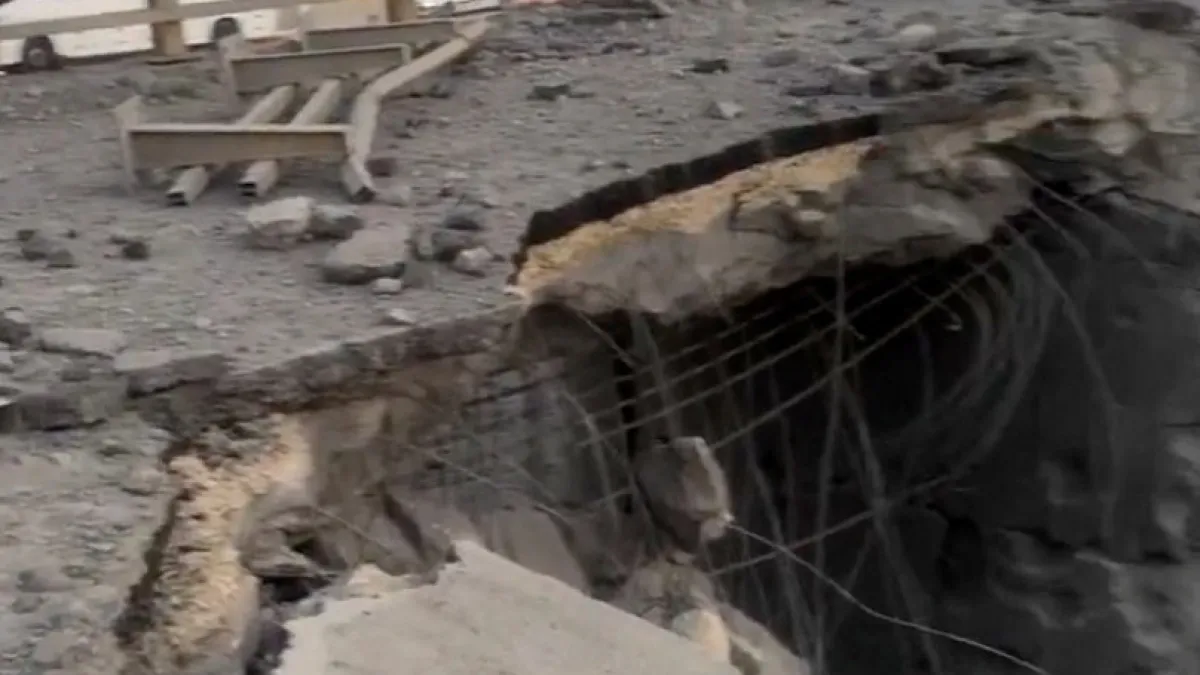
The United States has intensified its military campaign against Iran with a sixth consecutive night of strikes, targeting infrastructure that Iranian officials allege includes railway stations, residential areas, bridges, water facilities, and food silos. The attacks have caused significant damage in southern cities such as Bandar Abbas and Ahvaz, resulting in civilian casualties and widespread disruption to transport and utility networks. While the Trump administration states the objective is to degrade Iran’s ability to threaten shipping in the Strait of Hormuz and enforce a naval blockade, the scope of the destruction has drawn scrutiny from legal experts and regional analysts.
Iranian authorities confirmed that at least two people were killed and eight wounded in Bandar Abbas after strikes hit the Kahurestan Bridge and a residential neighbourhood. Local reports indicate that a railway facility was also damaged, while officials in Hormozgan province stated that six bridges were hit in the latest attacks. These strikes targeted key transport routes linking Bandar Abbas with surrounding towns, including the Gariyeh Bridge and structures near Latidan village. The damage has severely impacted the region’s connectivity, with Tasnim news agency reporting that a communications tower overlooking the city was struck, causing power outages in surrounding areas.
The escalation follows a memorandum of understanding signed in April to extend a ceasefire, an agreement that both nations have accused each other of violating. The renewed fighting comes a month after Washington and Tehran signed the accord, which set out a framework for negotiations aimed at ending the war that began on February 28. Since fighting resumed after Tehran and Washington met in Switzerland on June 22, Iran says a further 38 civilians have been killed and more than 400 injured in US attacks. Iranian Foreign Minister Abbas Araghchi has described the strikes on what he termed the country’s “vital infrastructure” as a flagrant violation of the United Nations Charter and the Geneva Conventions.
Under international humanitarian law, civilian objects are protected from attack unless they contribute to military action. Joel Rayburn, a retired US Army colonel and senior fellow at the Hudson Institute, suggested that military lawyers at US Central Command (CENTCOM) might have cleared these targets as “dual-use,” meaning they are civilian infrastructure also potentially used for military purposes. CENTCOM has repeatedly stated that its operations are targeting Iranian command centres, air defence sites, and missile capabilities used to threaten vessels transiting the strategic waterway. However, the increasing focus on civilian infrastructure has raised questions about whether Washington is pursuing a broader strategy to increase pressure on Tehran beyond degrading its armed forces.
Mark Hilborne, a senior lecturer in the School of Security Studies at King’s College London, noted that while the US would defend its strikes by arguing that many targets have military utility, they would certainly affect civilians and stray beyond purely military targets. He added that bridges have become a particular focus because they underpin Iran’s military logistics in the south, enabling the movement of equipment to interfere with shipping in the strait. Hilborne also pointed to a bridge struck in northeastern Iran earlier this month, which forms part of a key trade corridor linked to China’s Belt and Road Initiative, suggesting the US aims to undermine Iran’s economic value and sanctions evasion.
Analysts suggest the strikes may also aim to disrupt military logistics, increase economic pressure, or prepare for a potential ground invasion. Alex Alfirraz Scheers, a London-based military analyst, told Al Jazeera that the expansion of attacks beyond conventional military facilities could point to a broader shift in US strategy, potentially indicating early stages of preparation for a limited ground invasion. Simon Mabon, a professor of international relations at Lancaster University, said the pattern of strikes could be interpreted as a precursor to a ground invasion, though he warned that such a scenario would be hugely catastrophic and a misreading of the situation. Mabon added that the attacks were more likely intended to intensify pressure on Tehran and get them to the negotiating table, noting that previous rounds of escalation had eventually been followed by renewed diplomacy.
In response to the US actions, Tehran has expanded its retaliatory operations to include targets within Syria and Bahrain. Iran’s military said on Friday it had hit US aircraft at a military base in Bahrain, and Kuwait is responding to missile and drone attacks. Air defence systems have again been activated this week across Bahrain, Kuwait, Oman, Qatar, the United Arab Emirates, and Jordan. The confrontation over the Strait of Hormuz has also grown, with Iran stating it will block marine traffic entering the strategic waterway after Oman announced a new shipping transit corridor, while the US has resumed a naval blockade of vessels travelling to and from Iranian ports and coastal areas.