Ugreen bets on local AI to challenge cloud giants in smart home market
The accessories maker unveils a privacy-focused ecosystem with hubs priced up to $20,000, aiming to keep sensitive user data off the cloud.
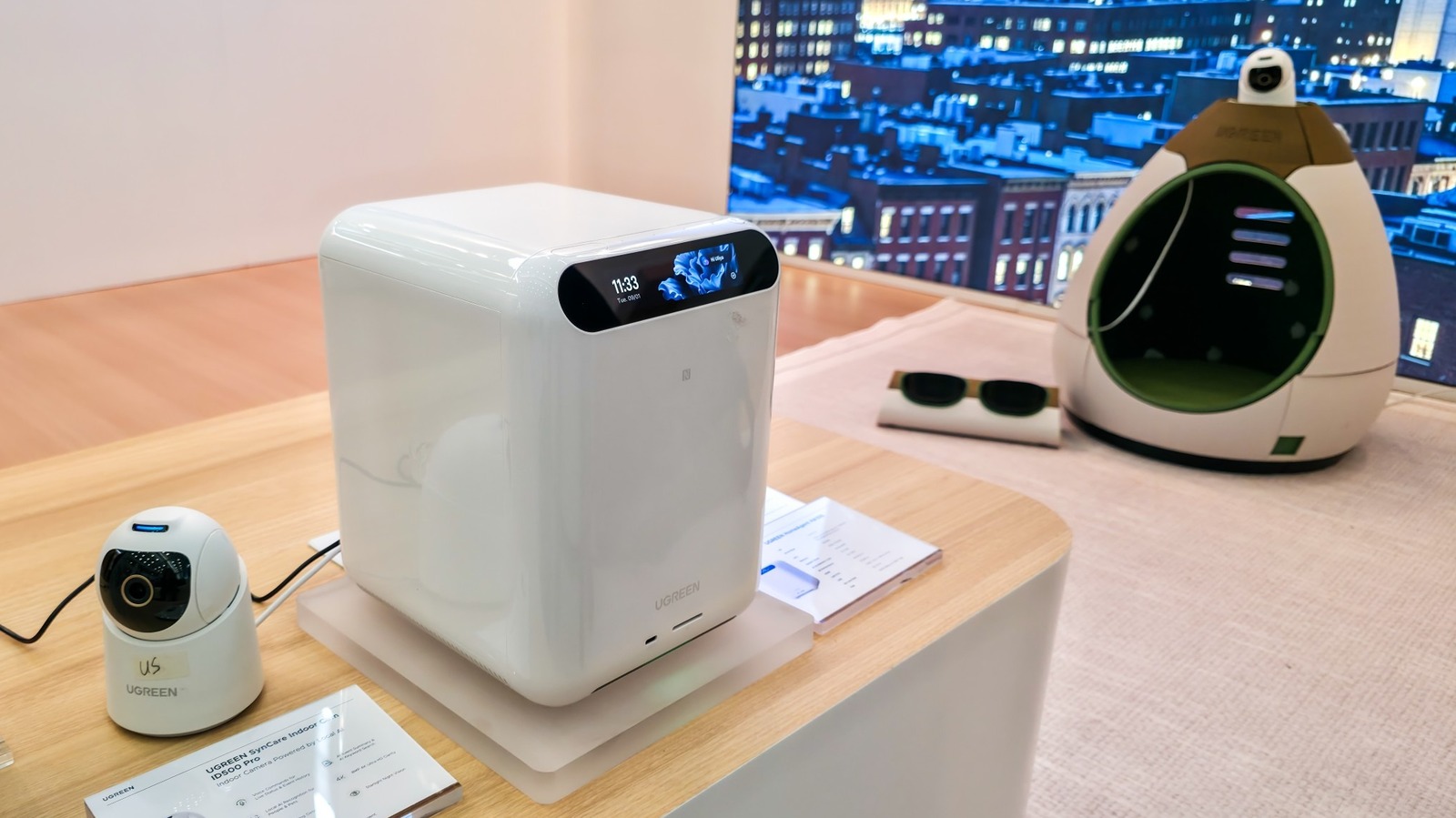
Ugreen, a company traditionally recognised for fast chargers, USB cables and network-attached storage devices, has launched a new smart home ecosystem centred on local AI hubs. The move represents a significant expansion into the "AIoT" sector, positioning the brand as a privacy-focused alternative to cloud-dependent systems from Amazon and Google. The launch event was held at Gillette Stadium in Foxborough, Massachusetts, where Ugreen detailed its strategy to process sensitive user data locally rather than transmitting it to remote servers.
At the core of the lineup are the HomeAgent and MasterAgent hubs, which run on ARM architectures. The top-tier MasterAgent MA100 is priced at $20,000 and runs on Nvidia’s Jetson Thor platform, a Blackwell system-on-module with 128GB of unified memory. This flagship model offers up to 2,070 TOPS of AI performance, effectively placing a scaled-down AI server in the living room. The more accessible HomeAgent comes in two variants: the HA100, priced at $1,799, and the HA100 Pro, priced at $5,999. Both models feature early bird discounts, with the HA100 available for $899 and the HA100 Pro for $2,999.
The ecosystem includes three SynCare security cameras, a smart speaker named Uliya, and a smart picture frame. The devices support Matter and ONVIF standards, ensuring compatibility with a wide range of third-party hardware. Ugreen’s NAS community manager, Thomas Brown, suggested that the savings accrued by running local AI models, as opposed to paying token costs for cloud inference, would make these hubs attractive to consumers. Marketing materials also highlight potential savings on cloud storage costs, although the high upfront price tag remains a barrier for many.
The SynCare cameras, including the Indoor Cam ID500 Pro, PoE Cam OD600 Pro and Battery Cam OD800 Pro, are priced between $149 and $399, with early bird deals available. Ugreen emphasised that remote access will use end-to-end encryption, while local data is protected using standard AES-256 encryption. The smart speaker, Uliya, retails for $99 and serves as a voice interface for the HomeAgent, while the 13.3-inch E-Ink picture frame, the Ugreen Gallery, is priced at $439.
Pre-orders for the HomeAgent and MasterAgent hubs open on 3 September 2026, with a crowdfunding period following through the rest of the year. Shipping for the full lineup is planned for January. The launch coincided with competitor Anker, via its subsidiary Eufy, announcing a similar AI-powered smart home hub on the same day. However, Ugreen’s ecosystem lacks official Home Assistant support, a feature included in Anker’s offering, which may be a drawback for some tech-savvy users.
While the platform offers a compelling proposition for those seeking privacy, real-world performance remains untested. Review samples were scarce at the launch event, and only a single working model of the HomeAgent was demonstrated, showing basic control of smart curtains and lights. The more complex features, such as voice-based rule creation, were not demoed. For investors and consumers, the success of Ugreen’s venture will depend on whether the promise of local AI efficiency can justify the substantial initial investment.