Sun’s surface churns with previously unseen plasma vortexes, challenging solar models
Researchers confirm that magnetic field boundaries on the Sun are sites of intense fluid dynamics, a finding published in Nature that may reshape understanding of solar heat transfer.
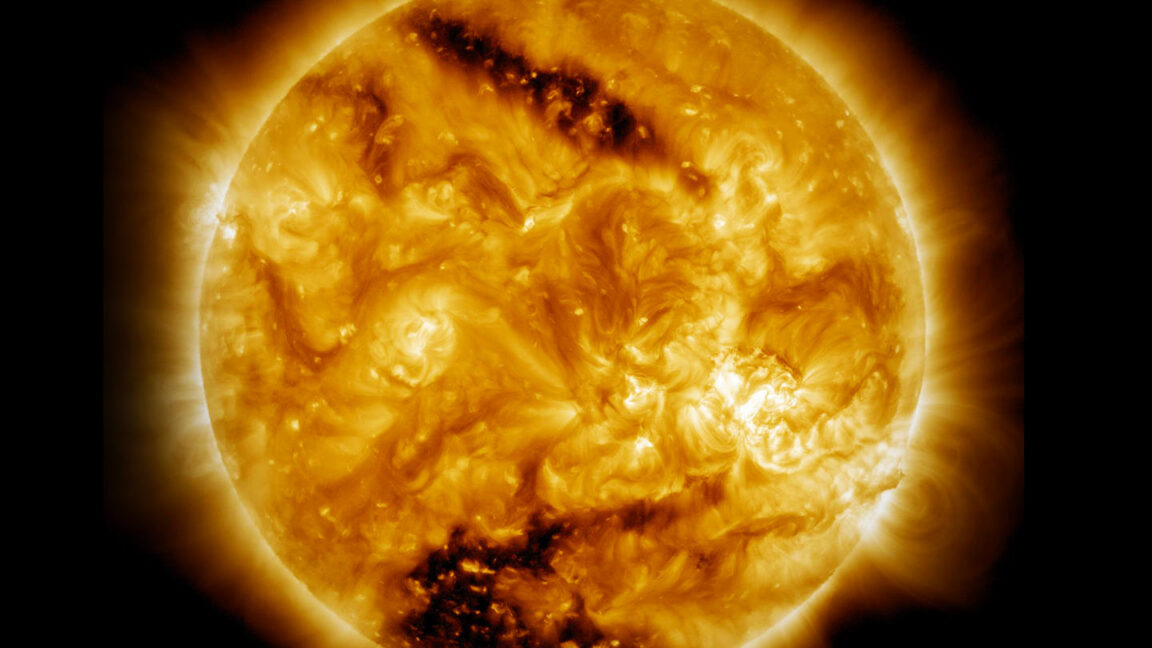
The Daniel K. Inouye Solar Telescope in Hawaii has captured the first direct observations of Kelvin-Helmholtz instabilities on the Sun’s surface, revealing that plasma vortexes are ubiquitous along magnetic field boundaries. Led by David Kuridze and Friedrich Wöger of the National Solar Observatory, the team utilised the facility’s 4-meter aperture to record these structures at a spatial resolution of approximately 19 kilometres. The findings, published in Nature, suggest that these instabilities significantly alter current models of heat, mass, and magnetic energy transfer within the solar atmosphere.
Kelvin-Helmholtz instability is a fluid dynamics phenomenon where boundary layers between fluids moving at different speeds curl into vortexes, a process previously observed in water ripples and cloud formations. While scientists had long hypothesised that similar mechanics occurred with plasma on the Sun, the small scale of these solar vortexes—often below 2 metres—rendered them invisible to most Earth-based telescopes. The discovery became possible only after the US National Science Foundation’s telescope entered its operational phase in November 2021, providing the necessary diffraction-limited performance to resolve such fine details.
During a three-minute observation window on 14 April 2025, the team recorded images at a wavelength of 416 nanometers to maximise resolution. The resulting data revealed 47 vortex-bearing interfaces, with individual vortexes measuring between 25 and 170 kilometres in diameter and spaced 60 to 100 kilometres apart. The structures were observed to double in size in under a minute and propagate at speeds ranging from 0.67 to 3 kilometres per second. The instability occurs because magnetic field lines run perpendicular to the plasma flow, failing to suppress the boundary instability as they would if aligned with the flow.
To ensure the observations were not artifacts of image processing, the researchers conducted computer simulations seeded with actual magnetic field maps of the observed region. These simulations accurately reproduced the vortexes’ appearance, growth rates, and dynamics, providing theoretical proof of the phenomenon. The study proposes that these vortexes act as a stirring mechanism, allowing magnetised and unmagnetised gas to blend. This mixing enables cool material from convection cell edges to leak into magnetic regions, a process that existing solar convection models do not currently account for.
The implications extend to the solar corona, the Sun’s million-degree outer atmosphere, which is heated partly by the shuffling and braiding of magnetic field lines. The observed twisting motions at the surface may represent the shuffling mechanism responsible for this heating. However, the team notes that the findings are based on a limited snapshot, and further long-term observations with direct magnetic field measurements are required to quantify the energy budget and dissipation rates associated with these instabilities.
