Student-developed map tracks global data centre policy divergence
University of Washington student Isabelle Reksopuro’s platform updates four times daily, revealing stark contrasts between regulatory approaches in regions such as Maine and Texas.
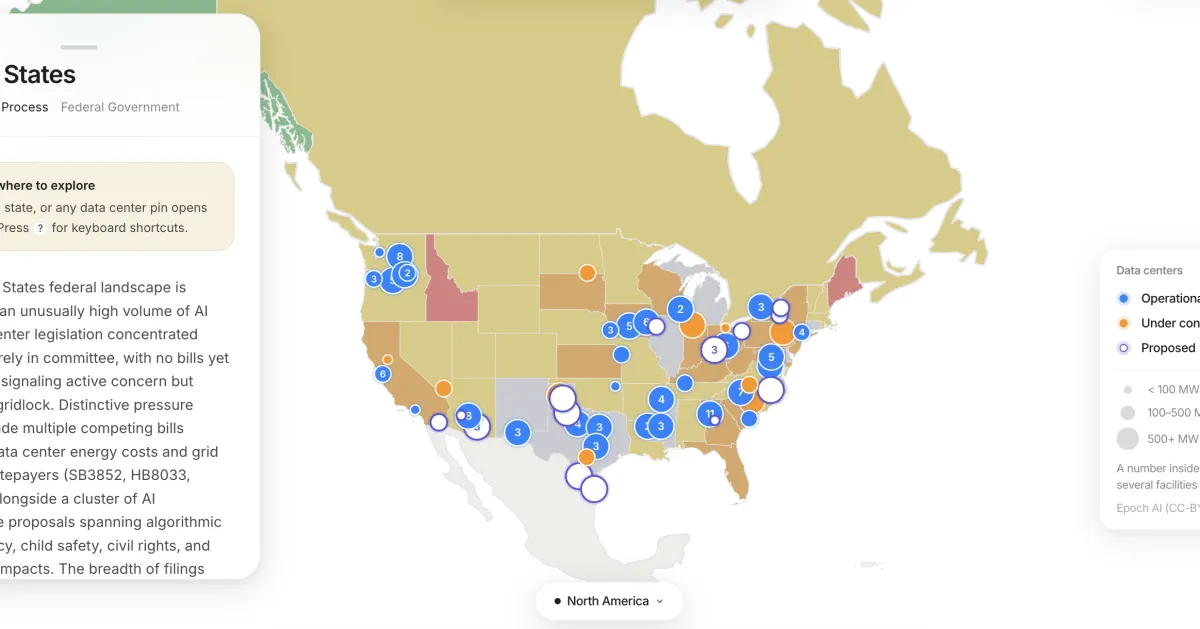
Isabelle Reksopuro, a University of Washington student, has launched an interactive map tracking data centre policies and community sentiment across North America, Europe, and Asia. The project aggregates data from Epoch AI and legislative sources, updating four times daily to provide real-time insights into regulatory responses and local opposition. The tool was developed to address the opacity surrounding data centre construction and to empower residents with accessible information.
The initiative was inspired by controversies in The Dalles, Oregon, where disputes over resource allocation have intensified scrutiny of tech infrastructure. The city sought to reclaim a 150-acre portion of Mount Hood National Forest, citing municipal needs driven by population growth recorded at 16,010 in the 2020 census. Critics allege the move is intended to secure water for Google’s local data centre, which consumes approximately one-third of the city’s supply. Google has denied acquiring the land, with Reksopuro noting the city framed the request as a need for watershed access rather than a direct corporate acquisition.
Reksopuro designed the platform to be user-friendly, aiming to make complex policy data accessible to non-experts. She stated she wanted the tool to be simple enough for her younger sisters to explore, preferring to educate peers through interactive data rather than social media platforms. The map scrapes new legislative sources and news feeds four times a day, automatically generating summaries and populating a sidebar to reflect the evolving landscape of data centre regulation.
The platform highlights significant divergence in regional policy approaches. In Maine, a state-level moratorium on hyperscale data centres was passed in April before being vetoed by Governor Janet Mills, leaving the long-term regulatory impact unclear. Conversely, Texas has adopted a supportive stance, providing the industry with more than $1 billion in annual tax breaks. Reksopuro argues that such disparities underscore the need for greater transparency, allowing communities to negotiate for job training, tax revenue, and environmental monitoring before facilities are built.
Opposition to data centres has emerged as a rare point of consensus across party lines in the United States, driven by concerns over high water consumption, limited permanent job creation, and rising utility bills for residents. Reksopuro, who studies the intersection of technology and public policy, emphasises that early public knowledge would provide communities with leverage to secure tangible benefits. The map serves as a resource to monitor these developments as the industry continues to expand globally.

