Sotheby’s T. rex auction intensifies debate over private fossil ownership
As Sotheby’s prepares to auction a 67-million-year-old Tyrannosaurus rex skeleton for up to $30 million, experts argue the trend of wealthy individuals acquiring fossils as luxury assets is eroding the foundations of paleontological research.
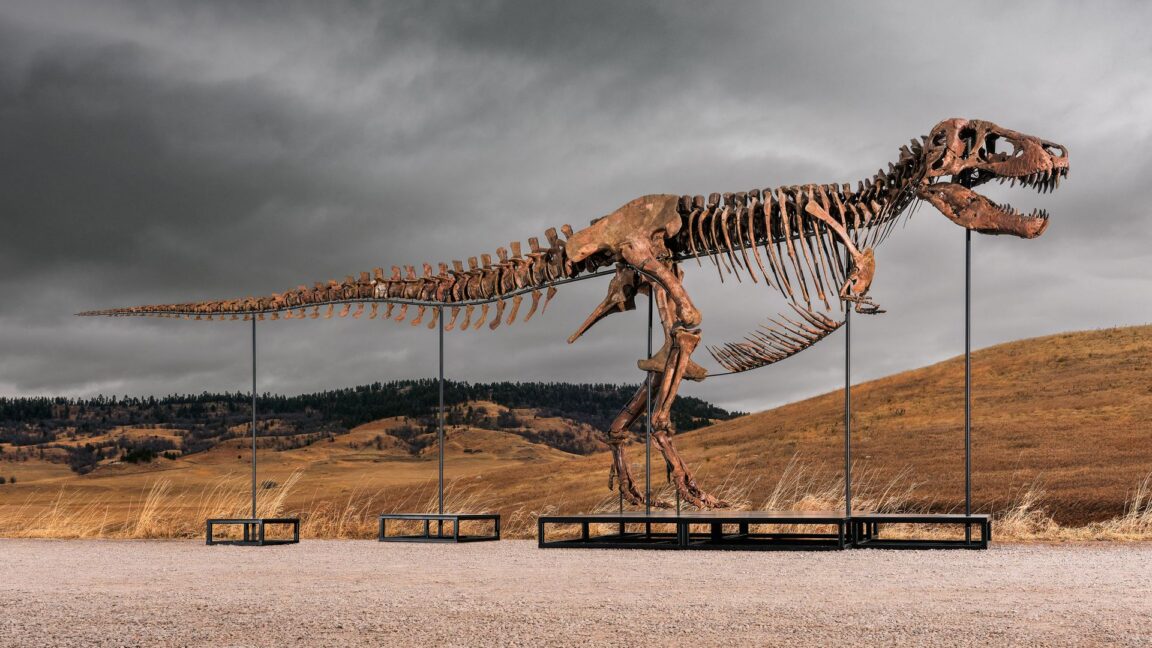
Sotheby’s opened live bidding on July 14 for a 67-million-year-old Tyrannosaurus rex skeleton dubbed Gus, a specimen expected to fetch up to $30 million. The auction has reignited concerns among paleontologists that wealthy private collectors are increasingly outbidding museums for significant fossil specimens, effectively removing them from scientific study. Experts argue that private ownership hinders research reproducibility and that auction houses often prioritise marketing narratives over scientific accuracy. In response, the Society of Vertebrate Paleontology is encouraging buyers to donate acquired fossils to public museums.
Gus, described as one of the largest and most complete T. rexes ever found, comprises 183 fossil bone elements, making it approximately 61 per cent complete by bone count. The skeleton, discovered on a ranch in South Dakota, has been mounted in a custom steel armature with replicas of missing bones. While Sotheby’s vice chairman Cassandra Hatton noted that the sale helps rescue fossils from erosion, paleontologists counter that the incentive to sell to the highest bidder undermines science. This includes commercial excavation practices that fail to document geological context and mounting techniques that make modern imaging studies impossible.
The trend of selling major fossils at auction in the US began in earnest in 1997 with the sale of Sue, the most complete T. rex on record, which sold for approximately $8.4 million to the Field Museum. Unlike in many other countries where the state owns such specimens, US law generally dictates that whoever owns the land also owns the fossils found on it. A 2025 study indicated there are more T. rex fossils in private collections than in public trusts, with recent high-profile sales including a Stegosaurus named Apex sold to hedge fund billionaire Ken Griffin for $44.6 million in 2024.
Disputes over scientific interpretation have also emerged surrounding Gus. Sotheby’s describes holes in the jaw and other bones as tyrannosaurid bite marks, suggesting the specimen battled or scavenged its own kind. However, paleontologist Stuart Sumida disputes this, noting the holes are perfectly round and smooth-edged, which is inconsistent with puncture wounds; he hypothesises they may result from infections. Sotheby’s defends the bite-mark claim, stating the edges show lateral bites and clean breaks, though it did not specify the source of this analysis.
The central issue with auctioning fossils is that when specimens end up in private hands, they become unavailable for scientific study. Scientific journals typically refuse to publish studies on specimens not held in publicly accessible museums, as permanent public access is required for research reproducibility and future study. To address this, the Society of Vertebrate Paleontology is working to facilitate donations from private collectors to public museums, aiming to ensure that scientifically important fossils remain in the public trust for future generations.
