Silicon Valley investors back Panthalassa's wave-powered floating AI data centre initiative
The Ocean-3 prototype, an 85-metre steel sphere, is scheduled for testing in the northern Pacific later in 2026, utilising wave energy and seawater cooling while transmitting data via satellite links
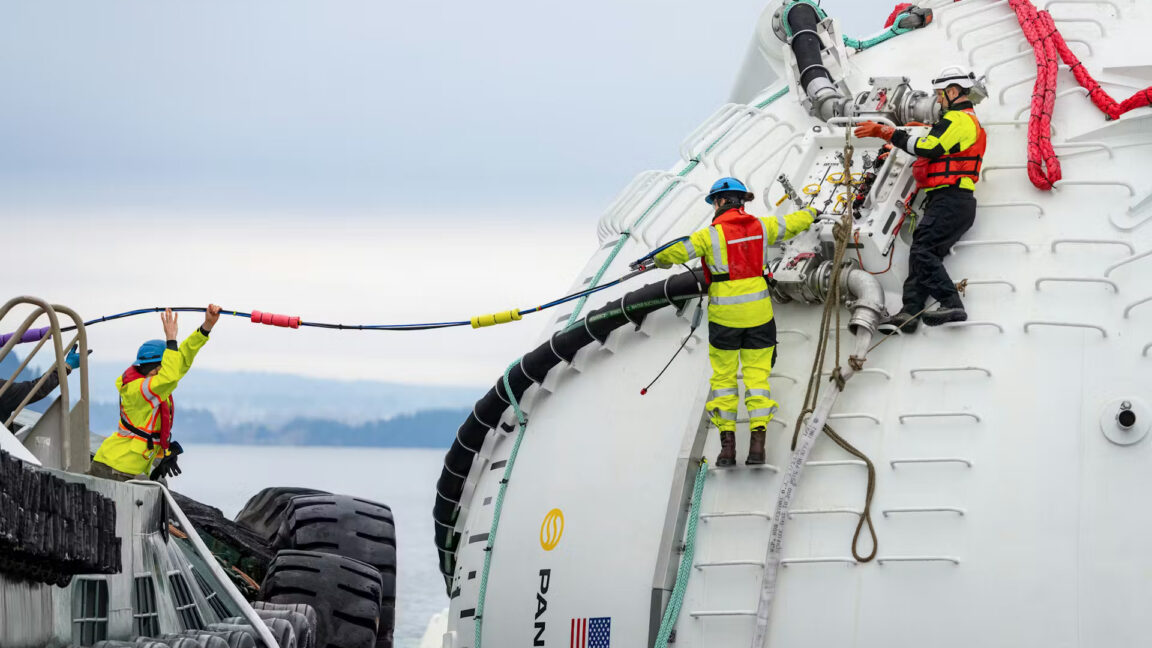
Silicon Valley investors, led by Palantir co-founder Peter Thiel, have committed $210 million to Panthalassa to develop a new generation of wave-powered artificial intelligence data centres. The funding, which includes a recent $140 million round announced on 4 May, is intended to accelerate the construction of a pilot manufacturing facility near Portland, Oregon, and speed up the deployment of autonomous computing nodes. This significant capital injection arrives as major US technology firms face mounting pressure from local communities, labour shortages, and power supply constraints regarding land-based infrastructure projects.
The core of the initiative involves the Ocean-3 prototype, a steel sphere approximately 85 metres in length, which is scheduled for testing in the northern Pacific Ocean later in 2026. Unlike traditional facilities, these floating nodes are designed to generate their own electrical power directly from ocean waves using a pressurised reservoir and turbine system. By eliminating the need to transmit renewable energy to land-based sites, the project aims to transform an energy transmission problem into a data transmission problem, allowing the nodes to power onboard AI chips independently.
To address the intense heat generated by high-performance computing, the floating nodes utilise the surrounding seawater to cool the AI chips. This approach bypasses the high water and electricity consumption typical of air-conditioned land-based data centres. Benjamin Lee, a computer architect at the University of Pennsylvania, noted that the ambient temperature of the ocean offers a massive cooling advantage, potentially reducing the operational overheads that often plague terrestrial facilities.
Data transmission from these remote locations to customers will rely on satellite links rather than the traditional fibre-optic cables used by most data centres. While this method allows for the transmission of inference tokens representing AI model outputs, experts caution that satellite bandwidth limitations may restrict speeds compared to terrestrial connections. Lee highlighted that while feasible for real-time responses to prompts, frequent coordination between multiple nodes or the transfer of large volumes of data could present significant technical challenges.
Panthalassa has already validated the underlying wave energy technology through previous prototypes, including Ocean-1, which was tested in 2021, and Ocean-2, which completed a three-week sea trial off the coast of Washington state in February 2024. The company's CEO, Garth Sheldon-Coulson, has expressed ambitions to eventually deploy thousands of these nodes, though the current focus remains on proving the viability of the Ocean-3 design in harsh ocean conditions.
Despite the audacity of the plan, the project faces scrutiny regarding the durability of autonomous hardware in the open ocean. Experts point out that maintaining equipment without human intervention for over a decade is a formidable engineering challenge, noting that previous underwater initiatives such as Microsoft's Project Natick did not proceed to commercialisation. Nevertheless, the investment underscores a growing willingness to explore alternative locations for computing resources as terrestrial options become increasingly difficult to secure.
