Scientists confirm Andes hantavirus strain on MV Hondius capable of human-to-human transmission
While social media claims suggest the virus is not contagious, medical authorities confirm the Andes strain circulating on the MV Hondius can spread between people, though its low reproduction rate limits widespread outbreak potential.
Scientists have confirmed that the Andes strain of hantavirus circulating on the MV Hondius cruise ship is capable of human-to-human transmission, directly contradicting online assertions that the pathogen is not contagious. The World Health Organisation (WHO) announced on 3 May that three passengers on the vessel, which was crossing the Atlantic Ocean, had died from the virus. In response, quarantine measures and contact tracing were implemented for those ill or possibly infected.
The confirmation clarifies the nature of the outbreak, which has seen 12 suspected and confirmed cases in total. While the virus carries a high lethality rate of 38 percent, according to the US Centres for Disease Control and Prevention (CDC), experts describe it as not highly contagious. The basic reproduction number (R0) is estimated at approximately 1, meaning that, on average, an infected person transmits the virus to only one other person. This contrasts sharply with the R0 of approximately 3.28 recorded for Covid-19 during the 2020 pandemic.
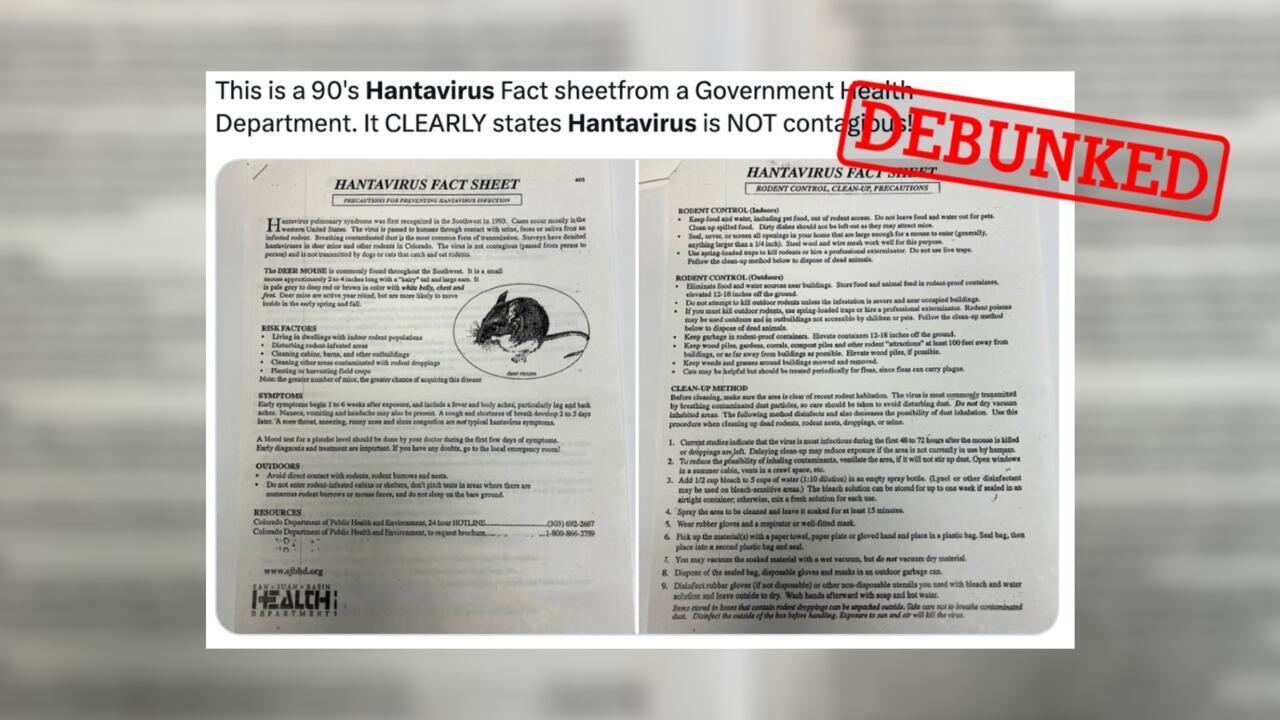
Transmission requires relatively prolonged contact with an infected individual, distinguishing the Andes virus from other strains. The Sin Nombre virus, which has been present in Colorado since 1993, does not spread between humans. The La Plata County Public Health Department, which assumed responsibilities from the dissolved San Juan Basin Health Department, confirmed that the strain on the MV Hondius is distinct from the Sin Nombre virus found in Colorado.
Social media users had circulated claims that hantavirus cannot be spread from human to human, citing a "Hantavirus Fact Sheet" attributed to the San Juan Basin Health Department. The department was dissolved on 1 January 2024, making it difficult to establish with absolute certainty if the specific document circulating online is authentic. The La Plata County Public Health Department stated the fact sheet "seemed authentic" but could not confirm it with 100 percent certainty. However, this document pertains to the Sin Nombre virus, not the Andes strain.
Medical experts emphasised the biological differences between the strains. Mircea Sofonea, an epidemiologist at Montpellier University and the Nîmes University Hospital, noted that the Andes virus is the only one in its grouping to have established human-to-human transmission. This capability was documented in a 2019 study published in The New England Journal of Medicine regarding an outbreak in Argentina. Bruno Lina, chief of the virology department at Hospices civils de Lyon, described the viruses as different "models" within the same family, stressing that the Andes virus behaves differently from the non-contagious Sin Nombre strain.
With the current R0 hovering around 1, experts suggest that preventative measures and good hygiene can drive the reproduction number below 1, effectively ending the epidemic. The limited number of cases on the MV Hondius supports the assessment that the virus is not highly contagious compared to other respiratory pathogens. Full epidemiological data regarding the outbreak is not yet available, but the distinction between the strains remains critical for public health guidance.