Northrop Grumman launches DARPA-backed robotic satellite servicer into geosynchronous orbit
The Pentagon’s DARPA invested $420 million in the robotics payload, which Northrop Grumman will operate for up to 13 years to service and extend the life of critical communications and military satellites.
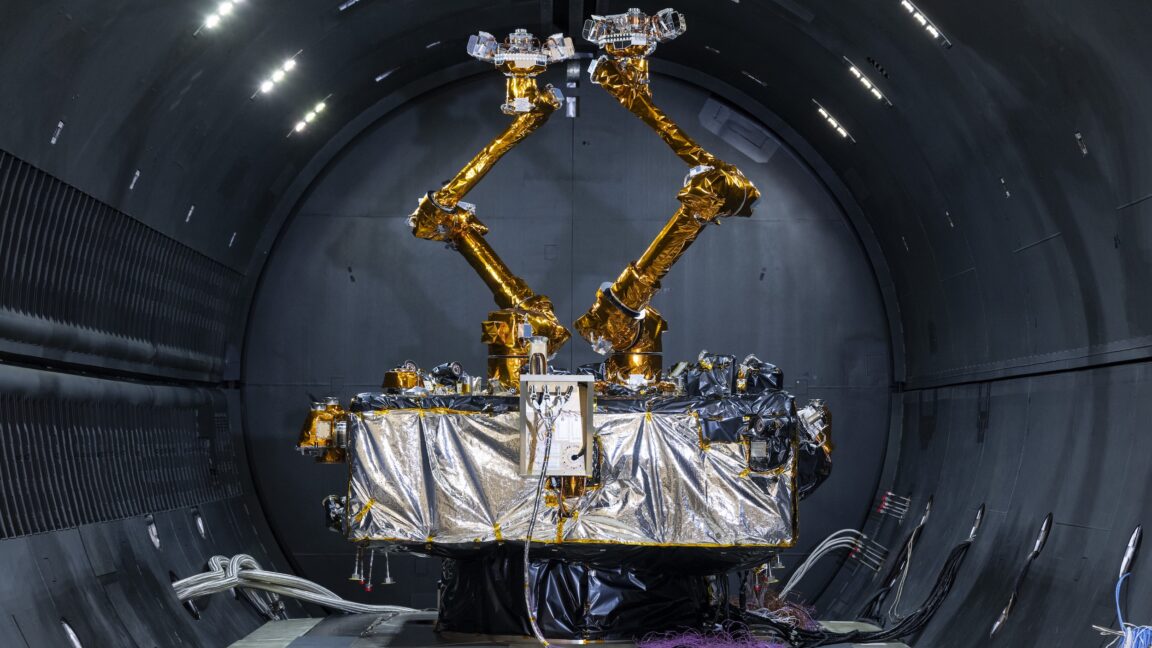
Northrop Grumman’s Mission Robotic Vehicle (MRV) launched aboard a SpaceX Falcon 9 rocket from Cape Canaveral Space Force Station on Tuesday, initiating a decade-long mission to service and inspect satellites in geosynchronous orbit. Developed in partnership with the US Defence Advanced Research Projects Agency (DARPA), the spacecraft is equipped with two flexible, seven-degree-of-freedom robotic arms designed to autonomously approach, capture, and upgrade client satellites that were not originally designed for servicing.
The MRV is en route to an orbit approximately 36,000 kilometres above the equator, a journey expected to take about a year. Three Mission Extension Pods (MEPs), functioning as standalone propulsion units, launched alongside the MRV and will use electric propulsion to reach the same orbit. These pods will loiter in space for retrieval by the MRV’s robotic arms, which can then install them onto aging satellites to provide propulsion for up to eight years.
DARPA invested approximately $420 million in the satellite’s robotics payload, which was developed by the Naval Research Laboratory (NRL) over more than 20 years. The technology traces its lineage to the 2002 RescueSat concept and represents a significant shift from the traditional "launch-and-abandon" model. Jim Shoemaker, the RSGS program manager at DARPA, described the system as an operational capability designed to permanently change how space assets are maintained, enabling on-orbit interventions such as inspections, mechanical anomaly resolution, and upgrades.
Northrop Grumman retains ownership of the satellite and payload, with a planned operational lifespan of 10 to 13 years. The company has commercial agreements with communications operators SES and Optus to provide servicing, and the US Space Force is expected to use the vehicle for its own assets. While the MRV has not yet identified its first client satellite, it is designed to handle complex tasks beyond simple life extension, including the installation of MEPs and potentially future in-space logistics operations involving spare parts from depot spacecraft.
The mission underscores the growing strategic importance of geosynchronous orbit, which hosts critical military and civilian infrastructure. US military officials have previously highlighted concerns about China’s on-orbit capabilities, including its Shijian-21 and Shijian-25 satellites, which have demonstrated refueling and debris mitigation. The MRV’s advanced robotics, including redundant arms and multiple tool interfaces such as pod capture tools and Marman ring tools, provide a versatile platform for maintaining US space dominance without the need for immediate replacement of expensive, one-of-a-kind satellites.
