NASA’s Psyche probe captures high-resolution Mars imagery during gravity assist manoeuvre
The Psyche mission has released new images of the Martian surface, including the south polar cap and Syrtis Major region, as it completes a critical trajectory adjustment.
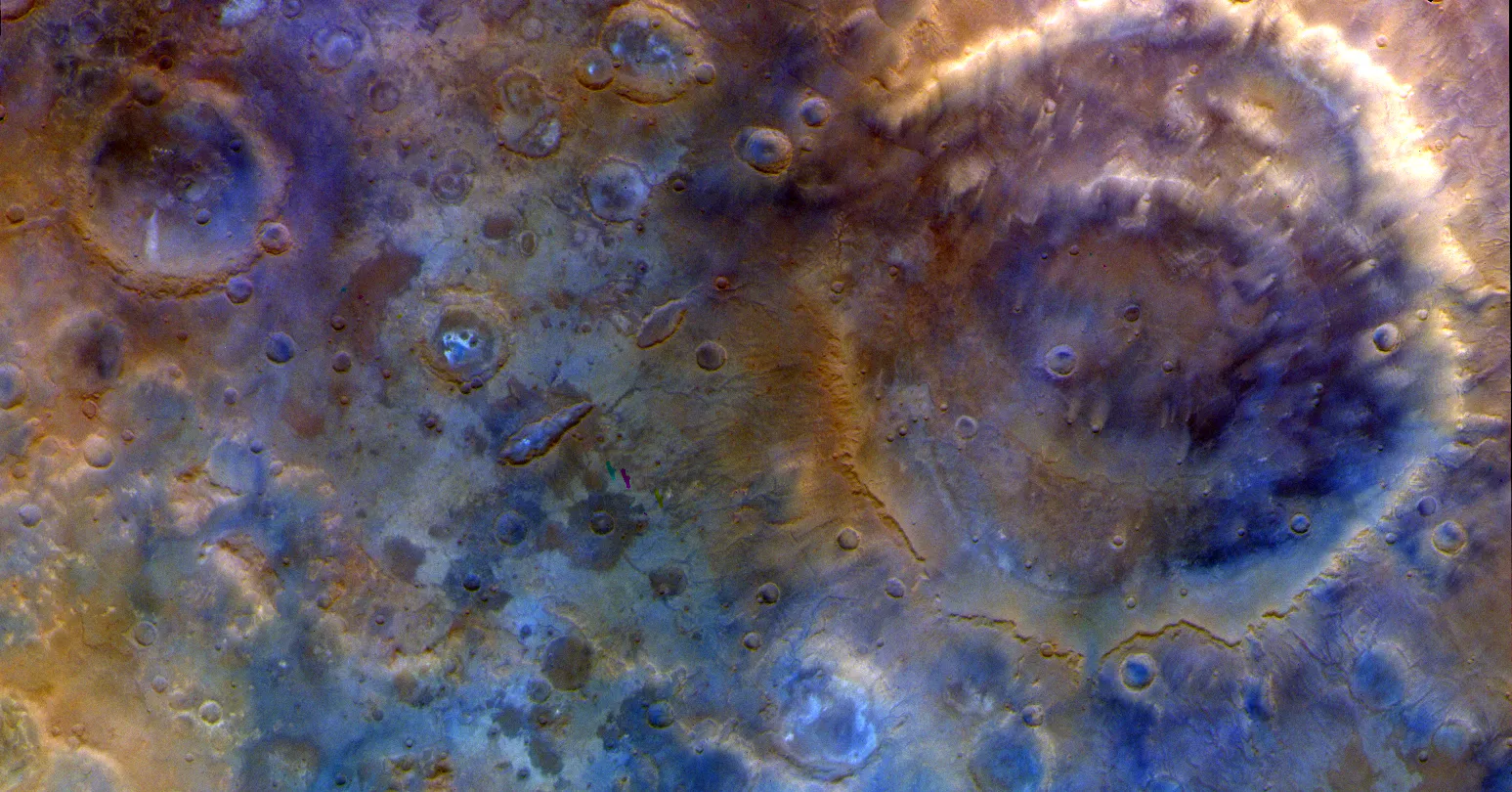
NASA’s Psyche spacecraft has captured detailed imagery of Mars during a gravity assist flyby on 25 May 2026, utilising the planet’s gravitational pull to adjust its trajectory toward the metallic asteroid Psyche. The probe passed within 4,609 kilometres of the Martian surface, a manoeuvre that not only altered its orbit by one degree but also provided a unique opportunity to calibrate onboard scientific instruments.
During the approach, the spacecraft activated its cameras, magnetometers, and gamma ray and neutron spectrometers to characterise performance using Mars’ atmosphere and terrain. The flyby boosted the probe’s velocity to 1,600 kilometres per hour, setting the stage for its long-duration journey to the asteroid belt. The mission, which launched in October 2023, is scheduled to reach its target in August 2029 to map the asteroid and study the structure of Earth’s interior.
The newly released images reveal rugged surface features, including the large double-ring Huygens crater in the Syrtis Major region, which spans approximately 470 kilometres in diameter. Other notable features captured include traces of solar wind around craters and the south polar cap, an area rich in water ice. These visuals offer mission scientists valuable data on the planet’s geological history and environmental conditions.
Jim Bell, the Psyche imager instrument lead at Arizona State University, highlighted the strategic value of the flyby for the broader mission. He noted that the dataset provides unique opportunities to calibrate cameras and test early versions of image processing tools intended for use at the asteroid Psyche. The thousands of images captured during the approach and close approach phases are critical for ensuring the accuracy of future observations.
The Psyche asteroid is believed to be the partial core of a planetesimal, a primitive building block of a planet. By mapping the asteroid’s surface, scientists aim to gain insights into the formation of terrestrial planets and the composition of Earth’s core. The successful completion of the Mars flyby marks a significant milestone in the mission’s timeline, demonstrating the spacecraft’s operational readiness for its primary scientific objectives.
