McLaren’s Stella Attributes Hungarian Pole to Execution Over Raw Pace
Lando Norris secures first 2026 pole position, but Andrea Stella warns that operational precision, not superior car speed, defined McLaren’s qualifying performance.
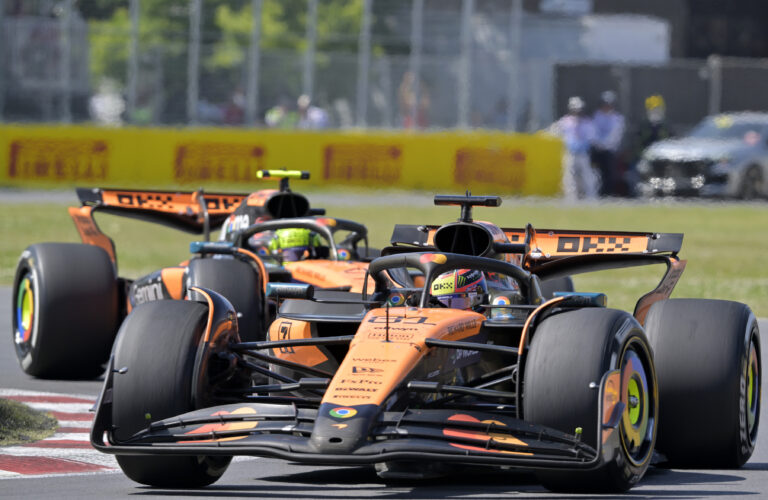
McLaren team principal Andrea Stella has cautioned that Lando Norris’s pole position at the 2026 Hungarian Grand Prix was secured through flawless operational and driver execution rather than superior raw car speed. Despite the team introducing a new upgrade package to the MCL40 chassis that performed exactly as anticipated, Stella suggested that Ferrari retains a fundamental engineering advantage, particularly in the slow-speed corners that define the Hungaroring’s tight layout.
Norris claimed his first pole position of the season by a margin of 0.012 seconds ahead of Ferrari’s Charles Leclerc. The result followed a clean sweep of Free Practice 3 and all three qualifying segments for the British driver. His teammate, Oscar Piastri, qualified in third place, ensuring McLaren occupied the front two rows of the grid, although Lewis Hamilton was promoted to the front row after receiving a three-place grid penalty for impeding another driver during qualifying.
Stella emphasised that the narrow margin was a product of precision rather than a clear performance gap. “If we take Leclerc’s best corners and Hamilton’s best corners, I think their potential was still higher than ours,” Stella explained. He noted that pole position was primarily the result of executing a perfect lap, rather than the car possessing the highest overall pace. The McLaren boss broke down the telemetry to highlight how operational discipline compensated for what he perceives as Ferrari’s superior underlying potential.
The team’s new upgrade package was designed to optimise aerodynamic efficiency and straight-line speed, areas where McLaren has seen gains. However, Stella acknowledged that Ferrari’s chassis remains the benchmark for mechanical grip. This distinction is critical at the Hungaroring, a circuit historically known for rewarding cars with exceptional downforce and mechanical grip over raw top speed. Stella identified that part of McLaren’s performance gain came on the straights, whereas Ferrari’s strength lies in the slow-speed sections.
The race strategy for Sunday is expected to hinge on whether McLaren’s straight-line speed advantage can overcome Ferrari’s superior mechanical grip in Sector 2, where tire protection is vital. With overtaking notoriously difficult on this circuit, the outcome will likely depend on whether McLaren’s pit wall execution can match the precision displayed during qualifying. Stella’s assessment suggests that while McLaren is competitive, the team must manage expectations regarding the car’s absolute pace against their Italian rivals.