Korea's Kospi Index Surges 75% in 2026 as AI Chipmakers Drive Rally
President Lee Jae Myung's governance reforms and structural support from the shipbuilding sector underpin the market's performance ahead of year-end targets.
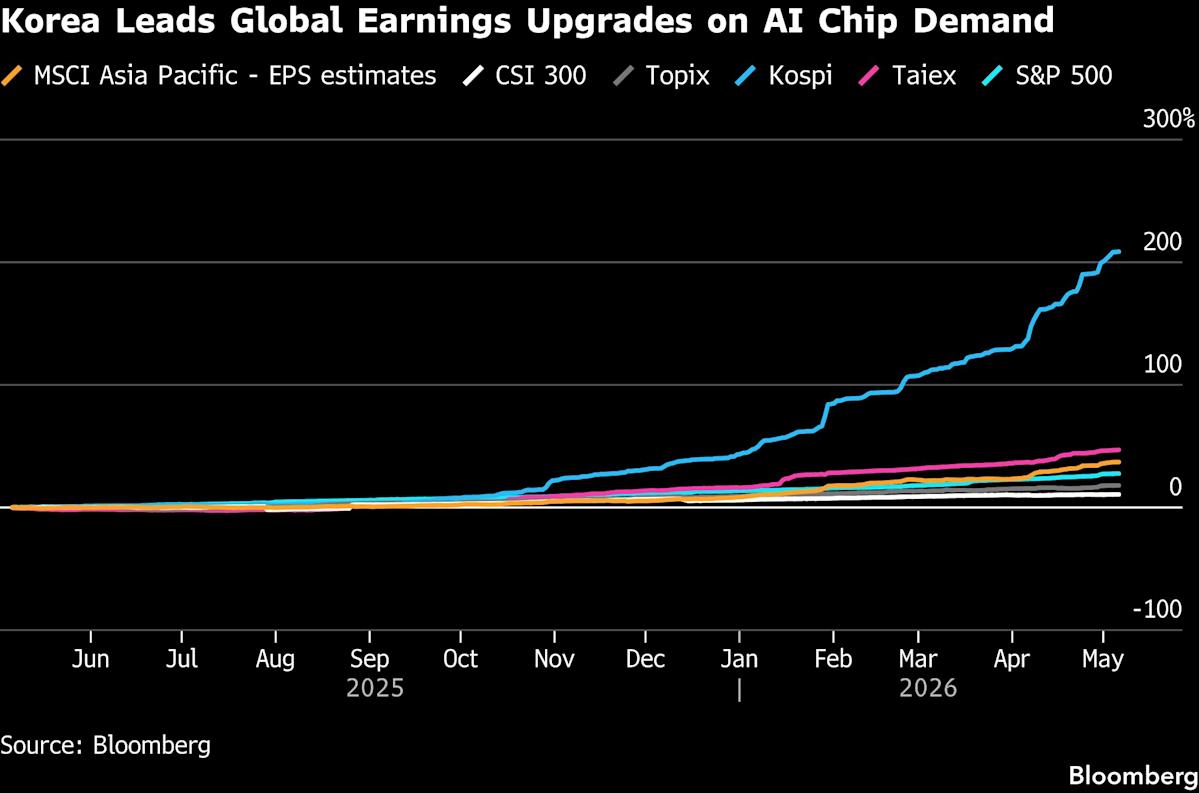
South Korea's benchmark Kospi index rose 6.5% on Wednesday, pushing the year-to-date gain to 75% by early May 2026. This performance places the market on the cusp of surpassing last year's record 76% advance, which was achieved within just five months of the calendar year starting. The rally is heavily concentrated in the artificial intelligence sector, specifically memory chipmakers Samsung Electronics and SK Hynix, whose share prices have more than doubled this year.
The benchmark Kospi closed at 7,384.56, significantly exceeding President Lee Jae Myung's election campaign goal of 5,000 and approaching Goldman Sachs' ambitious year-end target of 8,000. Overseas investors purchased more than $2 billion worth of Kospi shares on Wednesday, nearing the record buying volume seen in October. This enthusiasm boils down to one theme: artificial intelligence. Long disregarded by global investors, Korean companies are now enjoying a re-rating as their technological edge across the AI supply chain makes their products highly sought after.
Despite the broad index gain, the rally shows narrow breadth, with over 600 of the 835 stocks in the Kospi falling on Wednesday. Short sellers are increasing their bets that a market pullback is inevitable after such a quick and explosive rally. Analysts warn that the market is becoming increasingly dependent on continued earnings upgrades from a small number of semiconductor leaders. If global liquidity tightens further, or AI spending expectations start to normalise, volatility could rise quite quickly given how concentrated the rally has become.
Analysts project earnings growth of more than 200% for Kospi stocks over the next 12 months, citing historical highs in memory maker earnings driven by AI demand and a bull cycle in the shipping industry benefiting shipbuilders. Even after Samsung Electronics and SK Hynix's share prices have both more than doubled this year to set a series of record highs, analysts see room for further gains on insatiable demand for their chips and still-low valuations. The Kospi's close on Wednesday puts it far above the once-unthinkable goal of 5,000 announced by the president during his election campaign last year.
President Lee Jae Myung's reforms to strengthen corporate governance and promote equities as a cornerstone of household wealth are providing structural support to the market. While the war in Iran has added risks for some sectors due to higher oil prices, the conflict has also renewed focus on the global competitiveness that Korean shipbuilders and defence firms have quietly accumulated. The rally in the Korean market has been supported by several tailwinds, with earnings of memory makers reaching historical highs boosted by strong AI-driven demand.
Valuations remain low relative to peers; Samsung trades at six times forward earnings and SK Hynix at 5.3 times, compared to Nvidia's 22 times. "There's still massive upside," said Chan H. Lee, a managing partner at hedge fund Petra Capital Management in Seoul. "This isn't just a local Korea story; it's a global AI memory cycle. Samsung Electronics' intrinsic value is finally being recognised." As precarious as the rally may seem, analysts see the expected earnings growth as providing ample justification for the current market levels.