JWST weighs distant black hole; meteorite hints at lost protoplanet
Astronomers have used the James Webb Space Telescope to measure the mass of a dormant black hole 10 billion light-years away, while analysis of a Sahara Desert meteorite suggests the existence of a large, early solar system body.
Astronomers have utilised the James Webb Space Telescope to directly measure the mass of a dormant black hole located 10 billion light-years away, marking the farthest such measurement to date. The black hole resides at the centre of MRG-M0138, a distant galaxy from the early universe. Researchers employed gravitational lensing to combine the telescope’s high-resolution imaging with a natural magnifying effect, allowing them to observe the black hole’s sphere of influence and measure stellar speeds. Lead author Andrew Newman from Carnegie Science noted this technique enables precise mass determination.
Dormant black holes are typically more difficult to observe than active ones, as they lack the surrounding light from hot gas and dust associated with material being pulled in. By leveraging the gravitational lensing phenomenon, where the gravity of a massive object warps passing light, the team could peer inside the black hole’s sphere of influence. Newman stated that this method boosts the speeds of stars, providing one of the best techniques for weighing a black hole and extending it to an earlier period in cosmic history. The findings are published in the journal Science.
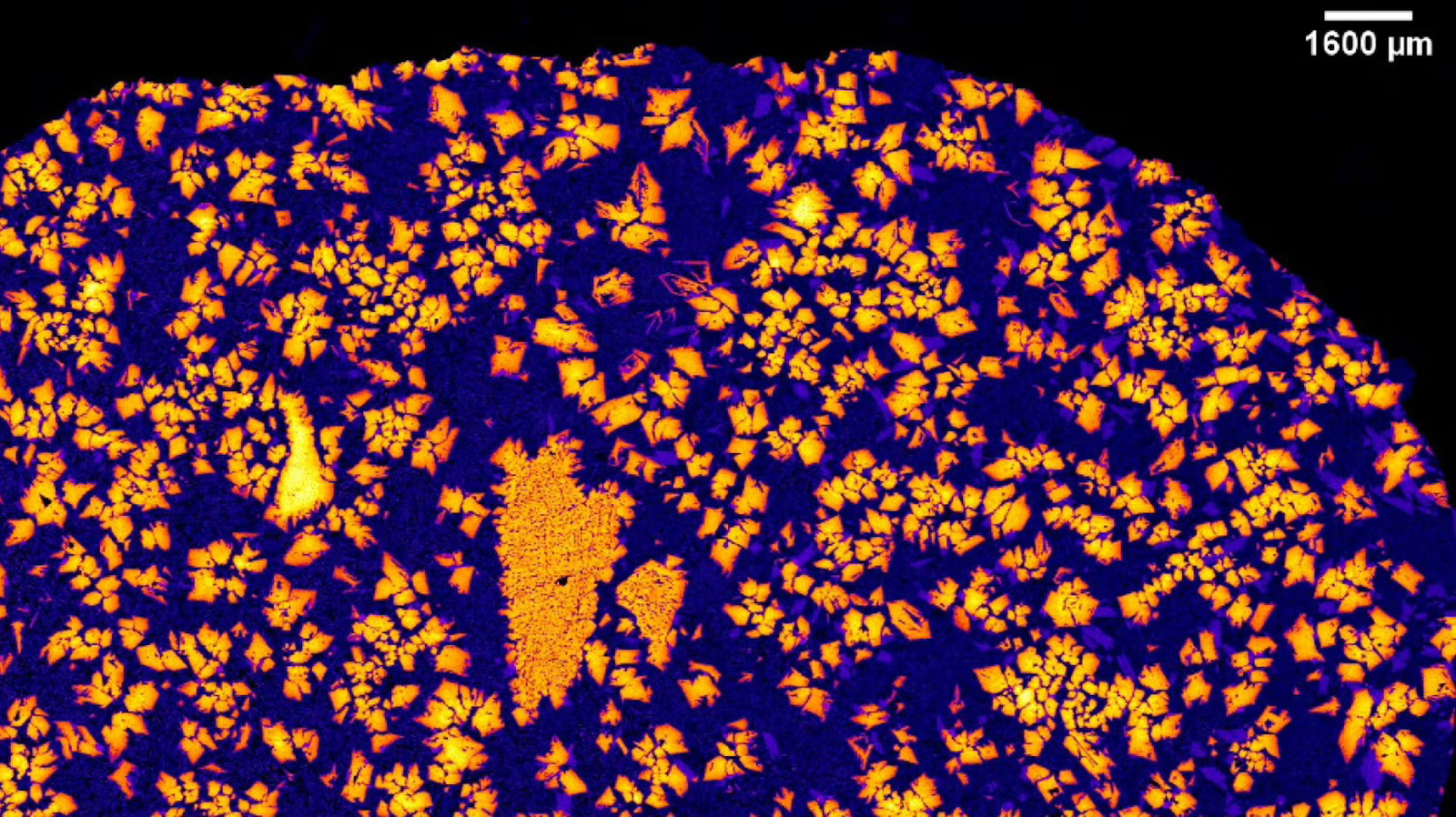
Separately, analysis of the angrite meteorite NWA 12774, discovered in the Sahara Desert, indicates it originated from a large protoplanet, potentially the size of the Moon or Mars, that existed 4.5 billion years ago. The meteorite contains an aluminum-rich mineral crystal, clinopyroxene, which formed under pressures of at least 17.5 kilobars, suggesting a parent body radius of at least 1,118 miles. Assistant research professor Aaron Bell from the University of Colorado Boulder highlighted that the materials are fundamentally distinct from those found on Earth or Mars, pointing to a separate evolutionary path in planetary formation.
While angrites have previously been thought to be products of asteroids due to their low silica content, the crystal patterns in NWA 12774 suggest formation at a shallow depth under much greater pressure than an asteroid origin would allow. Bell noted that the team only knows the object existed because fragments landed on Earth, preserving evidence of a different pathway for early planet development. These findings are published in the journal Earth and Planetary Science Letters.
Other recent science developments include the official decommissioning of NASA’s MAVEN space probe and a successful AI-designed vaccine test by the University of Cambridge. Additionally, NASA has announced that the Nancy Grace Roman Space Telescope is scheduled for launch on 30 August.
