JWST study reveals exoplanet weather asymmetry, challenging metallicity estimates
Scientists used the James Webb Space Telescope to map distinct morning and evening weather patterns, finding that traditional methods likely overestimated the abundance of heavy elements in similar gas giants.
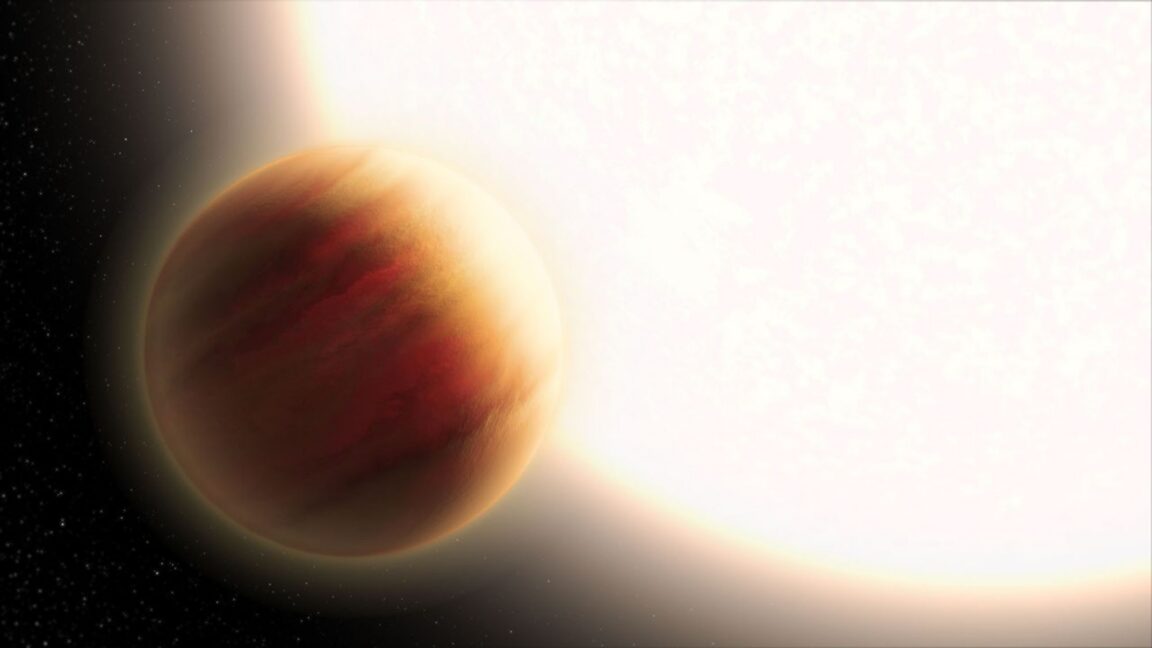
A study led by Sagnick Mukherjee of Johns Hopkins University, published in the journal Science, has utilised the James Webb Space Telescope to map the atmospheric weather patterns of WASP-94A b, a hot gas giant located approximately 700 light-years from Earth. By employing limb-resolved spectroscopy, researchers identified a significant atmospheric asymmetry: the planet’s morning limb is obscured by high-altitude clouds and aerosols, while the evening limb is clear and dominated by water vapour. This phenomenon is driven by equatorial super-rotation, where strong eastward winds transport cloud particles from the cooler night side to the hotter day side, causing them to evaporate before reaching the evening limb. The findings suggest that traditional transmission spectroscopy methods, which average the entire atmosphere, may have significantly overestimated the metallicity of tidally locked exoplanets.
WASP-94A b is a low-density gas giant with a mass slightly below half that of Jupiter but a diameter over 70 percent wider, making its atmosphere easier to observe. Tidal locking means the planet does not experience sweeping day-night temperature differences across its surface, but rather maintains permanent day and night sides. Mukherjee noted that understanding whether such atmospheres are static or dynamic was crucial, particularly regarding the presence of winds and clouds. The team found that while the morning side is cloudy, the evening skies are clear, a discovery that implies previous chemical assessments of such worlds may have been surprisingly inaccurate.
To capture this process, the researchers employed limb-resolved spectroscopy using the Near Infrared Imager and Slitless Spectrograph. This technique allowed the telescope to measure light curves as the planet transited its star, splitting the signal to extract separate chemical transmission spectra for the morning and evening limbs. The morning limb’s spectrum indicated high-altitude aerosols blocking light, while the evening limb showed no substantial evidence of aerosols, revealing spikes of gaseous water vapour instead. This method provided a more granular view than traditional transmission spectroscopy, which averages the entire planetary atmosphere as though it were a homogenous ball of gas.
The weather dynamics on WASP-94A b are dictated by temperature differences exceeding 1,500 Kelvin, with the evening limb approximately 450 Kelvin hotter than the morning limb. On the permanent night side, gases condense into droplets, which are then dragged by equatorial winds toward the morning side. As these clouds enter the heat of the day side, the droplets evaporate, leaving the evening limb clear. The equatorial winds are strong enough to keep heavy mineral droplets aloft, pushing them through the night side faster than gravity can pull them down. This confirms the presence of actual clouds rather than photochemical hazes, which would typically appear on the permanent day side and blow into the evening limb.
When the team reanalyzed the data using a traditional single-sphere model, the results were alarming for exoplanet science. The thick morning clouds diluted the clear water vapour signals from the evening, leading the averaged model to conclude that the planet’s metallicity was suspiciously high. While the resolved data showed an oxygen enrichment three to five times higher than the Sun, the averaged spectrum suggested an enrichment about 100 times higher. Mukherjee argues that this bias likely affects other tidally locked exoplanets, including sub-Neptunes and super-Earths, and that future studies must develop theoretical models to mitigate this bias without requiring larger telescopes.
