JWST Observation Suggests Existence of Hypothetical 'Black Hole Star'
The James Webb Space Telescope has detected an object emitting 100 billion times more energy than nuclear fusion allows, challenging conventional stellar models and offering a solution to mysterious red spots in the infant cosmos.
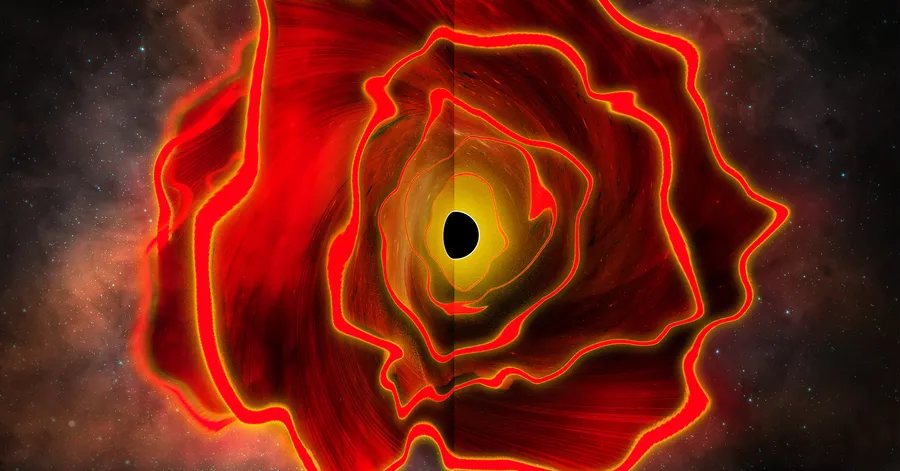
Astronomers utilising the James Webb Space Telescope have identified an object designated MoM-BH*-1, which may represent a "black hole star" from when the universe was 660 million years old. The discovery, detailed in a paper published in Nature, provides tangible evidence for a hypothetical class of objects that could explain the origin of mysterious red spots frequently observed in the early universe.
The object appears as a bright, reddish spot in deep space, initially resembling a giant star. However, its energy output defies standard astrophysical models. MoM-BH*-1 emits approximately 100 billion times more energy than a star could produce through nuclear fusion. This immense luminosity, combined with its location in the infant cosmos, marks it as an exceptionally bright anomaly.
Further analysis reveals light absorption patterns inconsistent with normal stellar behaviour. While stars can absorb certain wavelengths through their atmospheres, the signal from MoM-BH*-1 is too intense to be explained by such mechanisms. Researchers propose that an enormous amount of extremely dense gas is absorbing the light, a characteristic that supports the black hole star hypothesis.
Under this model, the object consists of a black hole at its centre devouring matter and releasing vast amounts of energy. This energy is then surrounded by a massive gas envelope that modifies the escaping light, causing it to mimic the characteristics of starlight. This structure allows the object to outshine its surroundings, a key factor in its identification.
Rohan Naidu, the study’s lead author who performed the work while at MIT, highlighted the uniqueness of the discovery compared to other early universe observations. He noted that while many red dots are consistent with black hole stars embedded in galaxies, MoM-BH*-1 is distinct because it essentially completely outshines its host galaxy, allowing astronomers to observe "pure black hole star light."
The findings address a persistent mystery regarding small red spots in the early universe that do not fit neatly into existing categories of deep space objects. Previous explanations have included compact galaxies teeming with stars or black holes hidden by dust. This research suggests that black hole stars are a viable explanation for these phenomena, potentially reshaping understanding of cosmic evolution.
The object’s signal originates from a period when the universe was just 660 million years old, compared to its current age of nearly 14 billion years. The identification of MoM-BH*-1 marks a significant step in validating theoretical models of black hole stars, which have long been proposed to account for these enigmatic cosmic features.